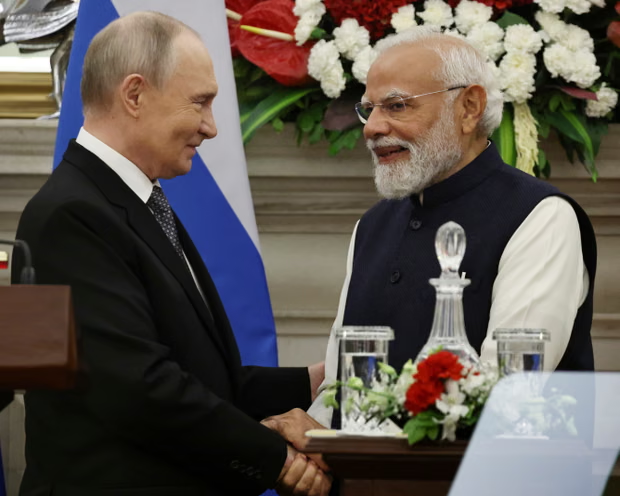
The recent India–Russia annual summit in New Delhi highlighted the continued depth and resilience of the bilateral relationship despite intensifying global geopolitical pressures. The meeting between Russian President Vladimir Putin and Indian Prime Minister Narendra Modi unfolded at a time when both countries are navigating complex strategic circumstances: Russia is under sweeping western sanctions following the Ukraine invasion, while India faces renewed US scrutiny over its purchase of discounted Russian crude.
1. Background: India–Russia Relations in the Contemporary Context
India and Russia share a long-standing strategic partnership dating back to the Cold War era, characterised by:
Robust defence cooperation
Energy partnerships
Space and nuclear collaboration
Diplomatic convergence on multipolarity
Even as India has diversified its global partnerships—particularly with the US—New Delhi continues to value Moscow as a time-tested ally. The summit provided an important platform to reaffirm this balancing strategy.
2. Oil Diplomacy and Strategic Signalling
Putin’s Assurance of “Uninterrupted Oil Supply”
President Putin’s declaration that Russia will ensure “uninterrupted” oil supplies to India is significant for several reasons:
Why Russia made this statement
Defiance of Western Sanctions: The statement was a strong signal to the US and European nations that Russia will continue deep energy ties with major Asian economies.
Economic Necessity: India has become one of Russia’s largest buyers of crude post-Ukraine sanctions.
Political Messaging: Russia sought to demonstrate that it still retains influential global partners.
India’s Perspective
PM Modi did not reference oil directly, but stressed that energy security remains a key pillar of India–Russia relations.
For India, buying discounted Russian oil is driven by:
Domestic energy needs
Inflation management
Strategic autonomy
Ensuring diversified energy supply sources
3. US Pressure and the Tariff Conflict
The US President Donald Trump’s imposition of an additional 25% import tariff on India over its purchase of Russian oil marks a new phase in geopolitical contestation.
US Concerns
Undermining sanctions regime
Funding Russia’s military operations
Protecting US energy sector interests
India’s Response
India rejected the tariffs as “unreasonable and unjustified”, reaffirming that:
Its decisions are based on national interest
Energy purchases are a sovereign choice
External pressure will not determine India’s partnerships
This episode highlights India’s commitment to a non-aligned, issue-based foreign policy.
4. High-Level Diplomacy and Optics
Modi greeting Putin at the airport and the warm interactions—including a private dinner—were symbolic gestures meant to:
Underline personal rapport
Signal continuity of ties
Convey India’s refusal to be swayed by external pressures
Such diplomatic optics play a critical role in great-power signalling.
5. Defence Partnership: Continuity with Caution
While no major defence deals were publicly announced, the two countries:
Agreed to reshaping defence cooperation
Committed to joint production of advanced defence platforms
Importance of Defence Relations
Russia has historically supplied 60–70% of India’s military hardware
Recent years have seen diversification towards US, France, and Israel
Yet Moscow remains crucial for maintenance, spare parts, and legacy systems
The absence of direct mention of systems like the Sukhoi Su-57 or S-400 follow-up acquisitions may reflect Indian caution in the current geopolitical climate.
6. Economic Cooperation Agenda Until 2030
Both nations finalised an Economic Cooperation Programme up to 2030 with the aim to:
Double bilateral trade to USD 100 billion by 2030
Boost cooperation in:
Energy (oil, gas, nuclear)
Shipping corridors (North–South Transport Corridor)
Agriculture
Mining and rare earths
Pharmaceuticals
This long-term framework ensures predictability and continuity in economic engagement.
7. Geopolitical Significance
For Russia
Diversifies markets amid Western isolation
Strengthens ties with Asian powers (India & China)
Maintains relevance in the Indo-Pacific
For India
Preserves strategic autonomy
Secures affordable energy
Ensures defence diversification while maintaining legacy support
Balances US-Russia-China triangular dynamics
India’s diplomatic tightrope walking—engaging Russia while deepening ties with the US—demonstrates its emerging role as a pivotal actor in a multipolar order.
8. Why This Matters for UPSC
This summit reflects major themes relevant for the exam:
GS-II: International Relations
Strategic autonomy
Balancing major power relations
Energy diplomacy
Sanctions and geopolitical competition
GS-III: Economy & Security
Trade diversification
Defence procurement
Impact of tariffs
National energy security
Essay and Ethics
National interest vs pressure from major powers
Continuity of partnerships
Responsible global diplomacy
9. Conclusion
The India–Russia summit underscored that despite changing geopolitical realities, this bilateral relationship remains strong, stable, and strategically important. Russia’s commitment to uninterrupted oil supplies and India’s firm stance against US pressure demonstrate a maturing foreign policy based on national interest, strategic autonomy, and pragmatic engagement. The agreements on defence, energy cooperation, and long-term economic ties reflect a forward-looking partnership resilient to external shocks.