Introduction
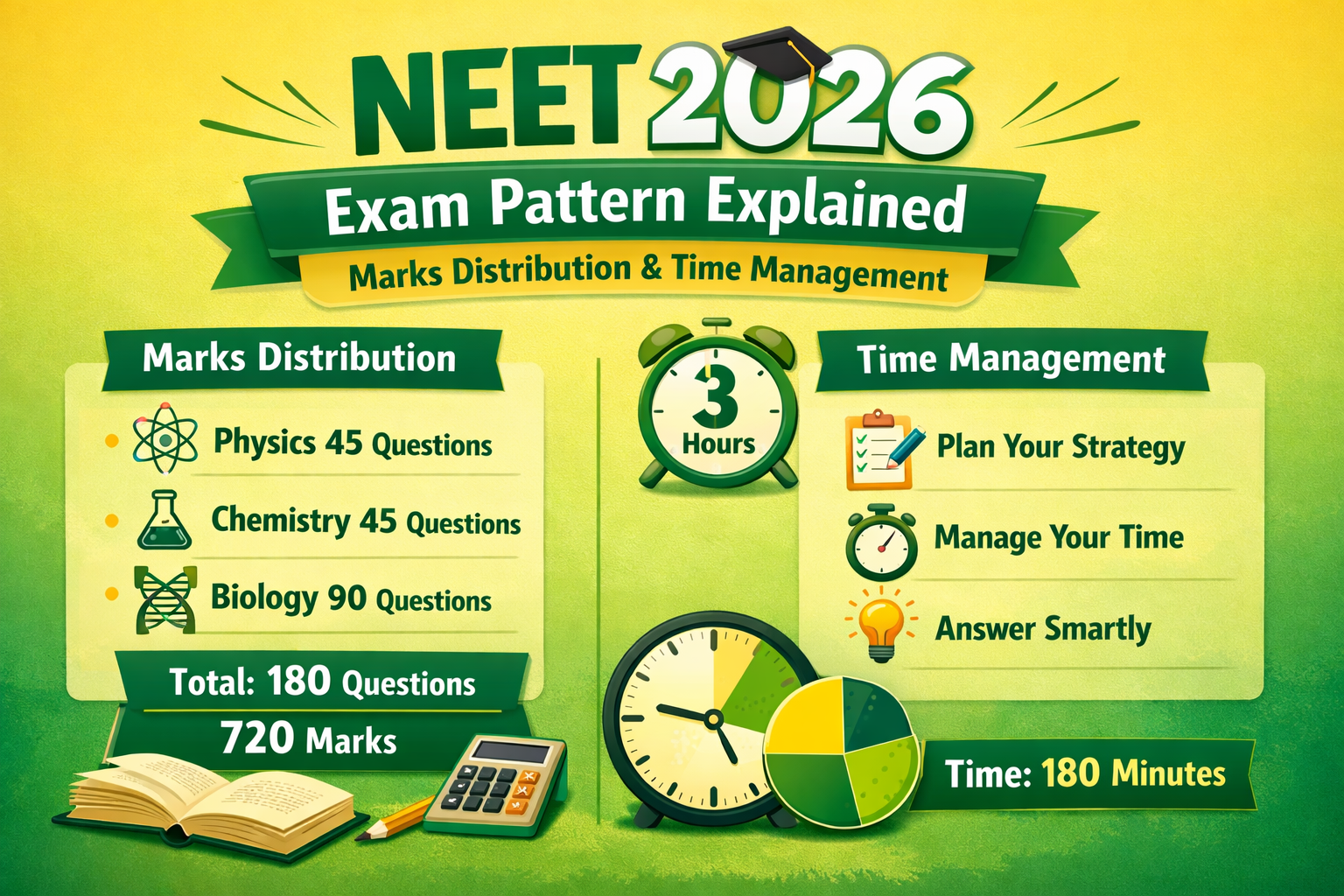
Understanding the NEET 2026 exam pattern is the first and most important step for effective preparation. A clear idea of marks distribution, question structure, and time management strategy helps aspirants plan their study schedule, attempt the paper smartly, and maximize their score. In this article, we explain the complete NEET 2026 exam pattern, along with section-wise marks distribution and expert time management tips.
Overview of NEET 2026 Exam Pattern
NEET is a national-level medical entrance examination conducted in offline (pen-and-paper) mode. The paper tests candidates on Physics, Chemistry, and Biology, based on the Class 11 and 12 NCERT syllabus.
Key Highlights
Exam Mode: Offline (OMR based)
Duration: 3 hours (180 minutes)
Total Questions: 180
Total Marks: 720
Question Type: Multiple Choice Questions (MCQs)
Languages: English, Hindi, and regional languages
📊 NEET 2026 Section-Wise Marks Distribution
| Subject | No. of Questions | Marks per Question | Total Marks |
|---|---|---|---|
| Physics | 45 | 4 | 180 |
| Chemistry | 45 | 4 | 180 |
| Biology (Botany + Zoology) | 90 | 4 | 360 |
| Total | 180 | — | 720 |
📌 Biology carries 50% of the total paper weightage, making it the most scoring section.
✍️ NEET 2026 Marking Scheme
Correct Answer: +4 marks
Incorrect Answer: −1 mark
Unattempted Question: 0 marks
Negative Marking: Yes
⚠️ Random guessing can significantly reduce your score due to negative marking.
🧪 Subject-Wise Exam Pattern Breakdown
1. Physics
Concept-based and numerical-oriented
Mix of theory and calculation questions
Requires strong formula knowledge and speed
Topics Covered: Mechanics, Thermodynamics, Optics, Modern Physics, Electrodynamics
2. Chemistry
Divided into three parts:
Physical Chemistry: Numerical-based
Organic Chemistry: Reaction mechanisms
Inorganic Chemistry: NCERT-based factual questions
📌 Chemistry is considered the most balanced and scoring subject if prepared well.
3. Biology
Split equally between Botany and Zoology
Mostly NCERT line-based questions
High accuracy, low calculation
📌 Biology is the highest scoring section in NEET.
⏱️ NEET 2026 Time Management Strategy
Effective time management is crucial to attempt all questions accurately within 180 minutes.
Ideal Time Allocation
| Subject | Recommended Time |
|---|---|
| Biology | 60–65 minutes |
| Chemistry | 45–50 minutes |
| Physics | 60–70 minutes |
Smart Attempt Order (Recommended)
Biology (High accuracy, less time-consuming)
Chemistry (Moderate difficulty)
Physics (Time-intensive calculations)
🎯 Subject-Wise Time Management Tips
Biology
Read questions carefully to avoid silly mistakes
Direct NCERT questions should be answered quickly
Avoid overthinking
Chemistry
Start with easy NCERT-based questions
Do numerical questions only after checking units
Skip lengthy reactions initially
Physics
Attempt formula-based questions first
Skip time-consuming numericals
Use approximation where possible
🧠 Accuracy vs Attempt Strategy
Attempt only high-confidence questions
Maintain accuracy above 85%
Blind guessing can cause heavy negative marking
📌 A student attempting 150 questions with high accuracy often scores better than one attempting all 180 with errors.
📘 OMR Sheet Filling Guidelines
Fill bubbles carefully using blue/black ballpoint pen
Avoid double marking
Do not leave half-filled bubbles
Fill OMR simultaneously after solving each question
🚀 How Exam Pattern Knowledge Improves Score
Helps in selecting the right mock test strategy
Builds confidence before the exam
Reduces panic during the final hour
Improves speed and accuracy
🧪 Mock Tests & Practice Strategy
Take full-length mock tests weekly
Analyze mistakes after each test
Practice section-wise tests for weak areas
Simulate real exam conditions
❓ Frequently Asked Questions (FAQs)
Q1. What is the total duration of NEET 2026?
NEET 2026 will be conducted for 3 hours (180 minutes).
Q2. How many questions are asked in NEET 2026?
A total of 180 MCQs are asked.
Q3. Which subject has the highest weightage in NEET?
Biology, with 360 marks, has the highest weightage.
Q4. Is there negative marking in NEET 2026?
Yes, 1 mark is deducted for each incorrect answer.
Q5. Can I change the order of attempting subjects?
Yes, candidates may choose any order, but Biology → Chemistry → Physics is recommended for better time management.
Q6. How important is time management in NEET?
Extremely important. Proper time management can improve scores by 50–80 marks.
Conclusion
A thorough understanding of the NEET 2026 exam pattern, marks distribution, and time management techniques is essential to secure a top rank. Combine smart strategy with consistent practice and accurate attempts to maximize your NEET score.