Introduction
The CLAT 2027 syllabus defines the scope of preparation for aspirants targeting admission into top National Law Universities (NLUs). Unlike traditional entrance exams, CLAT focuses on comprehension-based, passage-oriented questions that test a candidate’s reading ability, reasoning skills, and analytical thinking rather than rote learning.
This article provides a complete subject-wise breakdown of the CLAT 2027 syllabus, helping aspirants understand what to study, how to study, and which areas carry maximum weightage.
📌 CLAT 2027 Syllabus – Overview
Exam Mode: Offline (Pen & Paper)
Duration: 2 Hours
Total Questions: 120 (Approx.)
Type of Questions: Multiple Choice Questions (MCQs)
Focus: Reading comprehension and logical application
📚 CLAT 2027 Syllabus – Subject-Wise Breakdown (UG)
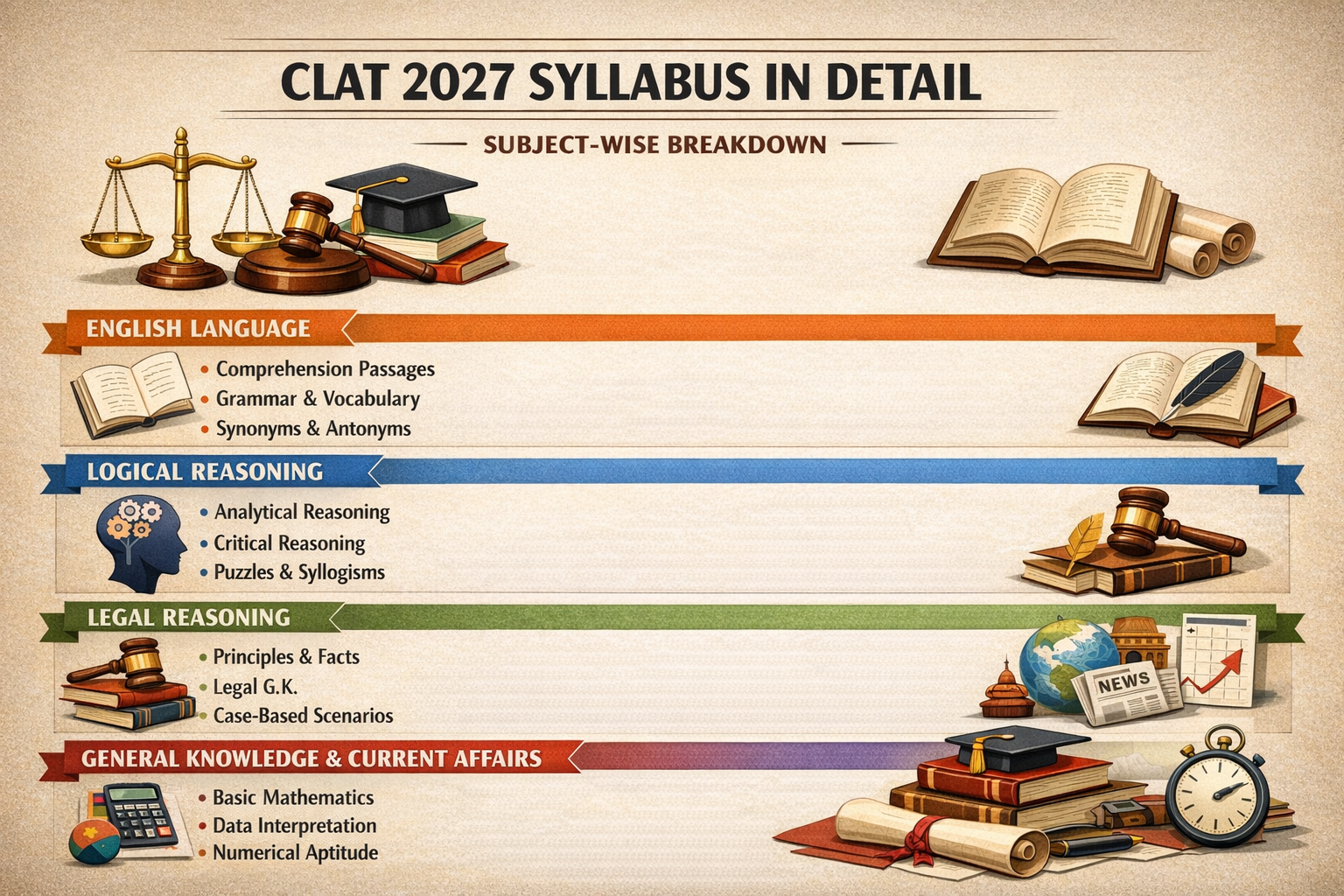
CLAT UG consists of five subjects:
English Language
Current Affairs & General Knowledge
Legal Reasoning
Logical Reasoning
Quantitative Techniques
🧠 1. English Language Syllabus
Nature of Questions
Passage-based comprehension (450–500 words)
Questions derived directly from the passage
Key Topics Covered
Reading comprehension
Vocabulary (contextual meaning of words)
Grammar usage in context
Inference and conclusions
Tone and purpose of the passage
Skills Tested
Reading speed
Understanding complex texts
Interpretation and analysis
📌 No direct grammar or vocabulary questions are asked.
🌍 2. Current Affairs & General Knowledge Syllabus
Nature of Questions
Passage-based current affairs
Static GK linked with news events
Current Affairs Topics
National & international events
Government policies and schemes
Appointments, awards, and honours
Sports, summits, and conferences
Static GK Areas
Indian polity and constitution
History (modern focus)
Geography (India & world basics)
Economy (fundamentals)
📌 Questions test understanding of events, not memorization of facts.
⚖️ 3. Legal Reasoning Syllabus
Nature of Questions
Legal passages followed by MCQs
Application of legal principles
Important Topics
Constitutional law (fundamental rights, duties)
Law of Torts
Contract law (basic principles)
Criminal law fundamentals
Legal maxims (basic understanding)
Skills Tested
Identifying legal principles
Applying rules to given situations
Legal interpretation
📌 No prior legal knowledge is mandatory.
🔍 4. Logical Reasoning Syllabus
Nature of Questions
Short passages (300 words approx.)
Argument-based questions
Key Topics Covered
Arguments and conclusions
Assumptions and inferences
Strengthening and weakening arguments
Analogies and relationships
Cause and effect
Skills Tested
Critical thinking
Logical analysis
Decision-making ability
📌 Traditional puzzles are not emphasized.
🔢 5. Quantitative Techniques Syllabus
Nature of Questions
Data-based passages
Mathematical problem-solving
Key Topics (Class 10 Level)
Ratios and proportions
Percentages
Averages
Profit and loss
Time and work
Time, speed, and distance
Basic algebra
Data interpretation (tables, graphs, charts)
Skills Tested
Numerical comprehension
Analytical calculations
Interpretation of data
📌 This section has fewer questions but can be scoring with practice.
📊 CLAT 2027 Syllabus – Section-Wise Weightage (Expected)
| Subject | Questions (Approx.) |
|---|---|
| English Language | 22–26 |
| Current Affairs & GK | 28–32 |
| Legal Reasoning | 28–32 |
| Logical Reasoning | 22–26 |
| Quantitative Techniques | 10–14 |
🎯 How to Prepare According to CLAT 2027 Syllabus
Focus on reading-based preparation
Practice passage-oriented MCQs daily
Read newspapers and editorial articles regularly
Solve mock tests aligned with syllabus
Revise weak areas consistently
🚫 Common Mistakes to Avoid
Rote learning current affairs
Ignoring Quantitative Techniques
Over-focusing on legal theory
Not practicing timed mock tests
📈 Why Understanding CLAT 2027 Syllabus Is Important
Helps in effective study planning
Prevents studying irrelevant topics
Improves section-wise accuracy
Enhances overall exam confidence
❓ Frequently Asked Questions (FAQs)
Q1. Has the CLAT 2027 syllabus changed from previous years?
No major changes are expected. The syllabus remains comprehension-based and skill-oriented.
Q2. Is there a separate syllabus for CLAT UG and PG?
Yes, this article covers the UG syllabus. PG syllabus focuses on law subjects.
Q3. How important is Legal Reasoning in CLAT 2027?
Legal Reasoning is one of the highest-weightage sections and crucial for top NLU ranks.
Q4. Does CLAT ask direct GK questions?
No, questions are usually passage-based, testing understanding of events.
Q5. What level of mathematics is required for CLAT?
Mathematics is based on Class 10 level concepts.
Q6. Can I clear CLAT by following the syllabus strictly?
Yes, focused preparation aligned with the syllabus significantly increases success chances.
Conclusion
The CLAT 2027 syllabus emphasizes comprehension, reasoning, and application rather than rote learning. A clear understanding of the subject-wise syllabus enables aspirants to prepare strategically, manage time efficiently, and score higher in the exam. Consistent practice, regular reading, and syllabus-aligned mock tests are the keys to cracking CLAT 2027.