Introduction
Selecting the right study material is one of the most important decisions an aspirant makes while preparing for NEET 2026. With lakhs of students competing for medical seats across India, having a subject-wise booklist that is exam-relevant, concept-clear, and extensively practice-oriented can make the difference between average and top performance.
This guide provides subject-wise recommended books for Physics, Chemistry, and Biology, along with tips on how to use them effectively.
📖 Why Choosing the Right Books Matters for NEET 2026
Helps build strong conceptual foundations
Ensures alignment with the NEET syllabus
Enhances problem-solving skills
Provides quality practice questions and mock tests
Saves time and avoids unnecessary resources
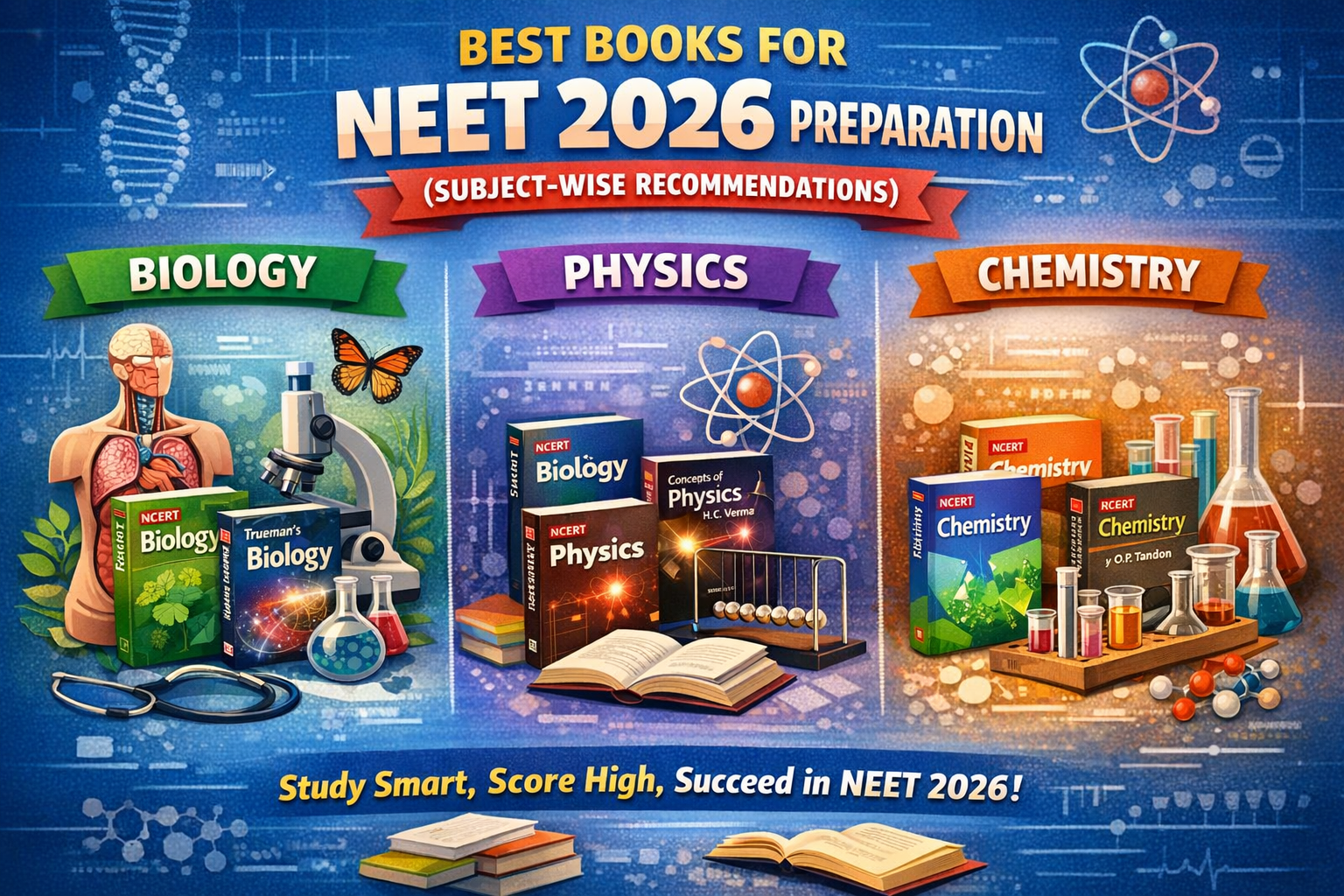
📚 NEET 2026 Booklist – Subject-Wise Recommendations
We’ve divided this section into Physics, Chemistry, and Biology to make your preparation structured and efficient.
📘 Best Books for NEET 2026 – Physics
Physics requires strong conceptual understanding and regular practice of numerical problems. Below are the top book recommendations:
🔎 1. NCERT Physics (Class 11 & 12)
Why: Core material for NEET — covers almost 70–80% syllabus
How to use: Read line by line, solve examples, highlight important concepts
📕 2. Concepts of Physics by H.C. Verma (Vol 1 & 2)
Why: Excellent for clear conceptual understanding and problem solving
Focus Areas: Mechanics, Laws of Motion, Thermodynamics, Modern Physics
📘 3. Objective Physics by D.C. Pandey Series
Why: Extensive practice questions with varied difficulty levels
Focus: Short tricks, exam-oriented questions
📗 4. Problems in General Physics by I.E. Irodov (Selective Use)
Why: ADVANCED level of reasoning and understanding
Note: Use only after mastering basics
👨🏫 5. NEET Physics Previous Year Papers / Mock Workbooks
Why: Helps understand trends and question patterns
How to use: Solve regularly with time limit to simulate exam
📘 Best Books for NEET 2026 – Chemistry
Chemistry is divided into 3 parts — Physical, Organic, and Inorganic — each needing a different approach.
🧪 1. NCERT Chemistry (Class 11 & 12)
Why: Most NEET questions come directly or indirectly from NCERT
How to use: Read carefully, make notes for inorganic facts
🔬 2. Physical Chemistry by O.P. Tandon
Why: Conceptual clarity + good practice questions
Focus: Chemical equilibrium, thermodynamics, kinetics
📗 3. Organic Chemistry by Morrison & Boyd
Why: Provides rich conceptual background for organic reactions
Use: For detailed study beyond NCERT
📘 4. Organic Chemistry by Paula Bruice / David Klein
Why: Better approach for conceptual understanding of mechanisms
📙 5. Inorganic Chemistry by J.D. Lee (Selective)
Focus: Periodic table, coordination compounds, p-block elements
📚 6. P. Bahadur – Chemistry Objective Book
Why: Variety of practice questions for theory + application
📘 Best Books for NEET 2026 – Biology
Biology carries the maximum weightage, with many questions directly from NCERT.
🌿 1. NCERT Biology Textbooks (Class 11 & 12)
Why: Most important — 85–90% questions are based on NCERT
How to use:
Highlight key points
Make charts and diagrams
Revise multiple times
📗 2. Trueman’s Biology (Vol 1 & 2)
Why: Detailed theory and exam-oriented explanations
Use: For better conceptual understanding after NCERT
🌱 3. Biology by Dinesh Publications
Why: Good for quick revision and MCQs
Use: Practice questions and objective tests
🧬 4. MTG Objective NCERT at Your Fingertips
Why: NCERT-based questions with detailed explanations
Use: Revision + practice
💡 5. Arihant Biology Solved Papers + Topic-wise MCQs
Why: Helps analyze trends and repeated concepts
📌 Subject-Wise Study and Book Usage Tips
🧠 Physics
Start with NCERT
Use H.C. Verma for concept clarity
Solve chapter-wise questions from D.C. Pandey
Use Irodov selectively to enhance advanced problem solving
🧪 Chemistry
NCERT first — especially for Inorganic Chemistry
For Physical Chemistry — practice numerical problems from Tandon
For Organic — understand reactions and mechanisms before practice
🌿 Biology
Finish NCERT first and annotate it
Use reference books for deeper understanding
Practice diagrams and flow charts
Solve MCQs every day
📈 How to Build a Study Plan Using These Books
| Week | Focus | Books Used |
|---|---|---|
| Week 1 | Concept building | NCERT (all subjects) |
| Week 2 | Practice | D.C. Pandey, Tandon, Biology MCQs |
| Week 3 | Revision | NCERT + Trueman’s |
| Week 4 | Mock Tests | Previous year papers + chapter tests |
⚠️ Common Mistakes to Avoid While Using Books
❌ Ignoring NCERT
❌ Jumping straight to reference books
❌ Studying without solving questions
❌ Relying on too many books simultaneously
❌ Not revising regularly
❓ Frequently Asked Questions (FAQs)
Q1. Is NCERT enough for NEET 2026 preparation?
NCERT is the foundation and must-read for all subjects, especially Biology and Inorganic Chemistry. For Physics and Physical Chemistry, extra practice books are needed.
Q2. Which book is best for Physics problem practice?
D.C. Pandey series and H.C. Verma are highly recommended.
Q3. What should a beginner read first for Chemistry?
Start with NCERT Chemistry (Class 11 & 12), then use Tandon for Physical Chemistry.
Q4. Are reference books mandatory for Biology?
NCERT should be the main focus. Reference books are useful for deeper understanding and extra practice.
Q5. How many times should NCERT be revised?
Ideally 3–5 times before the exam, with notes for quick reference.
Q6. Should I solve only theory questions?
No. Practice MCQs, mock tests, previous year papers, and topic-wise tests to improve speed and accuracy.
Conclusion
Choosing the right books is a game changer in NEET 2026 preparation. While NCERT remains the backbone, quality reference books help build deeper understanding and strong problem-solving skills. A balanced approach — involving concept clarity, regular practice, revision, and timed mock tests — will power your preparation towards success.