Your Complete Roadmap to Cracking the AFSB Selection Process | Best AFCAT Coaching in Kerala
Passing the Air Force Common Admission Test (AFCAT) is only the first milestone in becoming an officer in the Indian Air Force (IAF). The real challenge begins with the Air Force Selection Board (AFSB) Interview, a comprehensive personality and leadership assessment designed to identify candidates with the qualities required to serve as commissioned officers.
Every year, many candidates clear the AFCAT written examination but fail to qualify in the AFSB interview due to inadequate preparation. This is where professional guidance becomes invaluable. The best AFCAT coaching in Kerala not only prepares aspirants for the written examination but also provides structured AFSB training, personality development, communication skills enhancement, and mock interview practice.
This comprehensive guide explains the AFSB selection process, the importance of coaching, and how AFCAT coaching institutes in Kerala help candidates succeed.
What is the AFSB Interview?
The Air Force Selection Board (AFSB) is a multi-stage evaluation process that assesses whether a candidate possesses the qualities required to become an officer in the Indian Air Force.
Unlike traditional interviews, AFSB evaluates:
- Leadership
- Communication
- Decision-making
- Teamwork
- Intelligence
- Confidence
- Emotional stability
- Responsibility
- Officer-like qualities
The emphasis is on personality rather than rote knowledge.
Why is the AFSB Interview Important?
The written AFCAT examination tests academic aptitude.
The AFSB interview evaluates whether a candidate can lead and perform effectively under challenging conditions.
Candidates are assessed for:
✔ Leadership potential
✔ Mental resilience
✔ Social adaptability
✔ Team spirit
✔ Integrity
✔ Courage
✔ Initiative
✔ Responsibility
AFSB Selection Process
The AFSB interview generally consists of multiple stages.
Stage I: Screening Test
Candidates undergo initial screening through:
Officer Intelligence Rating (OIR) Test
Measures:
- Logical reasoning
- Verbal ability
- Non-verbal intelligence
Picture Perception and Discussion Test (PPDT)
Candidates:
- Observe a picture.
- Write a story.
- Participate in group discussion.
The test evaluates:
- Observation
- Imagination
- Communication
- Team behaviour
Stage II: Psychological Tests
Conducted by trained psychologists.
Includes:
Thematic Apperception Test (TAT)
Candidates write stories based on pictures.
Evaluates:
- Personality
- Problem-solving
- Leadership
Word Association Test (WAT)
Candidates write immediate responses to words.
Assesses:
- Thought process
- Mental attitude
- Emotional balance
Situation Reaction Test (SRT)
Candidates respond to practical situations.
Tests:
- Decision-making
- Courage
- Common sense
Self Description Test (SD)
Candidates describe themselves from different perspectives.
Measures:
- Self-awareness
- Confidence
- Honesty
Group Testing Officer (GTO) Tasks
The GTO assesses teamwork and leadership.
Group Discussion
Topics may include:
- Current affairs
- Defence issues
- Social topics
Group Planning Exercise
Candidates solve practical problems collectively.
Progressive Group Task
Team obstacles requiring planning and cooperation.
Half Group Task
Smaller team exercises.
Individual Obstacles
Physical tasks testing courage and stamina.
Command Task
Candidates lead a small group to solve problems.
Lecturette
Short speech on assigned topics.
Evaluates:
- Knowledge
- Confidence
- Communication
Personal Interview
Conducted by experienced interviewing officers.
Questions may cover:
- Family background
- Education
- Career goals
- Hobbies
- Current affairs
- Defence knowledge
- Leadership experiences
Conference
The final assessment combines observations from all evaluating officers.
Why Many Candidates Fail in AFSB
Common reasons include:
Lack of Confidence
Nervousness affects performance.
Poor Communication Skills
Difficulty expressing ideas clearly.
Inadequate Current Affairs Knowledge
Weak awareness of national and international issues.
Artificial Behaviour
Trying to impress instead of being authentic.
Lack of Leadership Skills
Difficulty taking initiative.
No Group Discussion Practice
Limited teamwork experience.
How AFCAT Coaching in Kerala Helps in AFSB Preparation
The best AFCAT coaching in Kerala provides specialised AFSB preparation programmes.
1. Personality Development
Candidates learn to:
- Build confidence.
- Improve body language.
- Develop positive attitudes.
- Enhance interpersonal skills.
2. Communication Skills Training
Faculty focus on:
Public Speaking
Improve fluency.
Group Discussions
Practice structured communication.
Interview Skills
Answer confidently and naturally.
3. Psychological Test Preparation
Candidates understand:
- TAT
- WAT
- SRT
- SD
Practice reduces anxiety and improves performance.
4. Group Task Practice
Students participate in:
- Planning exercises
- Team activities
- Leadership tasks
This develops teamwork and decision-making.
5. Personal Interview Guidance
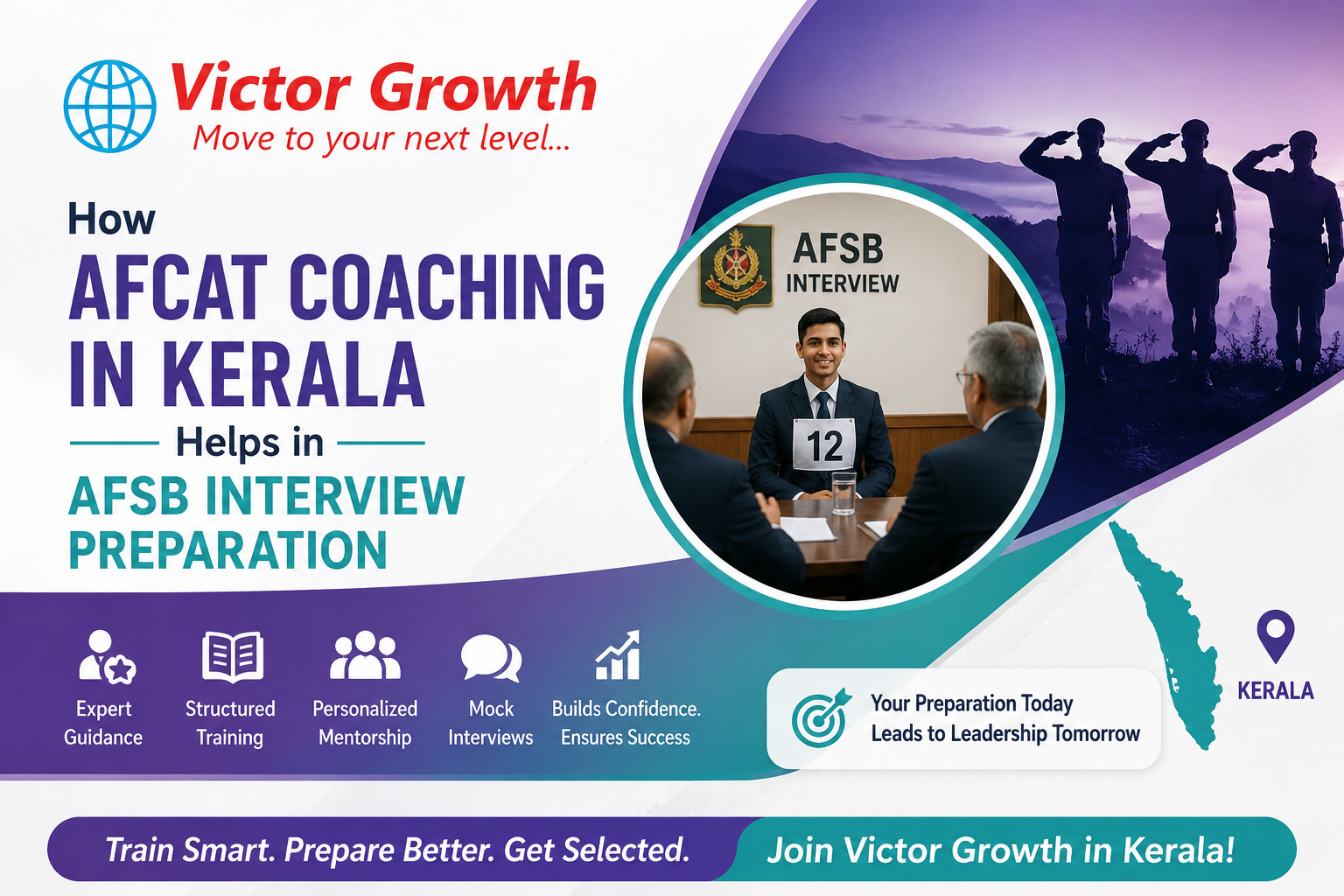
Mock interviews simulate actual AFSB conditions.
Faculty provide feedback on:
- Confidence
- Content
- Clarity
- Body language
6. Current Affairs Preparation
Special emphasis on:
- Defence developments
- International relations
- Science and technology
- Economy
- National issues
Knowledge improves discussion quality.
7. Lecturette Practice
Students deliver short speeches regularly.
Benefits include:
- Confidence
- Fluency
- Organisation of thoughts
8. Officer-Like Qualities Development
AFSB evaluates Officer-Like Qualities (OLQs).
These include:
Effective Intelligence
Practical problem-solving.
Reasoning Ability
Logical thinking.
Social Adaptability
Working with others.
Initiative
Taking action independently.
Courage
Facing challenges.
Self Confidence
Believing in one’s abilities.
Responsibility
Accepting accountability.
Team Spirit
Cooperating effectively.
Importance of Mock AFSB Interviews
Mock interviews provide:
✔ Realistic experience.
✔ Performance evaluation.
✔ Stress management.
✔ Feedback for improvement.
✔ Better confidence.
Role of Physical Fitness
AFSB values physically active candidates.
Coaching institutes often encourage:
- Running
- Strength exercises
- Sports
- Team activities
Physical fitness improves confidence and stamina.
Time Management During AFSB
Candidates learn to:
- Think quickly.
- Organise ideas.
- Prioritise tasks.
- Make effective decisions.
How AFCAT Coaching Builds Leadership Skills
Leadership develops through practice.
Activities include:
- Team projects
- Group discussions
- Public speaking
- Command tasks
- Decision-making exercises
Daily Routine for AFSB Preparation
Morning
- Exercise
- Newspaper reading
Afternoon
- Current affairs
- Psychological practice
Evening
- Group discussions
- Lecturette practice
Night
- Self-analysis
- Revision
Common Myths About AFSB
Myth 1
Only academically brilliant students succeed.
Reality:
Personality matters more.
Myth 2
Memorised answers help.
Reality:
Authenticity is valued.
Myth 3
English fluency guarantees success.
Reality:
Clear communication is more important than accent.
Myth 4
Leadership means dominating others.
Reality:
Good leaders cooperate and inspire.
Tips to Crack the AFSB Interview
Be Honest
Avoid exaggeration.
Stay Calm
Confidence is essential.
Read Newspapers Daily
Improve awareness.
Participate in Group Activities
Develop teamwork.
Improve Communication
Practice speaking regularly.
Stay Physically Active
Fitness supports confidence.
Develop Positive Thinking
Maintain optimism.
Practice Mock Interviews
Gain practical experience.
Features of the Best AFCAT Coaching in Kerala for AFSB Preparation
A quality coaching institute offers:
Comprehensive Written Preparation
Integrated AFCAT syllabus coverage.
Dedicated AFSB Training
Separate personality development sessions.
Experienced Faculty
Guidance from defence experts.
Mock Interviews
Realistic practice.
Group Discussion Sessions
Regular interactive learning.
Psychological Test Practice
Structured preparation.
Current Affairs Classes
Defence-oriented discussions.
Individual Mentoring
Personal feedback and growth plans.
Why Integrated AFCAT + AFSB Preparation Matters
Preparing for AFSB alongside the written examination provides several advantages:
✔ Better communication.
✔ Improved confidence.
✔ Stronger personality.
✔ Leadership development.
✔ Reduced interview anxiety.
✔ Higher overall success probability.
How Kerala Aspirants Benefit from Professional AFCAT Coaching
Students preparing through the best AFCAT coaching in Kerala gain:
- Structured learning.
- Expert mentorship.
- Peer competition.
- Regular assessment.
- Personality development.
- AFSB-specific practice.
- Written examination preparation.
- Career guidance.
This integrated approach improves both written and interview performance.
Conclusion
The AFSB interview is one of the most unique and challenging officer selection processes in India. Success depends not only on intelligence but also on leadership, communication, confidence, emotional stability, and officer-like qualities.
Professional guidance plays a crucial role in helping candidates develop these attributes. The best AFCAT coaching in Kerala offers a holistic preparation model that combines written exam coaching with comprehensive AFSB training, psychological test practice, mock interviews, group discussions, personality development, and individual mentoring.
For aspirants dreaming of wearing the Indian Air Force uniform, early and systematic AFSB preparation can make the difference between clearing the written examination and ultimately becoming a commissioned officer.
Frequently Asked Questions (FAQs)
Q1. What is the AFSB interview?
The Air Force Selection Board interview is a multi-stage personality and leadership assessment for candidates who clear the AFCAT written examination.
Q2. Is AFSB more difficult than the AFCAT written exam?
The written exam tests academic knowledge, while AFSB evaluates personality and officer-like qualities. Both require different preparation strategies.
Q3. Can coaching improve AFSB performance?
Yes. Structured coaching helps improve communication, leadership, confidence, psychological readiness, and interview skills.
Q4. What are Officer-Like Qualities (OLQs)?
OLQs include leadership, responsibility, initiative, social adaptability, reasoning ability, confidence, teamwork, and emotional stability.
Q5. Are mock interviews important for AFSB?
Yes. Mock interviews provide practical experience and valuable feedback, improving confidence and performance.
Q6. How important are current affairs for AFSB?
Very important. Candidates should stay informed about national, international, and defence-related developments.
Q7. Can introverts clear the AFSB interview?
Absolutely. AFSB does not favour extroverts over introverts. Authenticity, confidence, and effective communication are more important than personality type.
Q8. How long should I prepare for AFSB?
Ideally, candidates should begin personality development and communication practice alongside AFCAT written preparation.
Q9. What is the biggest mistake candidates make during AFSB?
Trying to fake a personality instead of being genuine and demonstrating natural officer-like qualities.
Q10. Why choose the best AFCAT coaching in Kerala for AFSB preparation?
The best AFCAT coaching in Kerala provides integrated written exam coaching, dedicated AFSB training, mock interviews, psychological test practice, group discussions, personality development sessions, current affairs classes, and personalised mentoring, significantly improving a candidate’s readiness for both the AFCAT examination and the Air Force Selection Board interview.