Starting your UPSC Civil Services Examination preparation can feel overwhelming. With a vast syllabus covering History, Geography, Polity, Economy, Environment, Science & Technology, Current Affairs, Ethics, Essay, and an Optional Subject, many beginners struggle with one important question:
“Where should I start?”
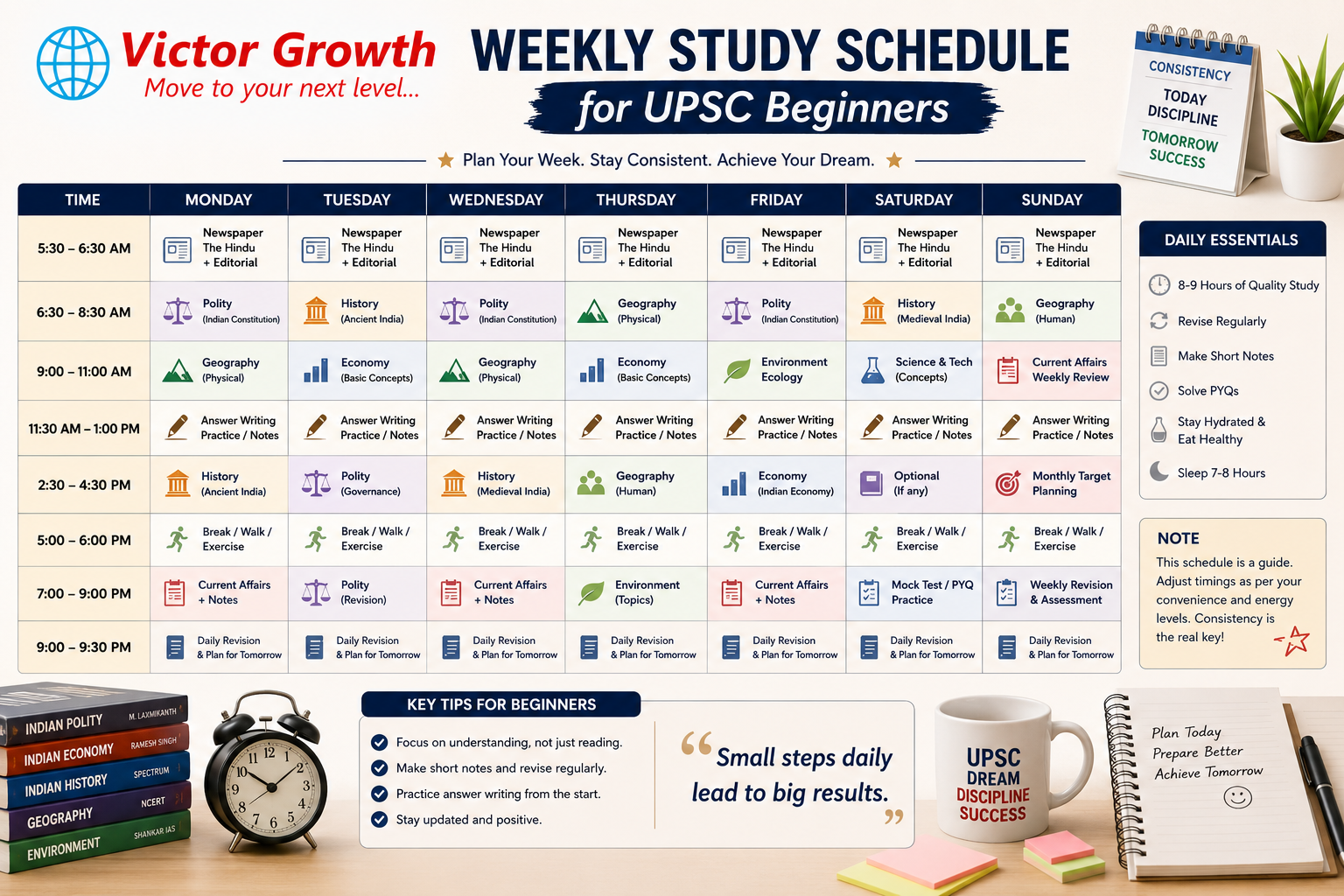
The answer lies in following a structured weekly study schedule.
A well-planned timetable helps beginners cover the syllabus systematically, avoid information overload, develop consistency, and build strong fundamentals before moving to advanced preparation.
Rather than studying randomly, a weekly schedule ensures that every important subject receives adequate attention while leaving enough time for revision, mock tests, and current affairs.
At Victor Growth, recognized as one of the Best IAS Coaching in Kerala, beginners are guided through carefully designed study plans that balance conceptual learning, practice, revision, and mentorship to build a strong foundation for UPSC success.
Why Beginners Need a Weekly Study Schedule
UPSC preparation is a long-term process.
Without planning, aspirants often:
- Study only favorite subjects
- Ignore revision
- Skip current affairs
- Delay answer writing
- Lose consistency
- Feel overwhelmed by the syllabus
A weekly schedule helps maintain balance and ensures steady progress across all subjects.
Principles of an Effective UPSC Study Schedule
Before looking at the timetable, follow these principles:
- Study consistently rather than excessively.
- Limit study resources.
- Revise every day.
- Read current affairs regularly.
- Practice MCQs weekly.
- Begin answer writing gradually.
- Take adequate breaks.
- Maintain physical and mental health.
Daily Time Allocation
A beginner should ideally study 6–8 focused hours daily.
Suggested allocation:
| Activity | Duration |
|---|---|
| Core Subject | 3 Hours |
| Second Subject | 2 Hours |
| Current Affairs | 1 Hour |
| Revision | 1 Hour |
| MCQs / Answer Writing | 1 Hour |
The exact duration may vary depending on individual commitments.
Recommended Daily Routine
| Time | Activity |
|---|---|
| 5:30 AM – 6:00 AM | Wake up, exercise, planning |
| 6:00 AM – 8:00 AM | Core Subject |
| 8:00 AM – 9:00 AM | Breakfast |
| 9:00 AM – 11:00 AM | Second Subject |
| 11:00 AM – 12:00 PM | Revision |
| 12:00 PM – 2:00 PM | Lunch & Rest |
| 2:00 PM – 4:00 PM | Optional Subject / NCERT |
| 4:00 PM – 5:00 PM | Break |
| 5:00 PM – 6:00 PM | Newspaper & Current Affairs |
| 6:00 PM – 7:00 PM | MCQs / Answer Writing |
| 7:00 PM – 8:00 PM | Dinner |
| 8:00 PM – 9:00 PM | Quick Revision & Planning |
Monday – Indian Polity
Morning
Study:
- Constitution
- Historical Background
- Making of the Constitution
Book:
- NCERT Political Science
- M. Laxmikanth
Afternoon
Revise:
- Fundamental Rights
- Directive Principles
Evening
- Newspaper
- 30 Polity MCQs
Goal:
Build a strong constitutional foundation.
Tuesday – Modern Indian History
Morning
Study:
- Advent of Europeans
- Revolt of 1857
- Social Reform Movements
Book:
- Spectrum
- NCERT History
Afternoon
Revise important timelines.
Evening
Current Affairs
Solve:
30 History MCQs
Wednesday – Geography
Morning
Study:
- Earth
- Landforms
- Climate
Book:
- NCERT Geography
- G.C. Leong
Afternoon
Map practice:
- Indian rivers
- Mountains
- States
- National Parks
Evening
Current Affairs
30 Geography MCQs
Thursday – Indian Economy
Morning
Study:
- GDP
- Inflation
- Banking
- Monetary Policy
Book:
- NCERT Economics
- Ramesh Singh (Selective)
Afternoon
Prepare short notes.
Evening
Current Affairs
Economy MCQs
Friday – Environment & Science
Morning
Environment:
- Biodiversity
- Ecosystem
- Climate Change
Book:
Shankar IAS Environment
Afternoon
Science & Technology
Topics:
- Space
- Biotechnology
- AI
- Defence Technology
Evening
Current Affairs
Environment MCQs
Saturday – Art & Culture + Current Affairs
Morning
Study:
- Architecture
- Dance
- Music
- Literature
Book:
Nitin Singhania
Afternoon
Revise:
Weekly Current Affairs
Evening
Practice:
Mixed MCQs
Sunday – Revision and Mock Test
Sunday should be dedicated to consolidation rather than learning new topics.
Morning
Full-Length Mock Test
Afternoon
Analyse mistakes.
Evening
Weekly Revision
Update:
- Notes
- Error notebook
- Next week’s plan
Weekly Subject Distribution
| Day | Subject |
|---|---|
| Monday | Polity |
| Tuesday | History |
| Wednesday | Geography |
| Thursday | Economy |
| Friday | Environment & Science |
| Saturday | Art & Culture + Current Affairs |
| Sunday | Revision + Mock Test |
Daily Newspaper Reading Strategy
Spend 45–60 minutes daily.
Recommended newspapers:
- The Hindu
- The Indian Express
Focus on:
- National issues
- Economy
- International Relations
- Environment
- Government policies
- Science
Avoid spending excessive time on political controversies.
Weekly Current Affairs Revision
Every Saturday:
Revise:
- Government schemes
- Economy
- Environment
- International Relations
- Science
- Reports
- Indices
Prepare concise notes for quick revision.
Weekly MCQ Practice
Suggested target:
- Monday – 30 Questions
- Tuesday – 30 Questions
- Wednesday – 30 Questions
- Thursday – 30 Questions
- Friday – 30 Questions
- Saturday – 50 Mixed Questions
- Sunday – Full-Length Mock Test
Regular practice improves accuracy and confidence.
Weekly Answer Writing Plan
Beginners should gradually build writing skills.
Week 1
2 Answers Daily
Week 4
5 Answers Daily
Month 3
One Full-Length Mains Test Every Week
Consistent practice improves structure, speed, and presentation.
Monthly Goals for Beginners
By the end of one month:
Complete:
- Basic NCERTs
- Polity Foundation
- Modern History
- Geography Basics
- Economy Basics
- Environment Introduction
Also:
- Read newspapers daily
- Solve 600–800 MCQs
- Write 50–60 Mains answers
- Complete four mock tests
Recommended Books for Beginners
| Subject | Book |
|---|---|
| Polity | M. Laxmikanth |
| Modern History | Spectrum |
| Geography | NCERT + G.C. Leong |
| Economy | NCERT + Ramesh Singh |
| Environment | Shankar IAS |
| Art & Culture | Nitin Singhania |
| Current Affairs | Newspaper + Monthly Magazine |
Stick to standard books and revise them multiple times.
Common Mistakes Beginners Should Avoid
Many beginners lose valuable time due to avoidable mistakes.
Avoid:
- Buying too many books
- Ignoring NCERTs
- Skipping revision
- Neglecting current affairs
- Delaying answer writing
- Avoiding mock tests
- Studying without a timetable
- Comparing yourself with others
- Following unreliable online sources
- Sacrificing sleep regularly
Consistency is more valuable than intensity.
Tips to Stay Consistent
- Set weekly targets.
- Track daily progress.
- Maintain a study journal.
- Celebrate small achievements.
- Take regular breaks.
- Exercise daily.
- Sleep well.
- Revise continuously.
- Seek guidance when needed.
Discipline builds long-term success.
Why Mentorship is Important for Beginners
A mentor helps beginners:
- Understand the UPSC syllabus
- Select the right books
- Create realistic study plans
- Improve answer writing
- Analyse mock tests
- Stay motivated
- Avoid common preparation mistakes
Early guidance saves time and improves efficiency.
Why Victor Growth is Considered One of the Best IAS Coaching in Kerala
Victor Growth provides structured learning plans specifically designed for beginners, ensuring that aspirants develop a strong foundation before advancing to higher levels of UPSC preparation.
Key Features
- Over 20 years of UPSC mentoring experience
- Beginner-friendly Foundation Programme
- Structured weekly and monthly study plans
- Comprehensive printed and digital study materials
- Daily current affairs discussions
- Regular Prelims and Mains test series
- Dedicated answer-writing practice
- Personalized mentorship and progress tracking
- Offline, Online Live, and Recorded learning options
- Continuous revision support and doubt-clearing sessions
With a disciplined and student-centric approach, Victor Growth helps beginners prepare systematically and confidently for every stage of the UPSC Civil Services Examination.
Final Thoughts
Beginning UPSC preparation can seem challenging, but a structured weekly schedule transforms an overwhelming syllabus into manageable daily goals. By studying consistently, revising regularly, practising MCQs, reading current affairs, and gradually improving answer-writing skills, beginners can build a strong foundation for long-term success.
Remember, UPSC is not won by studying everything at once—it is won through disciplined progress made every single week. Stay focused, trust your preparation, and continuously improve your strategy.
If you are looking for the Best IAS Coaching in Kerala, choose an institute that offers structured study plans, experienced mentors, comprehensive study materials, regular evaluations, and personalized guidance to help you begin your UPSC journey with confidence.
Frequently Asked Questions (FAQs)
1. How many hours should a beginner study for UPSC?
Beginners should aim for 6–8 focused study hours daily. The emphasis should be on quality learning, regular revision, and consistency rather than studying for excessively long hours.
2. Which subject should I start with?
Most beginners start with Indian Polity because it is foundational, followed by Modern History, Geography, Economy, Environment, and Art & Culture.
3. Is a weekly timetable important for UPSC preparation?
Yes. A weekly timetable ensures balanced coverage of all subjects, regular revision, current affairs preparation, mock tests, and answer-writing practice.
4. When should I begin reading newspapers?
Start from the very first day of your preparation. Spend 45–60 minutes daily reading one quality newspaper and making concise notes.
5. Should beginners start answer writing immediately?
After completing the basics of the syllabus, beginners should gradually start writing 2 answers daily, increasing practice over time to improve structure and presentation.
6. How often should I take mock tests?
Topic-wise tests can begin during the initial months, while one full-length mock test every week helps assess progress and improve exam readiness.
7. Which books are enough for beginners?
NCERT textbooks, M. Laxmikanth (Polity), Spectrum (Modern History), G.C. Leong (Geography), Shankar IAS (Environment), Nitin Singhania (Art & Culture), and a quality newspaper are sufficient to build a strong foundation.
8. Why is Victor Growth considered among the Best IAS Coaching in Kerala for beginners?
Victor Growth offers beginner-focused Foundation Programmes, structured weekly study schedules, experienced faculty, personalized mentorship, comprehensive study materials, current affairs support, answer-writing practice, and regular test series, creating an ideal environment for new UPSC aspirants to begin their preparation confidently.