Current Affairs form the backbone of the UPSC Civil Services Examination. Whether it’s the Preliminary Examination, Mains, or the Personality Test (Interview), staying updated with national and international developments is essential for success.
However, one of the biggest challenges faced by UPSC aspirants is deciding which current affairs resources to follow. With countless newspapers, magazines, YouTube channels, websites, and apps available, many students spend more time collecting resources than actually studying.
This comprehensive guide explains the best current affairs resources for UPSC aspirants, how to use them effectively, and how to avoid information overload. If you’re looking for the best IAS coaching in Kerala, combining quality coaching with the right current affairs strategy can significantly improve your chances of success.
Why Current Affairs Are Crucial for UPSC
Current Affairs are integrated into almost every stage of the UPSC examination.
UPSC Prelims
Questions are frequently asked on:
- Government schemes
- Environment and Ecology
- International organizations
- Science & Technology
- Economy
- Awards
- Geography-related events
- Reports and Indices
Nearly 20–30% of Prelims questions have a direct or indirect connection with current affairs.
UPSC Mains
Current affairs are essential for:
- Essay Paper
- General Studies Paper I
- General Studies Paper II
- General Studies Paper III
- General Studies Paper IV (Ethics)
Aspirants are expected to connect static concepts with recent developments.
UPSC Interview
The Personality Test assesses:
- Awareness of current national and international issues
- Balanced opinions
- Analytical thinking
- Decision-making ability
- Communication skills
Reading current affairs regularly helps build confidence during the interview.
Characteristics of Good Current Affairs Resources
An ideal UPSC current affairs source should:
- Be authentic and reliable
- Provide factual accuracy
- Offer analytical insights
- Cover government initiatives
- Link current events with the UPSC syllabus
- Be concise and easy to revise
Avoid relying on social media posts or unverified sources.
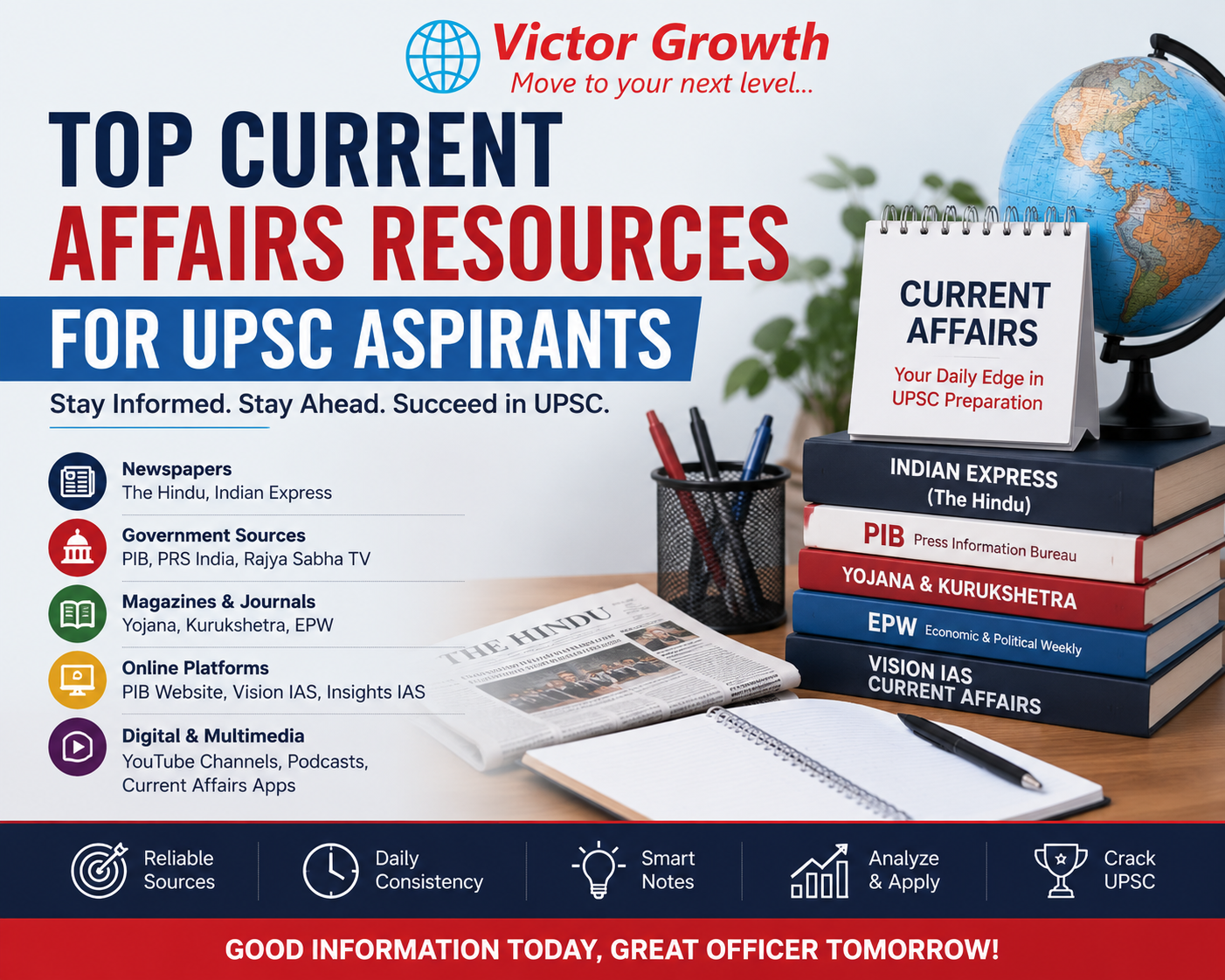
1. Newspapers – The Most Important Resource
Reading a quality newspaper daily is non-negotiable for UPSC preparation.
The Hindu
One of the most recommended newspapers because of:
- Editorial analysis
- Government policies
- International relations
- Judiciary
- Economy
- Environment
Read for 45–60 minutes daily.
The Indian Express
Especially useful for:
- Explained section
- Editorials
- Governance
- International Affairs
- Economy
Many aspirants prefer reading both selectively.
How to Read Newspapers Effectively
Read only UPSC-relevant topics.
Skip:
- Political gossip
- Crime news
- Celebrity news
- Sports (except major events)
- Local city news
Focus on:
- Supreme Court judgments
- Parliament
- International relations
- Economy
- Government schemes
- Reports
- Environment
- Science & Technology
2. PIB (Press Information Bureau)
PIB is the official source of Government of India information.
Important for:
- Government schemes
- Cabinet decisions
- Ministries
- New policies
- Budget updates
- National missions
Make short notes rather than reading every release.
3. Yojana Magazine
Published by the Government of India.
Excellent for:
- Social issues
- Governance
- Inclusive development
- Rural development
- Health
- Education
- Women empowerment
Very useful for Mains and Essay.
4. Kurukshetra Magazine
Focuses on:
- Agriculture
- Rural economy
- Panchayati Raj
- Rural development
- Sustainable development
Helpful for GS Paper II and III.
5. Economic Survey
One of the most important documents for UPSC.
It provides:
- Economic trends
- Government initiatives
- Data
- Statistics
- Case studies
Useful for:
- Essay
- GS Paper III
- Interview
6. Union Budget
Every aspirant should understand:
- Fiscal policy
- Taxation
- Government priorities
- Infrastructure
- Agriculture
- Education
- Health
- Defence expenditure
Focus on concepts rather than memorizing figures.
7. India Year Book
Useful for:
- Government institutions
- Culture
- Economy
- Agriculture
- Education
- Welfare schemes
Read selectively based on the syllabus.
8. Monthly Current Affairs Magazines
Monthly compilations save revision time.
They usually cover:
- National news
- International news
- Economy
- Environment
- Science & Technology
- Reports
- Indices
- Awards
- Sports
Ideal for monthly revision.
9. Government Reports
Frequently used reports include:
- NITI Aayog Reports
- RBI Reports
- NFHS
- NCRB Reports
- SDG Reports
- Human Development Reports
- World Bank Reports
- IMF Reports
Remember only important findings.
10. Rajya Sabha TV & Sansad TV Discussions
These discussions improve:
- Analytical ability
- Balanced viewpoints
- Mains answer writing
- Interview preparation
Watch selected debates instead of spending hours daily.
11. PRS Legislative Research
Useful for:
- Bills
- Acts
- Parliamentary Committees
- Governance
Excellent resource for GS Paper II.
12. Government Websites
Important ministries include:
- Ministry of Environment
- Ministry of External Affairs
- Ministry of Finance
- Ministry of Education
- Ministry of Agriculture
- Ministry of Health
Refer only when required for specific topics.
13. Reliable UPSC Coaching Current Affairs Material
Many reputed institutes provide:
- Daily Current Affairs
- Weekly Compilations
- Monthly Magazines
- Editorial Summaries
- MCQs
- Mains Answer Writing Practice
Choose one trusted source and revise it consistently.
14. Current Affairs Apps
Mobile apps can help during travel or breaks.
Useful features include:
- Daily quizzes
- News summaries
- Flashcards
- Monthly PDFs
- MCQs
Avoid using multiple apps simultaneously.
15. YouTube for Current Affairs
YouTube should supplement—not replace—newspaper reading.
Watch:
- Budget analysis
- Economic Survey discussions
- International relations
- Science & Technology explainers
Limit viewing to avoid distractions.
How to Make Current Affairs Notes
Effective notes should be:
- Short
- Topic-wise
- Digital or handwritten
- Updated regularly
- Easy to revise
Organize under subjects such as:
- Polity
- Economy
- Environment
- International Relations
- Science & Technology
- Agriculture
- Social Issues
Avoid copying entire articles.
Daily Current Affairs Study Plan
Morning (45–60 Minutes)
- Newspaper
- Editorial
- Important headlines
Afternoon (15 Minutes)
- PIB highlights
- Government updates
Evening (30 Minutes)
- Revise notes
- Attempt MCQs
- Update digital notes
Total Time
Approximately 1.5–2 hours daily
Monthly Current Affairs Revision Strategy
At the end of every month:
- Revise monthly magazine
- Solve Prelims MCQs
- Practice Mains questions
- Update notes
- Revise important reports
- Revise government schemes
Monthly revision prevents backlog.
Common Mistakes to Avoid
- Following multiple newspapers.
- Watching too many YouTube channels.
- Ignoring revision.
- Memorizing facts without understanding.
- Reading irrelevant political news.
- Not making notes.
- Skipping current affairs for several weeks.
- Depending entirely on coaching material.
- Ignoring government reports.
- Studying without connecting current affairs to the UPSC syllabus.
Best Current Affairs Strategy for Beginners
Month 1
- Start newspaper reading.
- Learn note-making.
- Understand the syllabus.
Month 2
- Add PIB.
- Monthly magazine.
- Weekly revision.
Month 3 onwards
- Daily MCQs.
- Mains answer writing.
- Monthly revision.
- Government reports.
- Budget and Economic Survey.
Consistency is more important than covering every available source.
Role of IAS Coaching in Current Affairs Preparation
Joining the best IAS coaching in Kerala can make current affairs preparation much more structured and efficient.
A good coaching institute offers:
- Daily current affairs classes
- Newspaper analysis
- Monthly current affairs booklets
- Prelims MCQs
- Mains answer writing practice
- Editorial discussions
- Government report summaries
- Budget and Economic Survey analysis
- Interview guidance
Expert mentorship helps aspirants focus only on relevant topics, saving valuable time and improving preparation quality.
Why Choose the Best IAS Coaching in Kerala?
Preparing current affairs independently can become overwhelming due to the vast amount of information available. The best IAS coaching in Kerala provides a systematic approach by integrating current affairs with the static syllabus, ensuring aspirants understand concepts rather than merely memorizing events.
Key advantages include:
- Experienced faculty with UPSC expertise
- Structured current affairs classes
- Comprehensive study materials
- Regular revision sessions
- Daily MCQs and quizzes
- Mains answer writing evaluation
- Personalized mentorship
- Flexible online and offline learning options
- Mock interviews with current affairs focus
Such an integrated approach significantly improves preparation for all stages of the UPSC examination.
Final Thoughts
Current affairs are not about reading every piece of news—they are about understanding issues, connecting them with the UPSC syllabus, and revising them consistently. A disciplined approach using a limited number of reliable resources will always outperform information overload.
Build a habit of reading newspapers daily, make concise notes, revise regularly, and practice both Prelims MCQs and Mains answer writing. Combined with guidance from the best IAS coaching in Kerala, a strong current affairs strategy can become one of your greatest strengths in the UPSC Civil Services Examination.
Frequently Asked Questions (FAQs)
How much time should I spend on current affairs every day for UPSC?
Ideally, spend 1.5 to 2 hours daily, including newspaper reading, note-making, revision, and solving a few MCQs.
Which newspaper is best for UPSC preparation?
The Hindu and The Indian Express are the most widely recommended newspapers. Read one consistently and focus on UPSC-relevant topics.
Is PIB necessary for UPSC?
Yes. PIB provides authentic information on government policies, schemes, cabinet decisions, and official initiatives, making it highly useful for both Prelims and Mains.
Should I make handwritten or digital notes for current affairs?
Either method works. The key is to keep notes concise, organize them subject-wise, and revise them regularly.
Are monthly current affairs magazines enough?
Monthly magazines are excellent for revision, but they should complement—not replace—daily newspaper reading and regular note-making.
How can I avoid current affairs backlog?
Read the newspaper every day, make short notes, revise weekly, and complete a comprehensive revision at the end of each month.
Do current affairs help in the UPSC Interview?
Yes. Interview questions often focus on recent national and international developments. A strong understanding of current affairs helps demonstrate awareness, balanced thinking, and analytical ability.
Why should I choose the best IAS coaching in Kerala for current affairs preparation?
The best IAS coaching in Kerala provides structured newspaper analysis, daily current affairs discussions, monthly compilations, expert mentorship, regular MCQs, answer writing practice, and integrated preparation for Prelims, Mains, and the Interview, making current affairs preparation more focused and effective.