
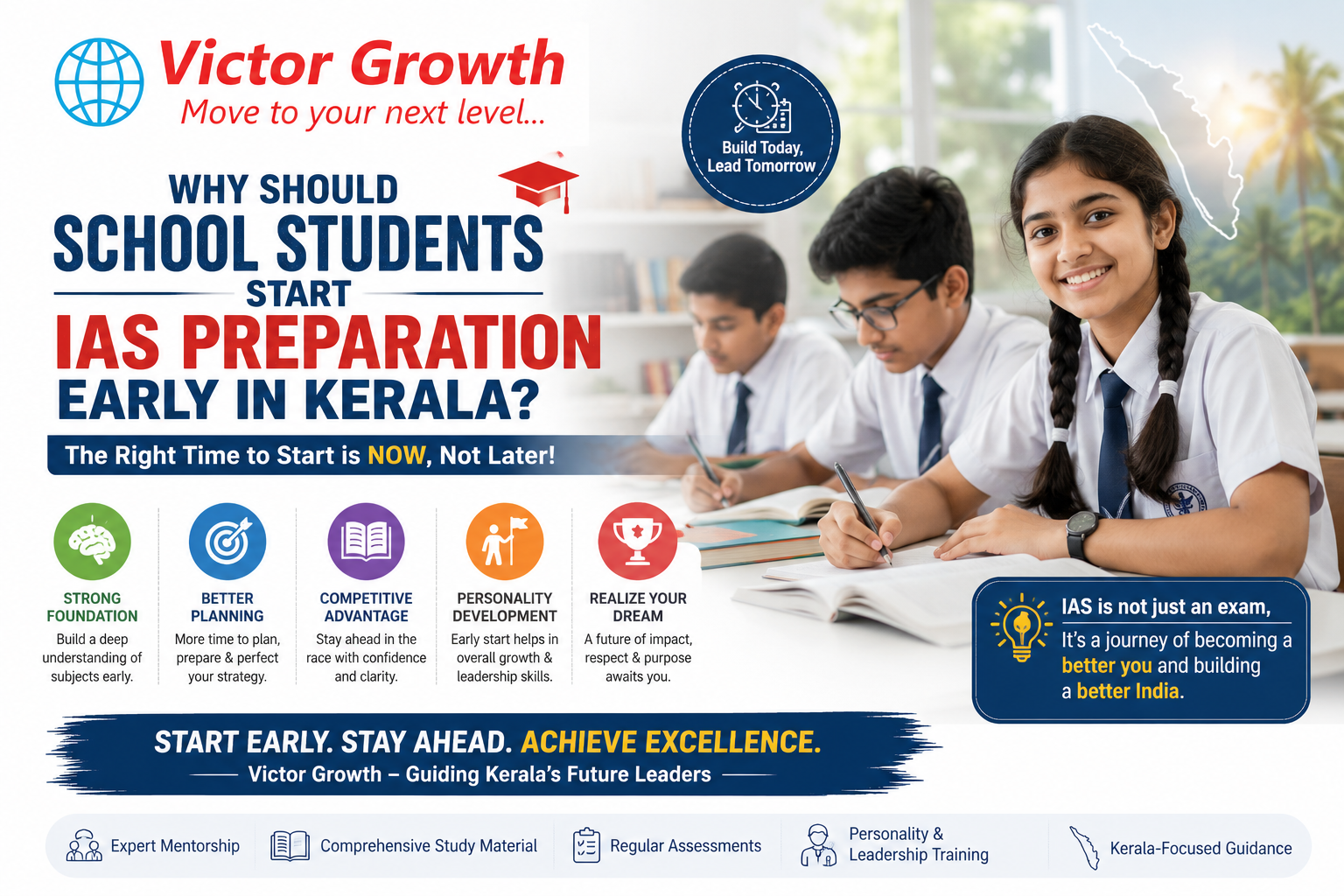
Every year, lakhs of students dream of becoming an IAS officer, but only a small percentage succeed in the UPSC Civil Services Examination. The difference often lies not only in hard work but also in early preparation.
Contrary to popular belief, IAS preparation does not begin after graduation. The foundation for success can be laid during the school years, especially from Classes 8 to 12. Students who start early develop strong academic fundamentals, analytical thinking, communication skills, and leadership qualities that later become invaluable in the UPSC journey.
With Kerala’s excellent literacy rate, quality education, and awareness about civil services, it has become one of the best places for young aspirants to prepare. Joining the best IAS coaching in Kerala through a structured foundation programme helps students gain a significant advantage before they even enter college.
Why Start IAS Preparation During School?
1. Strong Academic Foundation
The UPSC syllabus is vast and includes subjects like:
- History
- Geography
- Economics
- Indian Polity
- Science & Technology
- Environment
- International Relations
- Ethics
Interestingly, many of these subjects are introduced in school textbooks.
Students who understand these concepts deeply during school find UPSC preparation much easier later.
Instead of memorizing facts, they gradually develop conceptual clarity.
2. Better Reading Habits
Successful IAS officers are lifelong readers.
Starting early helps students develop habits such as:
- Reading newspapers daily
- Reading quality books
- Improving vocabulary
- Understanding current affairs
- Developing curiosity
By graduation, these students often possess thousands of hours of quality reading experience.
3. Improved General Knowledge
General knowledge cannot be built overnight.
It develops through continuous exposure to:
- National events
- International affairs
- Indian Constitution
- Government schemes
- Geography
- Economics
- Science
- Environment
Beginning during school allows students to absorb information naturally over many years.
4. Enhanced Analytical Thinking
UPSC questions increasingly test:
- Critical thinking
- Logical reasoning
- Decision-making
- Problem-solving
- Multi-dimensional analysis
Foundation courses encourage students to ask:
- Why did this happen?
- What are its consequences?
- How can it be solved?
- What is the government’s role?
These skills benefit not only UPSC but also academics and future careers.
5. Excellent Communication Skills
IAS officers interact with:
- Citizens
- Ministers
- Government officials
- Media
- International delegations
Students who begin early get opportunities to improve:
- Public speaking
- Debate
- Essay writing
- Presentation skills
- Interview confidence
These abilities continue to grow throughout school and college.
Why Kerala Students Have an Advantage
Kerala offers several unique advantages.
High Literacy
Kerala consistently ranks among India’s most literate states.
Students already possess strong learning habits.
Awareness About Competitive Exams
Many schools encourage participation in:
- Quiz competitions
- Debates
- Model Parliament
- Science fairs
- Social awareness programmes
These activities directly improve UPSC-related skills.
Access to Quality Coaching
Students have access to the best IAS coaching in Kerala, where experienced mentors guide them through a structured foundation programme designed specifically for school students.
Exposure to Social Issues
Kerala provides students with opportunities to understand:
- Local governance
- Panchayati Raj
- Environmental conservation
- Disaster management
- Health systems
- Education models
These real-world experiences help students relate theoretical concepts to practical governance.
Skills Developed Through Early IAS Preparation
Early preparation develops far more than subject knowledge.
Students build:
Leadership
- Taking initiative
- Responsibility
- Team management
Discipline
Daily study habits improve consistency and time management.
Confidence
Regular presentations, discussions, and mock interviews boost self-confidence.
Decision-Making
Students learn to evaluate multiple perspectives before reaching conclusions.
Emotional Intelligence
Future administrators require empathy and understanding.
Foundation programmes often include discussions on ethics, society, and public service.
How Early Preparation Helps in School Academics
One common concern among parents is whether IAS preparation affects school performance.
The answer is No—when done correctly.
In fact, students often improve in:
- Social Science
- English
- Science
- Essay writing
- Reading comprehension
- General awareness
- Project work
- Olympiads
- Scholarship examinations
UPSC foundation learning complements the school curriculum rather than competing with it.
Ideal Roadmap for School Students
Classes 6–8
Focus on:
- Reading habits
- Curiosity
- Basic General Knowledge
- Maps
- Stories from Indian history
- Vocabulary building
Classes 9–10
Begin:
- NCERT mastery
- Current affairs
- Logical reasoning
- Essay writing
- Public speaking
- Basic Constitution
Classes 11–12
Develop:
- Analytical thinking
- Editorial reading
- Answer writing
- Ethics
- Debate
- Leadership
- Personality development
By the time students complete Class 12, they will have a strong foundation that makes future UPSC preparation far more manageable.
Importance of Current Affairs
Current affairs are the backbone of UPSC preparation.
Students should gradually learn to follow:
- National news
- International developments
- Parliament
- Supreme Court judgments
- Science and technology
- Environment
- Economy
- Government policies
Starting early makes current affairs a daily habit rather than a last-minute burden.
Role of Parents
Parents play a crucial role by:
- Encouraging reading
- Limiting excessive screen time
- Promoting healthy discussions
- Supporting extracurricular learning
- Avoiding unnecessary academic pressure
- Encouraging curiosity instead of rote learning
The goal is not to make children study for UPSC from childhood but to help them develop lifelong learning habits.
Why Choose the Best IAS Coaching in Kerala for Foundation Preparation?
A dedicated foundation programme offers structured guidance that schools alone may not provide. Choosing the best IAS coaching in Kerala gives students access to:
- Expert faculty with UPSC experience
- Age-appropriate study materials
- Interactive classroom sessions
- Current affairs discussions
- Personality development programmes
- Public speaking and debate training
- Leadership development
- Regular assessments
- Mentorship and career guidance
- Doubt-clearing sessions
- Motivation and goal setting
The emphasis is on building a broad intellectual base rather than accelerating students into exam-specific coaching too early.
Long-Term Benefits Beyond UPSC
Even if a student later chooses a different career, early IAS preparation builds valuable life skills that benefit:
- Engineering
- Medicine
- Law
- Management
- Entrepreneurship
- Research
- Defence Services
- Journalism
- Public Policy
- Higher Education Abroad
Students become informed, confident, and socially responsible citizens.
Common Myths About Early IAS Preparation
Myth 1: IAS preparation should begin only after graduation.
Reality: Building strong fundamentals during school makes later preparation more effective and less stressful.
Myth 2: Foundation courses reduce school marks.
Reality: Properly designed programmes strengthen understanding, reading, writing, and analytical skills, often improving academic performance.
Myth 3: School students are too young for UPSC concepts.
Reality: Foundation courses introduce concepts in an engaging, age-appropriate manner focused on curiosity, awareness, and skill development.
Myth 4: Only toppers can become IAS officers.
Reality: Success in UPSC depends on consistency, discipline, critical thinking, and perseverance—not school marks alone.
Conclusion
Preparing for the IAS is a marathon, not a sprint. Starting during school allows students to develop strong academic foundations, reading habits, leadership qualities, communication skills, and analytical thinking over several years.
For families seeking the best IAS coaching in Kerala, a well-designed foundation programme can nurture curiosity, confidence, and civic awareness while supporting school education. The objective is not to rush children into competitive exam pressure, but to equip them with the knowledge, skills, and mindset needed to excel in higher studies, competitive examinations, and future leadership roles.
A thoughtful start today can help shape tomorrow’s administrators and nation-builders.
Frequently Asked Questions (FAQs)
1. What is the right age to start IAS preparation?
Students can begin building foundational skills from Classes 6 to 8 through reading, general knowledge, and curiosity-driven learning. Structured foundation programmes are often most suitable from Classes 8 to 12.
2. Will IAS foundation classes affect school studies?
No. A well-planned foundation course complements the school curriculum by improving reading, writing, critical thinking, and subject understanding.
3. Which subjects should school students focus on for IAS preparation?
Students should strengthen:
- History
- Geography
- Indian Polity
- Economics
- Science
- Environment
- English
- Current Affairs
4. Why is Kerala a good place for IAS preparation?
Kerala offers high educational standards, a strong reading culture, quality schools, experienced mentors, and access to some of the best IAS coaching in Kerala, making it an excellent environment for aspiring civil servants.
5. Is coaching necessary for school students?
Coaching is not mandatory, but a structured foundation programme with experienced mentors can provide direction, discipline, age-appropriate learning, and continuous motivation.
6. How does early IAS preparation improve personality?
Students develop communication skills, leadership, analytical thinking, confidence, ethics, and social awareness—qualities that are valuable for UPSC and every profession.
7. How much time should a school student spend on IAS foundation preparation?
Generally, 3–6 hours per week of structured learning, along with regular newspaper reading and book reading, is sufficient. The focus should remain on balanced development without compromising school studies.
8. What should parents look for when choosing the best IAS coaching in Kerala?
Parents should consider:
- Experienced faculty
- Structured foundation curriculum
- Age-appropriate study materials
- Mentorship
- Interactive learning methods
- Personality development activities
- Regular assessments
- A balanced approach that supports school education