
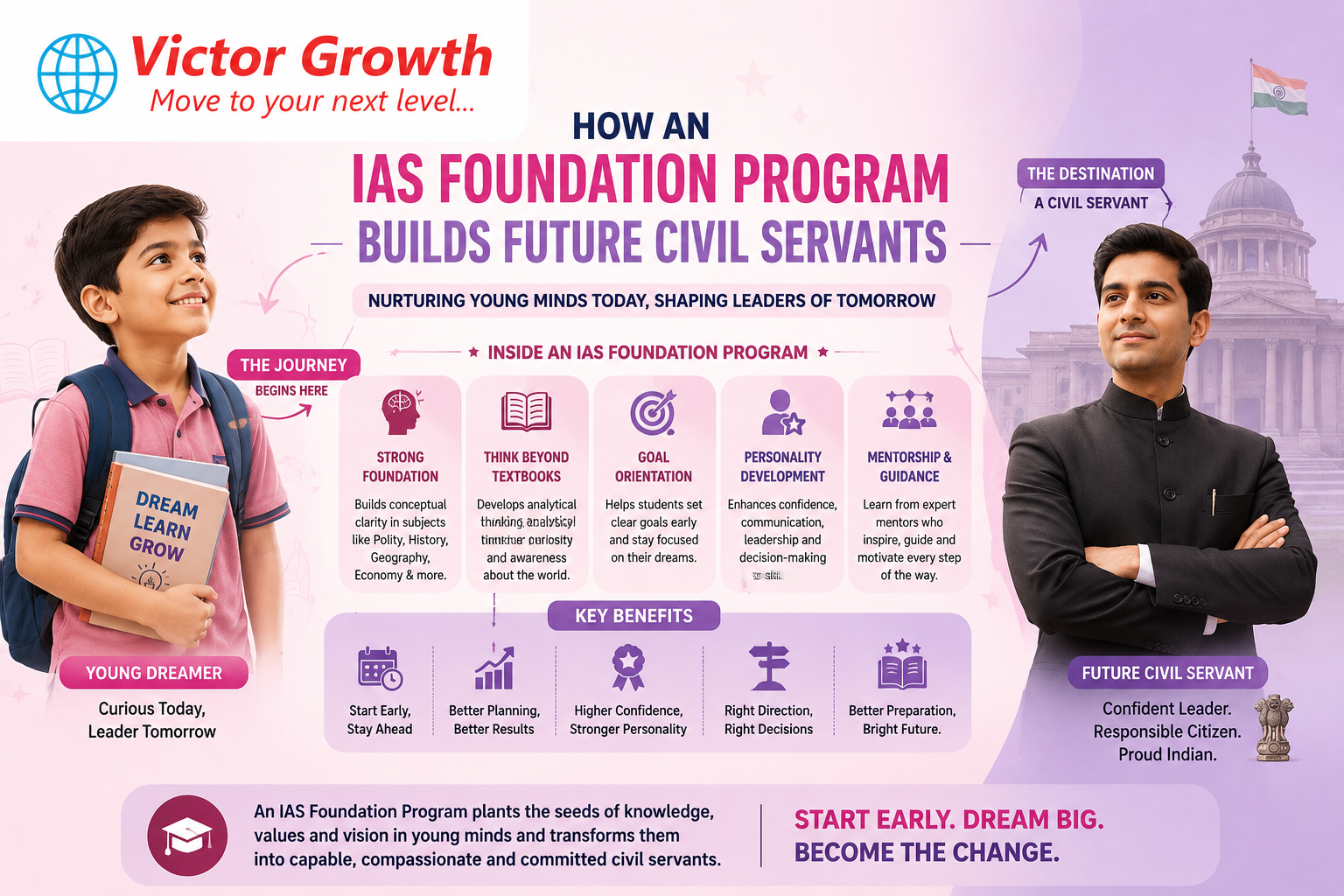
Every year, thousands of young Indians dream of wearing the prestigious IAS badge and serving the nation. However, becoming an Indian Administrative Service (IAS) officer requires much more than academic excellence. It demands leadership, integrity, critical thinking, decision-making ability, effective communication, emotional intelligence, and a deep understanding of society.
These qualities cannot be developed overnight. They are cultivated over many years through consistent learning, discipline, and exposure to real-world issues. This is where an IAS Foundation Program plays a crucial role.
An IAS Foundation Program is designed to nurture school students by building a strong academic, intellectual, and personal foundation. Instead of focusing solely on examination preparation, it develops the habits and skills that shape responsible, capable, and confident future leaders.
For parents and students searching for the best IAS coaching in Kerala, a structured foundation programme offers an ideal pathway to long-term success while supporting school education.
What Is an IAS Foundation Program?
An IAS Foundation Program is an age-appropriate learning programme for students, generally from Classes 6 to 12, that focuses on holistic development rather than immediate UPSC preparation.
The programme introduces students to:
- Indian History
- Geography
- Indian Constitution
- Economics
- Science and Technology
- Environment
- Current Affairs
- Leadership
- Ethics
- Communication Skills
- Personality Development
The objective is to prepare students not just for competitive examinations, but for becoming informed, responsible, and capable citizens.
Why Civil Servants Need More Than Academic Knowledge
The work of an IAS officer extends far beyond passing an examination. Civil servants are responsible for:
- Implementing government policies
- Managing public resources
- Solving administrative challenges
- Leading disaster management efforts
- Improving public welfare
- Coordinating with multiple departments
- Addressing citizens’ concerns
- Making ethical decisions under pressure
An IAS Foundation Program begins cultivating these competencies at an early age through structured learning and practical activities.
1. Building Strong Academic Foundations
Every successful civil servant begins with a strong understanding of core subjects.
A foundation programme helps students master:
- History
- Geography
- Polity
- Economics
- Science
- Environment
Rather than memorizing facts, students learn to understand concepts, identify connections between subjects, and apply knowledge to real-life situations.
This conceptual learning also improves school performance.
2. Developing Analytical Thinking
Modern UPSC examinations reward analytical thinking rather than rote learning.
Students are encouraged to examine issues from multiple perspectives by asking questions such as:
- Why has this issue emerged?
- What are its causes?
- Who is affected?
- What solutions are possible?
- What could be the long-term impact?
This habit of critical inquiry prepares students to become thoughtful decision-makers.
3. Creating a Habit of Reading
Reading is one of the defining habits of successful civil servants.
An IAS Foundation Program encourages students to regularly read:
- Newspapers
- Biographies
- General knowledge books
- Science magazines
- Government publications (age appropriate)
- Quality non-fiction
Consistent reading improves:
- Vocabulary
- General awareness
- Comprehension
- Writing ability
- Curiosity
Students who develop reading habits early often find future UPSC preparation far more manageable.
4. Strengthening Communication Skills
Civil servants interact with citizens, elected representatives, government officials, and the media. Clear communication is therefore essential.
Foundation programmes improve communication through:
- Public speaking
- Group discussions
- Debates
- Presentations
- Essay writing
- Creative writing
- Storytelling
These activities help students express ideas confidently and logically.
5. Developing Leadership Qualities
Leadership is a core requirement for civil servants.
Students are encouraged to:
- Work in teams
- Organize events
- Take responsibility
- Solve problems collaboratively
- Make informed decisions
- Respect diverse viewpoints
Leadership activities build confidence, accountability, and initiative.
6. Introducing Governance and the Constitution
Understanding how India functions as a democracy is essential for every future civil servant.
Students learn about:
- Constitution of India
- Fundamental Rights
- Fundamental Duties
- Parliament
- Judiciary
- Executive
- Elections
- Local Self Government
- Public administration
These concepts are introduced in an engaging and age-appropriate manner.
7. Building Awareness of Society
An effective administrator understands the challenges faced by different sections of society.
Foundation programmes encourage students to explore topics such as:
- Education
- Healthcare
- Poverty
- Rural development
- Urban planning
- Women’s empowerment
- Environmental conservation
- Social justice
This broad perspective fosters empathy and informed decision-making.
8. Cultivating Ethical Values
Integrity is one of the defining qualities of an IAS officer.
Students are encouraged to develop values such as:
- Honesty
- Responsibility
- Fairness
- Compassion
- Accountability
- Respect for diversity
Ethics-based discussions help students appreciate the importance of principled leadership.
9. Encouraging Curiosity and Lifelong Learning
Civil servants must continuously adapt to changing laws, technologies, and societal needs.
An IAS Foundation Program nurtures lifelong learners by encouraging students to:
- Ask questions
- Explore new ideas
- Conduct independent research
- Participate in quizzes
- Engage in discussions
- Stay informed about current affairs
Curiosity becomes a lifelong habit rather than a classroom requirement.
10. Improving Time Management and Discipline
Successful students learn to balance:
- School studies
- Homework
- Foundation classes
- Reading
- Sports
- Hobbies
- Family time
A structured foundation programme teaches students to plan effectively, prioritize tasks, and maintain consistency—skills that remain valuable throughout life.
11. Enhancing Writing Skills
UPSC Mains places significant emphasis on written expression. While school students are not preparing for the exam itself, early writing practice builds essential skills.
Students learn:
- Essay writing
- Report writing
- Opinion writing
- Structured note-making
- Logical argument development
These abilities improve school assignments and future competitive exam preparation.
12. Developing Decision-Making Ability
Civil servants make decisions that affect thousands of people.
Foundation programmes introduce students to simple case studies and real-life scenarios that encourage them to:
- Evaluate alternatives
- Consider consequences
- Make balanced decisions
- Respect ethical principles
Decision-making improves with practice, making early exposure highly valuable.
13. Building Confidence Through Practical Activities
Confidence grows through experience.
Students participate in:
- Debates
- Quiz competitions
- Group projects
- Mock interviews
- Leadership exercises
- Public speaking sessions
These activities help students overcome hesitation and develop a positive self-image.
14. Preparing Students for Future Competitive Examinations
Although the programme is not exam-focused, it lays a solid foundation for future examinations such as:
- UPSC Civil Services
- Kerala Administrative Service (KAS)
- NDA
- CDS
- SSC
- Banking examinations
- CLAT
- CUET
- Scholarship examinations
Students become comfortable with structured learning, analytical reasoning, and current affairs from an early stage.
15. Supporting Overall Personality Development
The ultimate objective of an IAS Foundation Program is to develop well-rounded individuals.
Students improve in:
- Confidence
- Leadership
- Communication
- Discipline
- Emotional intelligence
- Teamwork
- Social responsibility
- Creativity
- Problem-solving
These qualities contribute to success regardless of the career path they choose.
The Role of Parents in Building Future Civil Servants
Parents are key partners in a student’s journey. They can support foundation learning by:
- Encouraging daily reading
- Discussing current events at home
- Limiting unnecessary screen time
- Promoting healthy study habits
- Appreciating consistent effort
- Encouraging participation in debates, quizzes, and extracurricular activities
A positive and supportive environment helps students enjoy learning and remain motivated.
Why Choose the Best IAS Coaching in Kerala?
The best IAS coaching in Kerala provides more than subject knowledge. A quality foundation programme offers:
- Experienced UPSC mentors
- Structured and age-appropriate curriculum
- Comprehensive study materials
- Interactive classroom sessions
- Current affairs discussions
- Personality development workshops
- Leadership and communication training
- Regular assessments and feedback
- Individual mentorship
- A balanced approach that supports school academics
Such programmes help students build the skills and mindset required for future civil servants while ensuring they excel in school.
Long-Term Benefits Beyond the Civil Services
Even if students later choose different careers, the competencies developed through an IAS Foundation Program remain valuable.
These include careers in:
- Engineering
- Medicine
- Law
- Journalism
- Management
- Entrepreneurship
- Public Policy
- Research
- Defence Services
- International Relations
The emphasis on leadership, ethics, communication, and critical thinking benefits every profession.
Conclusion
An IAS Foundation Program is much more than an introduction to the civil services. It is a comprehensive programme that nurtures curiosity, strengthens academic understanding, develops leadership, enhances communication, and instills ethical values.
For parents looking for the best IAS coaching in Kerala, enrolling their child in a structured foundation programme is an investment in long-term success. Whether the student ultimately becomes an IAS officer or pursues another profession, the knowledge, discipline, confidence, and values gained through the programme will serve them throughout life.
Building future civil servants begins not with examination coaching but with creating informed, compassionate, and capable young citizens who are ready to lead and contribute to society.
Frequently Asked Questions (FAQs)
1. What is the main objective of an IAS Foundation Program?
The primary objective is to develop academic excellence, leadership, analytical thinking, communication skills, ethical values, and awareness of society, creating a strong foundation for future competitive examinations and responsible citizenship.
2. At what age can students join an IAS Foundation Program?
Students can begin foundation learning from Classes 6 to 8, while more structured programmes are commonly offered for Classes 8 to 12, depending on the institute.
3. Does an IAS Foundation Program prepare students directly for the UPSC examination?
No. It focuses on building concepts, skills, and habits that will support future UPSC preparation rather than teaching the graduate-level syllabus in depth.
4. How does an IAS Foundation Program improve school performance?
The programme strengthens conceptual understanding, reading comprehension, writing skills, time management, and analytical thinking, which often lead to better results in school examinations.
5. Which skills are developed through an IAS Foundation Program?
Students develop:
- Leadership
- Communication
- Critical thinking
- Decision-making
- Reading habits
- Writing ability
- Time management
- Teamwork
- Ethical reasoning
- General awareness
6. Is an IAS Foundation Program useful for students who choose other careers?
Yes. The skills gained are valuable in engineering, medicine, law, management, entrepreneurship, research, defence services, and many other professions.
7. How should parents choose the best IAS coaching in Kerala?
Parents should look for:
- Experienced faculty
- Structured curriculum
- Age-appropriate teaching methods
- Personality development modules
- Current affairs integration
- Individual mentorship
- Regular assessments
- A balanced approach that complements school education
8. Why is early foundation learning better than starting after graduation?
Early learning allows students to build strong concepts, reading habits, communication skills, leadership qualities, and analytical thinking gradually over several years, making future competitive examination preparation more effective and less stressful.