
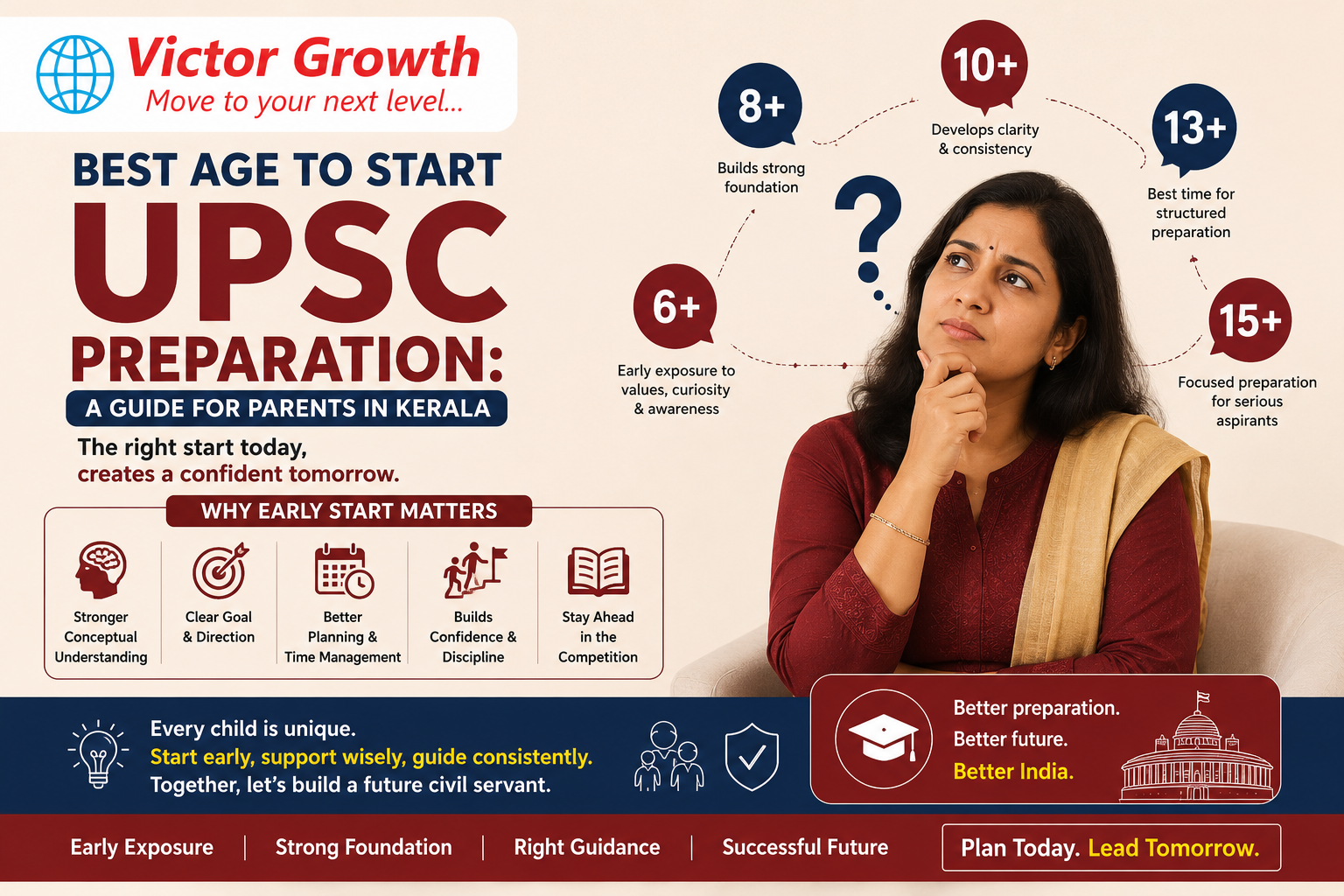
One of the most common questions parents ask is:
“What is the best age for my child to start UPSC preparation?”
With increasing awareness about the Civil Services Examination, many parents in Kerala want to give their children a head start. However, there is often confusion about whether students should begin in middle school, high school, after Class 12, or only after graduation.
The answer is not simply about age—it is about starting the right kind of preparation at the right stage of a child’s development.
Children do not need to study the entire UPSC syllabus during school. Instead, they should focus on building the knowledge, skills, habits, and personality traits that will help them succeed later. A well-designed IAS Foundation Programme introduces these concepts gradually without creating unnecessary academic pressure.
For families looking for the best IAS coaching in Kerala, understanding the ideal preparation roadmap can help make informed decisions that support both school education and long-term career aspirations.
Understanding the UPSC Journey
The UPSC Civil Services Examination is one of India’s most competitive examinations. It evaluates candidates on a wide range of abilities, including:
- Conceptual understanding
- Analytical thinking
- Decision-making
- Communication skills
- Ethics and integrity
- Leadership
- General awareness
- Writing ability
- Emotional intelligence
These qualities develop over time. They cannot be acquired through short-term preparation alone.
This is why educators increasingly recommend building a strong academic and personal foundation during the school years.
Is There an Official Age to Start UPSC Preparation?
There is no official minimum age to begin learning about the civil services. However, the UPSC examination itself can only be taken after meeting the prescribed eligibility criteria, including the minimum age and educational qualification.
Preparation, however, is different from appearing for the examination.
Early preparation focuses on:
- Developing reading habits
- Improving communication
- Building conceptual understanding
- Strengthening analytical thinking
- Encouraging curiosity
- Enhancing personality development
These skills benefit students regardless of whether they eventually choose the civil services.
Age-Wise Roadmap for UPSC Preparation
Classes 6–8 (Ages 11–13): Building Curiosity
This is the ideal stage to develop learning habits.
Students should focus on:
- Reading storybooks and biographies
- Learning basic geography through maps
- Understanding Indian history through engaging narratives
- Improving English vocabulary
- Participating in quizzes
- Reading age-appropriate newspapers or children’s news magazines
- Developing curiosity about the world
The emphasis should be on exploration rather than examination.
Classes 8–10 (Ages 13–16): Building Strong Foundations
This is widely regarded as one of the best stages to join an IAS Foundation Course.
Students can gradually begin studying:
- Indian History
- Geography
- Constitution
- Basic Economics
- Environment
- Science and Technology
- Current Affairs
Alongside academics, they should develop:
- Reading habits
- Public speaking
- Essay writing
- Logical reasoning
- Leadership skills
Learning at this stage remains balanced and enjoyable, complementing school education.
Classes 11–12 (Ages 16–18): Developing Analytical Thinking
Higher secondary education provides opportunities to deepen understanding.
Students should:
- Read newspapers daily
- Follow editorials
- Improve answer-writing skills
- Participate in debates
- Study NCERT books thoroughly
- Develop current affairs awareness
- Strengthen communication skills
At this stage, students become more capable of analyzing social, political, and economic issues.
Graduation (18 Years and Above): Focused UPSC Preparation
Graduation is generally the stage where students begin structured UPSC preparation.
They focus on:
- Complete UPSC syllabus
- Prelims preparation
- Mains answer writing
- Optional subject
- Test series
- Mock interviews
Students who have completed a foundation programme often find this phase more manageable because they already possess strong fundamentals.
Why Starting Early Makes a Difference
1. Strong Reading Habits
UPSC preparation requires consistent reading over several years.
Students who begin early naturally develop habits such as:
- Newspaper reading
- Book reading
- Note-making
- Vocabulary building
These habits become second nature.
2. Better Conceptual Understanding
School students have ample time to understand concepts rather than memorizing facts.
They gradually master:
- History
- Geography
- Polity
- Economics
- Science
- Environment
Conceptual learning remains useful throughout higher education.
3. Improved Communication Skills
Civil servants communicate with citizens, government officials, policymakers, and the media.
Foundation programmes help students improve:
- Public speaking
- Group discussions
- Debate
- Presentation skills
- Writing ability
Confidence grows steadily with regular practice.
4. Development of Leadership Qualities
Leadership is learned through experience.
Students participate in:
- Team activities
- Community projects
- Quiz competitions
- Student leadership programmes
- Presentations
These activities prepare them for future administrative responsibilities.
5. Better Time Management
Students who learn to balance school, reading, extracurricular activities, and foundation classes develop excellent organizational skills.
Time management becomes a lifelong strength.
6. Reduced Future Stress
Students who gradually build knowledge over several years experience less pressure during graduation.
Instead of starting from scratch, they revise and strengthen existing concepts.
Common Mistakes Parents Should Avoid
Starting Full UPSC Coaching Too Early
School students do not require graduate-level UPSC coaching.
Age-appropriate foundation learning is sufficient.
Creating Excessive Academic Pressure
Children should continue to enjoy:
- Sports
- Arts
- Reading
- Family time
- Hobbies
Balanced development produces better long-term outcomes than excessive coaching.
Focusing Only on Marks
Academic scores are important, but qualities such as curiosity, communication, discipline, and ethics are equally valuable for future civil servants.
Ignoring Personality Development
Leadership, empathy, teamwork, and confidence are essential qualities that should be developed alongside academics.
How Parents Can Support Their Child
Parents have a significant influence on a child’s learning journey.
They can encourage:
Daily Reading
Create a reading-friendly environment at home.
Healthy Discussions
Talk about current events, science, history, and social issues during family conversations.
Independent Thinking
Allow children to ask questions and express opinions respectfully.
Participation in Activities
Encourage involvement in:
- Debates
- Quiz competitions
- Science exhibitions
- Youth Parliament
- Public speaking
- Social service activities
Balanced Lifestyle
Ensure adequate:
- Sleep
- Exercise
- Recreation
- Nutrition
Healthy students learn more effectively.
Why Kerala Is an Ideal Place to Begin UPSC Preparation
Kerala offers several advantages for aspiring civil servants.
These include:
- High literacy rate
- Strong educational infrastructure
- Excellent school system
- Reading culture
- Access to libraries
- Active participation in academic competitions
- Quality coaching institutions
- Supportive learning environment
These factors make Kerala an excellent place for students to begin foundation learning.
Choosing the Best IAS Coaching in Kerala
When selecting a foundation programme, parents should evaluate:
Experienced Faculty
Teachers should have expertise in UPSC and school-level mentoring.
Age-Appropriate Curriculum
The programme should match the student’s learning stage rather than introducing advanced graduate-level content prematurely.
Comprehensive Skill Development
Look for courses that include:
- Communication skills
- Personality development
- Leadership training
- Current affairs
- Reading habits
- Writing practice
Individual Mentorship
Regular guidance helps students stay motivated and track progress.
Interactive Learning
Classroom discussions, quizzes, activities, and projects make learning enjoyable and effective.
Balanced Academic Approach
The programme should strengthen school performance rather than competing with it.
Choosing the best IAS coaching in Kerala ensures that students receive structured guidance, experienced mentorship, and a nurturing environment that supports both academic excellence and holistic development.
Long-Term Benefits of Early UPSC Preparation
Students who begin with a foundation programme often develop:
- Academic confidence
- Strong communication skills
- Leadership qualities
- Critical thinking
- Ethical values
- Time management
- Reading habits
- Social awareness
- Emotional intelligence
- Problem-solving ability
These qualities are valuable not only for the civil services but also for careers in engineering, medicine, law, management, research, entrepreneurship, and public policy.
Conclusion
The best age to start UPSC preparation is not defined by intensive coaching but by beginning the right learning journey at the right time.
For most students, Classes 8 to 10 provide an excellent opportunity to join an IAS Foundation Programme that develops reading habits, conceptual understanding, communication skills, leadership, and analytical thinking without compromising school education.
Parents should focus on nurturing curiosity, discipline, ethics, and a love for learning rather than rushing children into exam-oriented preparation. Over time, these qualities become the strongest foundation for future success.
For families seeking the best IAS coaching in Kerala, choosing a structured, age-appropriate foundation programme can provide students with the guidance, confidence, and skills needed to grow into capable professionals and future civil servants.
Frequently Asked Questions (FAQs)
1. What is the best age to start UPSC preparation?
While focused UPSC preparation typically begins during graduation, students can start building foundational skills from Classes 6 to 8, with Classes 8 to 10 being an ideal stage to join an IAS Foundation Programme.
2. Should school students study the complete UPSC syllabus?
No. School students should focus on age-appropriate learning that builds concepts, reading habits, communication skills, leadership, and general awareness rather than attempting the full graduate-level UPSC syllabus.
3. Will an IAS Foundation Programme affect school performance?
No. A well-designed foundation programme complements school education by improving conceptual understanding, reading ability, writing skills, and time management, often leading to better academic performance.
4. Why is Class 8 considered a good stage to start?
By Class 8, students have developed sufficient maturity to understand topics such as history, geography, governance, and current affairs while still having several years to build skills gradually.
5. What should parents focus on before graduation?
Parents should encourage:
- Reading habits
- Communication skills
- Curiosity
- Current affairs awareness
- Leadership activities
- Personality development
- Consistent study habits
These foundations are more valuable than early exam-oriented coaching.
6. Is an IAS Foundation Programme useful if my child chooses another career?
Yes. The programme develops transferable skills such as critical thinking, leadership, communication, discipline, and problem-solving, which are valuable in engineering, medicine, law, management, entrepreneurship, and many other professions.
7. How can parents choose the best IAS coaching in Kerala?
Parents should look for:
- Experienced faculty
- Age-appropriate curriculum
- Interactive teaching methods
- Current affairs integration
- Personality development modules
- Individual mentorship
- Regular assessments
- Balanced academic support
8. Why is Kerala a good place for early UPSC preparation?
Kerala’s high literacy rate, strong educational institutions, vibrant reading culture, quality coaching centres, and supportive academic environment make it an excellent place for students to begin their UPSC foundation journey.