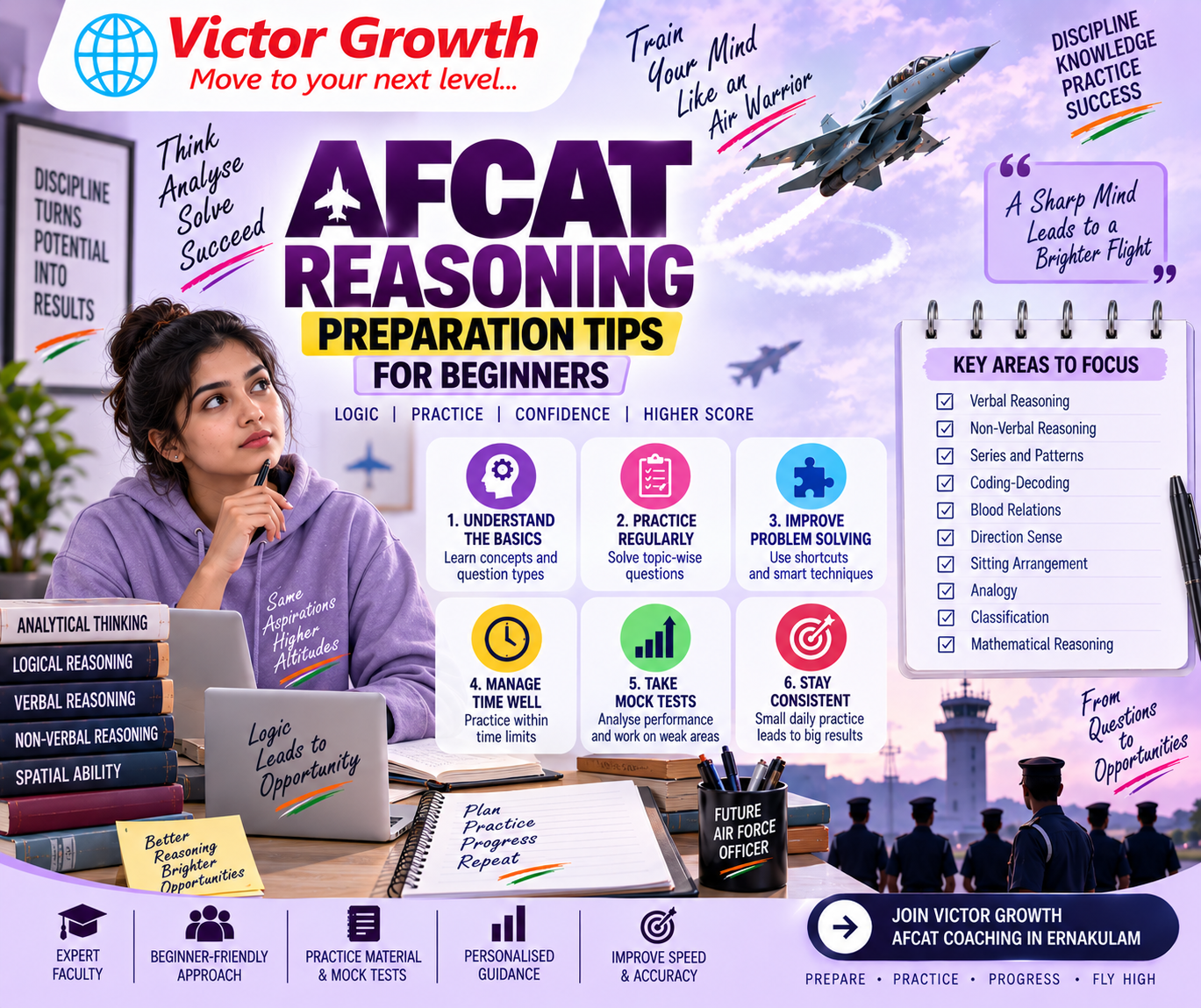
Reasoning is an important part of AFCAT preparation and requires candidates to think logically, identify patterns, and solve questions accurately within a limited time. Beginners may initially find some reasoning topics confusing, but regular practice and a structured approach can make them easier to handle.
For aspirants preparing in Ernakulam and other parts of Kerala, joining the best AFCAT coaching in Kerala can provide structured guidance, practice materials, mock tests, and expert support. However, consistent self-practice remains essential for improving reasoning skills.
Understand the AFCAT Reasoning Topics
Before starting preparation, become familiar with the major reasoning areas you may encounter.
Important topics include:
- Analogy
- Classification
- Series
- Coding-decoding
- Blood relations
- Direction sense
- Venn diagrams
- Syllogism
- Odd one out
- Ranking and ordering
- Non-verbal reasoning
- Figure-based questions
- Logical reasoning
Understanding the topics helps beginners create a systematic study plan.
1. Start with Basic Concepts
Beginners should not immediately start with difficult questions.
Start with simpler topics such as:
- Analogy
- Classification
- Number and alphabet series
- Coding-decoding
- Direction sense
Once the basic concepts become clear, gradually move towards more challenging question types.
The objective should be concept clarity first, speed later.
2. Practise One Topic at a Time
Avoid studying multiple reasoning topics randomly.
Choose one topic, understand its basic rules, and practise several questions.
For example:
Day 1–2: Analogy
Day 3–4: Classification
Day 5–6: Series
Day 7: Revision and test
This approach helps beginners understand different question patterns more easily.
3. Focus on Patterns
Reasoning questions often require you to identify a relationship or pattern.
When solving a question, ask yourself:
- What is changing?
- What is the relationship between the elements?
- Is there a sequence?
- Is there a logical rule?
- Can the options be eliminated?
Developing this habit can improve problem-solving ability.
4. Improve Speed Gradually
Beginners should not worry about speed during the initial learning stage.
First aim for:
Understanding → Accuracy → Speed
After becoming comfortable with a topic, start solving questions using a time limit.
This gradually develops the ability to solve reasoning questions under exam conditions.
5. Practise Daily
Reasoning is a skill that improves through regular practice.
Try solving a small set of questions every day rather than studying reasoning only once or twice a week.
A simple routine could include:
- 15 minutes concept learning
- 30 minutes question practice
- 15 minutes mistake analysis
Consistency is more important than studying for several hours occasionally.
6. Maintain a Mistake Notebook
Write down questions that you answered incorrectly or took too long to solve.
Record:
- The question type
- Your mistake
- Correct approach
- Important shortcut or rule
Review these mistakes regularly. This can help prevent repeated errors.
7. Practise Previous Questions and Mock Tests
Previous AFCAT questions and practice tests can help beginners become familiar with examination-style questions.
Start with topic-wise practice and then move towards:
- Sectional tests
- Mixed reasoning tests
- Full-length mock tests
After each test, analyse your performance rather than focusing only on the score.
How AFCAT Coaching Can Help Beginners
Beginners may find it difficult to understand which topics to study first and how much practice is required.
The best AFCAT coaching in Kerala can provide:
- Structured reasoning classes
- Concept-based teaching
- Topic-wise practice
- Problem-solving techniques
- Doubt-clearing sessions
- Regular tests
- Mock-test analysis
- Study materials
For students in Ernakulam, classroom coaching can also provide a disciplined learning environment and direct interaction with faculty.
Common Mistakes Beginners Should Avoid
Avoid these common mistakes:
- Starting with difficult questions
- Memorising shortcuts without understanding concepts
- Ignoring basic reasoning topics
- Practising only occasionally
- Focusing on speed before accuracy
- Not analysing mistakes
- Avoiding mock tests
- Spending too much time on one question
Simple Weekly Reasoning Plan
A beginner can follow a simple weekly schedule:
Monday: Analogy and classification
Tuesday: Series
Wednesday: Coding-decoding
Thursday: Blood relations and direction sense
Friday: Syllogism and logical reasoning
Saturday: Mixed practice
Sunday: Mock test and revision
The schedule can be adjusted according to individual strengths and weaknesses.
Final Thoughts
AFCAT reasoning preparation becomes easier when beginners follow a step-by-step approach. Start with basic concepts, practise one topic at a time, improve accuracy, and gradually develop speed.
For aspirants in Ernakulam, the best AFCAT coaching in Kerala can provide structured guidance, quality study materials, regular practice, and mock tests. Combining coaching with consistent self-study can help beginners build stronger reasoning skills and approach AFCAT preparation with greater confidence.
Frequently Asked Questions
1. Is reasoning difficult for AFCAT beginners?
Reasoning may seem difficult initially, but regular practice and understanding basic patterns can make the topics more manageable.
2. How should beginners start AFCAT reasoning preparation?
Start with basic topics such as analogy, classification, series, coding-decoding, and direction sense before moving to more challenging topics.
3. How much reasoning should I practise every day?
Around 45–60 minutes of focused practice can be a useful starting point. Increase the duration based on your preparation needs.
4. Should I learn shortcuts for reasoning?
Shortcuts can save time, but beginners should first understand the basic method. Once the concept is clear, appropriate shortcuts can be introduced.
5. Are mock tests important for reasoning?
Yes. Mock tests help improve speed, accuracy, time management, and familiarity with different question types.
6. Can coaching help beginners with AFCAT reasoning?
Yes. Coaching can provide structured lessons, faculty guidance, practice questions, doubt clarification, and regular tests.
7. What should I look for in the best AFCAT coaching in Kerala?
Look for experienced faculty, concept-based teaching, AFCAT-focused materials, regular practice, mock tests, doubt-clearing support, and performance analysis.