
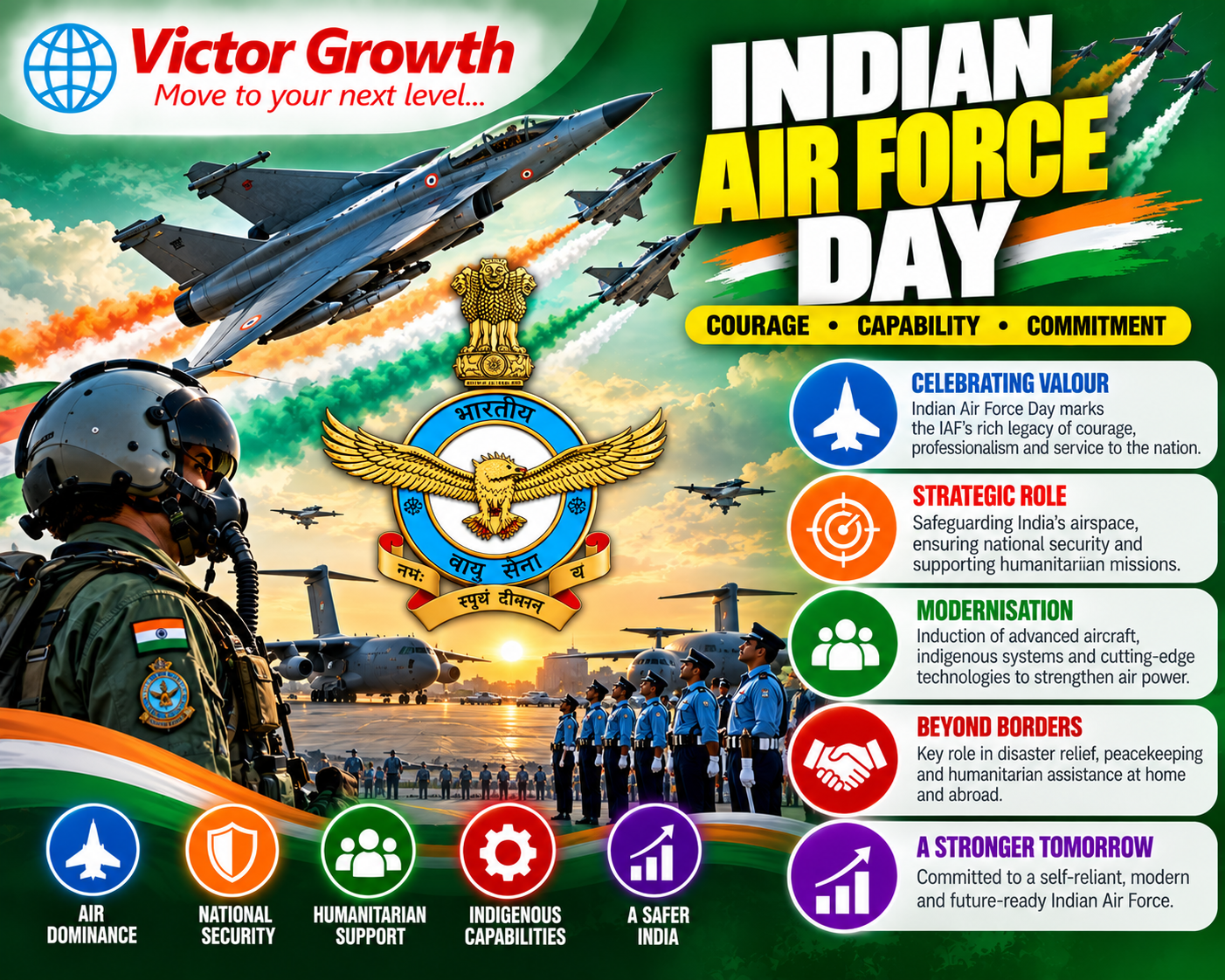
India is celebrating Indian Air Force Day on 8 October 2026, honouring the courage, professionalism and service of the Indian Air Force (IAF) and its personnel. Prime Minister Narendra Modi extended greetings to the Air Warriors and highlighted their commitment to protecting India’s skies.
The occasion marks the 94th anniversary of the Indian Air Force, which was officially established on 8 October 1932.
History of the Indian Air Force
The Indian Air Force was established on 8 October 1932 as an auxiliary air force of the British Royal Air Force.
Its first operational flight took place on 1 April 1933 with six RAF-trained officers, 19 airmen and four Westland Wapiti aircraft at Drigh Road, Karachi.
During World War II, the force was known as the Royal Indian Air Force. After India became a Republic in 1950, the prefix “Royal” was dropped and it became the Indian Air Force.
Role of the Indian Air Force
The IAF plays a crucial role in India’s national security through:
Air defence and protection of India’s airspace
Strategic and tactical air operations
Air superiority and precision strikes
Intelligence, surveillance and reconnaissance
Transport and logistical support
Humanitarian Assistance and Disaster Relief (HADR)
Evacuation of civilians during emergencies
Support to joint military operations
The IAF has also demonstrated its capabilities through international exercises and cooperation with friendly air forces.
IAF and Modern Warfare
The nature of warfare is rapidly changing with the increasing importance of:
Unmanned Aerial Vehicles (UAVs) and drones
Artificial Intelligence
Cyber and electronic warfare
Space-based surveillance
Network-centric warfare
Long-range precision weapons
Integrated air and missile defence
The IAF has been pursuing modernisation and indigenous capability development, including advanced aircraft, weapons, electronic warfare systems and AI-enabled technologies. The government has also emphasised Aatmanirbhar Bharat in defence production.
IAF and Indigenous Defence
Indigenisation is increasingly important for India’s aerospace and defence capabilities.
Platforms such as Tejas Light Combat Aircraft, along with indigenous radar, missiles and other systems, form part of India’s effort to reduce dependence on imports and develop a stronger domestic defence-industrial ecosystem.
The IAF has also encouraged innovation in areas such as drone technology, artificial intelligence and autonomous systems.
Humanitarian Role
The Indian Air Force is not limited to combat operations. It is an important first responder during natural disasters and humanitarian emergencies.
Its transport aircraft and helicopters are used for:
Rescue operations
Medical evacuation
Delivery of relief material
Evacuation from conflict zones
Disaster response in remote and inaccessible areas
This makes air power an important component of India’s broader disaster-management and humanitarian-response capabilities.
Why is Air Force Day Important?
Air Force Day provides an opportunity to recognise the contribution of India’s air warriors and highlight the importance of aerospace power in national security.
For India, maintaining credible air power is particularly important because of its complex security environment and long land and maritime borders.
Modernisation, indigenous production, technological innovation and integration of the armed forces will therefore remain key priorities for India’s future air power.
UPSC Relevance
Prelims
Important facts to remember:
Air Force Day: 8 October
Indian Air Force established: 8 October 1932
First operational flight: 1 April 1933
First operational base: Drigh Road, Karachi
IAF became part of independent India’s armed forces: 1947
“Royal” prefix dropped: 1950
Mains – GS Paper III
The topic is relevant to:
Defence and national security
Modernisation of armed forces
Defence indigenisation
Aerospace technology
Artificial Intelligence in warfare
Drone and counter-drone systems
Civil-military integration
Humanitarian Assistance and Disaster Relief
Possible UPSC Mains Question
“Air power is becoming increasingly decisive in modern warfare. Discuss the major technological and strategic challenges before the Indian Air Force in maintaining air superiority.”
Conclusion
Indian Air Force Day commemorates the long journey of the IAF from its establishment in 1932 to a modern aerospace force. As warfare becomes increasingly technology-driven and multi-domain, India’s air power will remain critical to national security.
For UPSC aspirants, Air Force Day provides an opportunity to connect defence modernisation, indigenous technology, emerging warfare, national security and disaster management.