| +25 bps | |
| SDF Rate | 5.25% |
| MSF Rate | 5.75% |
| Bank Rate | 5.75% |
| Policy Stance | Calibrated tightening |
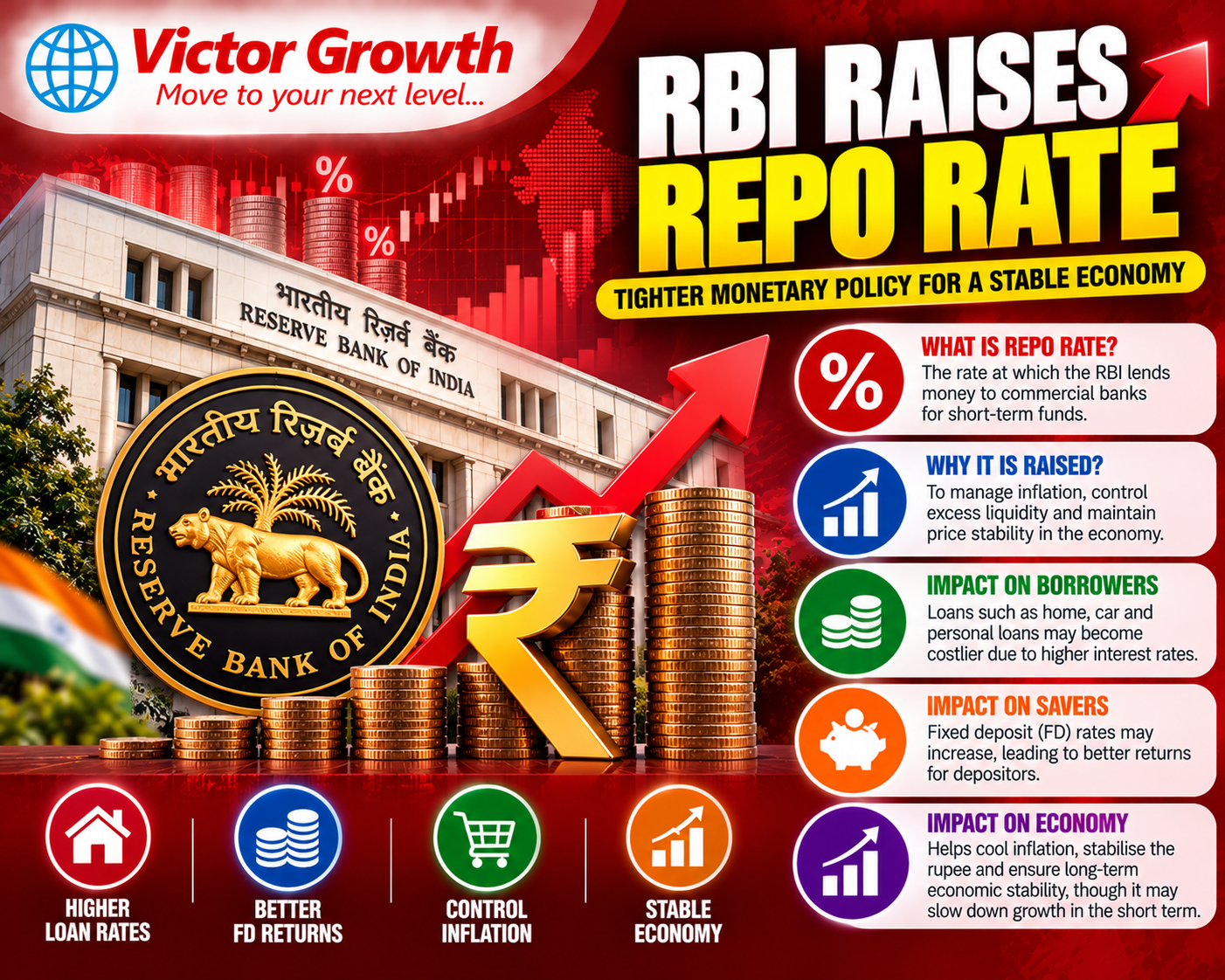
The repo rate increase was unanimous, while four of the six MPC members supported changing the stance to calibrated tightening.
Why Did RBI Raise the Repo Rate?
1. Rising Inflationary Pressures
CPI inflation increased to 4.82% in August 2026 from 4.45% in July. Food prices became more broad-based, while core inflation also increased.
The RBI has projected CPI inflation for FY 2026-27 at 5.2%, with inflation expected to remain elevated in the coming quarters.
2. Food and Energy Risks
A deficient southwest monsoon, El Niño conditions and volatility in international crude oil prices have increased the risk of higher inflation.
Higher energy prices can also raise transportation and production costs, creating broader inflationary pressures.
3. Weakening Rupee
Depreciation of the Indian rupee can make imported goods, particularly crude oil and other commodities, more expensive. This can add to domestic inflation.
4. Preventing Second-Round Effects
The RBI is also concerned that temporary supply-side price shocks could become embedded in inflation expectations and business pricing behaviour.
Monetary policy therefore aims to prevent temporary inflation from becoming persistent.
Growth Outlook
Despite the rate hike, the RBI remains positive about India’s economic growth.
It has projected real GDP growth for FY 2026-27 at 7.1%.
Quarterly projections include:
Q2: 7.2%
Q3: 6.9%
Q4: 6.8%
Strong services activity, credit growth, infrastructure investment and domestic demand are expected to support economic activity.
Impact of the Repo Rate Hike
On Loans
Banks may increase lending rates, making:
Home loans
Vehicle loans
Personal loans
Business loans
more expensive, particularly for borrowers with floating-rate loans.
On Inflation
Higher borrowing costs can reduce excess demand and help moderate inflation over time.
On Savings
Higher interest rates can potentially improve returns on bank deposits and other interest-bearing instruments.
On Investment
Higher borrowing costs may discourage some private investment. Therefore, the RBI must balance price stability with economic growth.
What is “Calibrated Tightening”?
A calibrated tightening stance indicates that monetary policy is moving towards controlling inflation and preventing further price pressures.
The RBI has indicated that near-term rate cuts are off the table and future action will depend on the evolution of inflation and growth.
Monetary Policy Committee and Inflation Targeting
The MPC is a six-member committee responsible for determining the policy interest rate needed to achieve the inflation target.
Under India’s flexible inflation-targeting framework, the CPI inflation target is 4% with a tolerance band of ±2 percentage points, meaning a range of 2% to 6%.
The MPC framework was institutionalised through amendments to the RBI Act, 1934, following the Finance Act, 2016.
UPSC Relevance
Prelims
Important facts:
Repo rate → Rate at which RBI lends short-term funds to banks
October 2026 repo rate → 5.50%
Increase → 25 basis points
New stance → Calibrated tightening
MPC → Six-member body
CPI inflation target → 4% ± 2%
RBI Act → 1934
Mains – GS Paper III
The topic is relevant to:
Monetary policy
Inflation management
RBI and banking system
Economic growth
Flexible inflation targeting
Financial stability
Exchange-rate management
Transmission of monetary policy
Possible UPSC Mains Question
“The RBI’s decision to raise the repo rate reflects the challenge of balancing price stability with economic growth. Discuss the transmission mechanism of monetary policy and the limitations of monetary policy in controlling supply-side inflation.”
Conclusion
The RBI’s decision to raise the repo rate to 5.50% marks a significant shift in India’s monetary policy cycle. With inflationary risks increasing because of food prices, energy costs, weather conditions and external uncertainties, the RBI has prioritised price stability while maintaining confidence in India’s growth prospects.
For UPSC aspirants, the development should be studied through the broader themes of inflation targeting, monetary policy transmission, RBI functions, growth-inflation trade-off and financial stability.