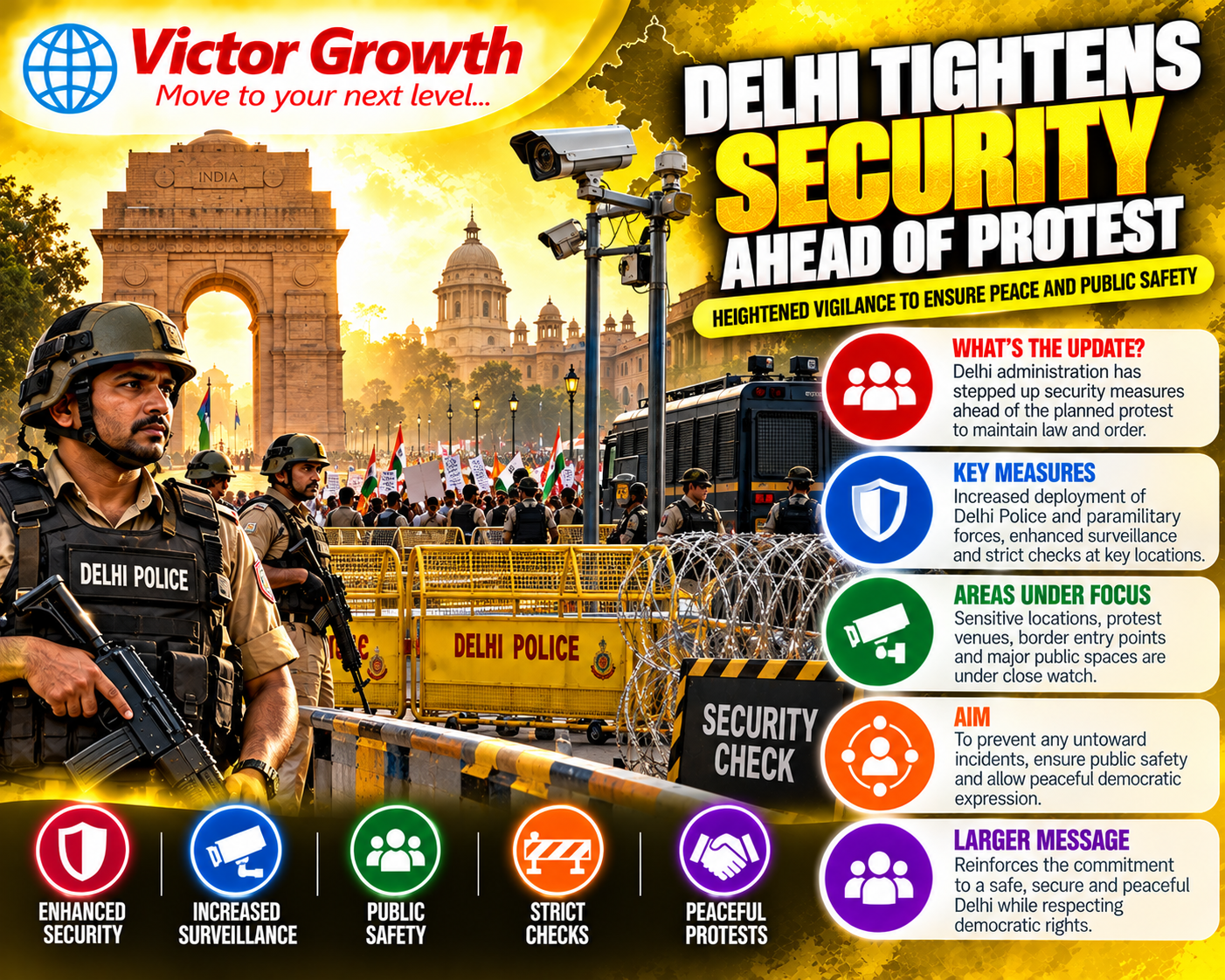
Delhi authorities tightened security ahead of a protest scheduled for 10 October 2026 at Jantar Mantar, organised by the Cockroach Janta Party (CJP) and supporters. The demonstration seeks the resignation of Chief Election Commissioner Gyanesh Kumar over allegations relating to the Special Intensive Revision (SIR) of electoral rolls. The Election Commission has rejected allegations of political manipulation. <Cite refs={[“turn619377news18″,”turn619377search0”]}/>
Key Security Measures
According to news reports, authorities introduced several measures to manage the proposed gathering and maintain public order:
Heavy deployment: Thousands of police and security personnel were deployed across the capital.
Restrictions on gatherings: Prohibitory orders were imposed in sensitive areas under Section 163 of the Bharatiya Nagarik Suraksha Sanhita (BNSS), 2023.
Transport restrictions: Metro access was restricted at several stations, and some train services were cancelled or affected.
Barricades and checkpoints: Police established checkpoints, traffic diversions and temporary detention facilities.
Protest permission: Delhi Police denied permission for the proposed demonstration, citing procedural and public-order concerns. <Cite refs={[“turn619377news18″,”turn619377search1″,”turn619377search0”]}/>
What Is the Special Intensive Revision (SIR)?
The Special Intensive Revision is an exercise undertaken by the Election Commission of India to verify and update electoral rolls. Its purpose is to improve the accuracy of voter lists by identifying eligible voters and addressing entries that may be duplicate, outdated or otherwise ineligible.
However, the exercise has generated controversy, with critics raising concerns about the possible exclusion of eligible voters. The Election Commission maintains that the process is intended to ensure accurate electoral rolls.
Constitutional and Legal Significance
The incident highlights the need to balance public order with democratic freedoms.
1. Right to Peaceful Assembly
Article 19(1)(b) of the Constitution guarantees citizens the right to assemble peacefully and without arms. Under Article 19(3), reasonable restrictions may be imposed in the interests of public order and the sovereignty and integrity of India.
2. Role of the Administration
Police and civil authorities are responsible for preventing violence, managing crowds and protecting public safety. Restrictions should have a lawful basis and be proportionate to the situation.
3. Electoral Democracy
Accurate electoral rolls are essential for free and fair elections. At the same time, transparent procedures and accessible grievance-redressal mechanisms are important to protect eligible voters from wrongful exclusion.
4. Judicial Oversight
Courts play an important role in examining whether restrictions imposed by public authorities comply with constitutional rights and applicable law. Reports indicated that the Supreme Court urged authorities to reconsider transport restrictions and preserve public access to essential services. <Cite refs={[“turn619377news17”]}/>
Challenges Ahead
The main challenges include preventing violence without unnecessarily restricting peaceful dissent, ensuring that electoral-roll revisions remain transparent, reducing disruption to commuters and protecting citizens’ fundamental rights.
Effective communication between police, protest organisers and the public can help reduce tensions and support peaceful democratic participation.
UPSC Exam Relevance
Prelims: Articles 19(1)(b) and 19(3), BNSS 2023, Election Commission of India and electoral-roll revision.
GS Paper II: Fundamental Rights, constitutional bodies, electoral reforms and democratic accountability.
GS Paper III: Internal security, public order and crowd management.
Possible UPSC Mains Question: How can the state maintain public order while protecting the fundamental right to peaceful assembly? Discuss with reference to constitutional provisions.
Conclusion
The security arrangements in Delhi highlight a key democratic challenge: maintaining public order while safeguarding the right to peaceful protest. Transparent electoral processes, proportionate restrictions and effective grievance-redressal mechanisms are essential for strengthening public trust in democratic institutions.