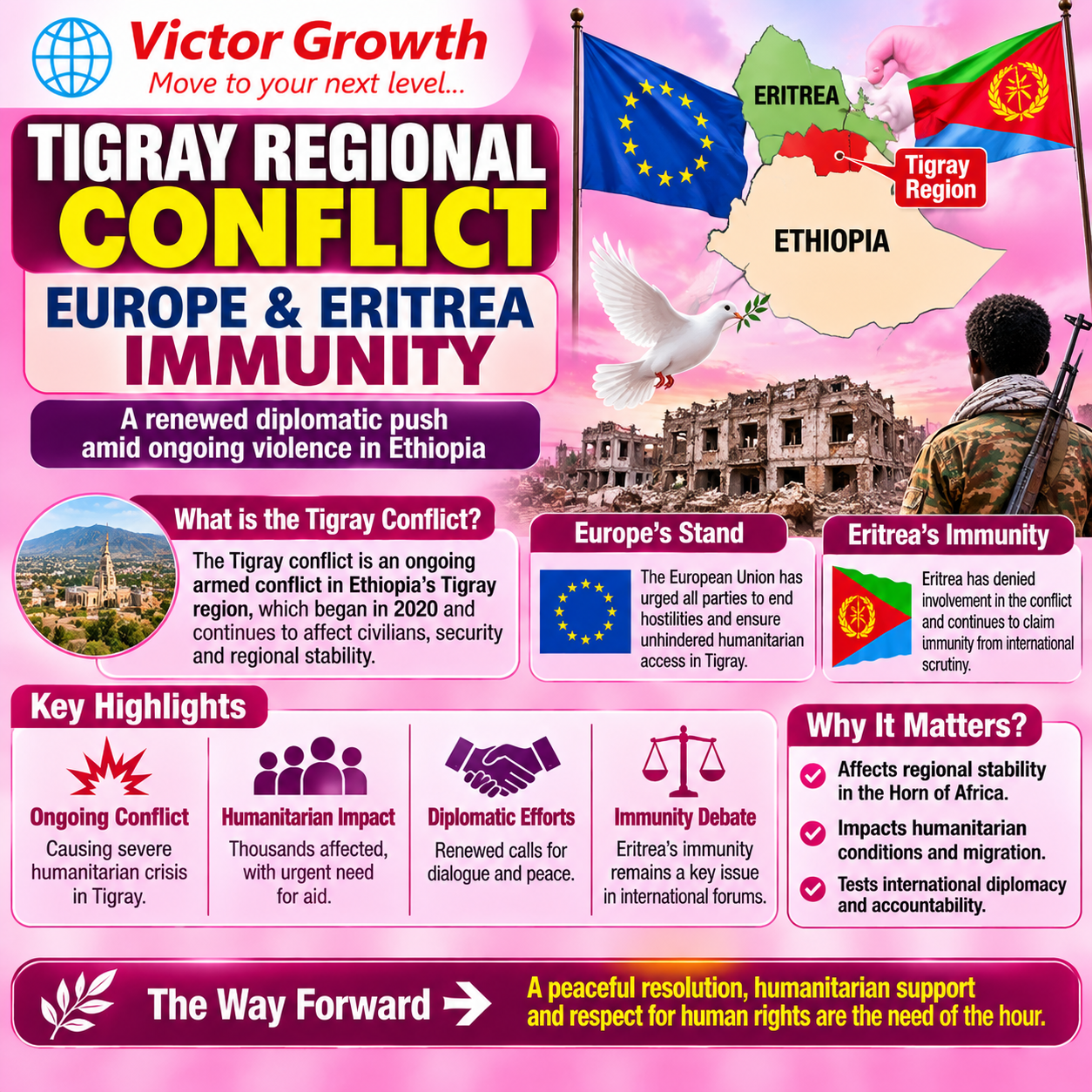
Renewed fighting in Ethiopia’s Tigray region in September–October 2026 has heightened tensions between Ethiopia and neighbouring Eritrea. Both countries have exchanged accusations of military aggression, raising fears that an internal conflict could escalate into a wider regional war in the Horn of Africa. The United Nations has called for an immediate cessation of hostilities and a return to dialogue.
Background: Understanding the Tigray Conflict
Tigray is a region in northern Ethiopia that shares a border with Eritrea. The Tigray People’s Liberation Front (TPLF) has played a major role in Ethiopian politics and has been involved in prolonged tensions with the federal government.
2020–2022 conflict: Fighting between Ethiopia’s federal government and TPLF forces caused extensive destruction, displacement and a severe humanitarian crisis.
Pretoria Agreement (November 2022): Brokered by the African Union (AU), the agreement aimed to end hostilities, restore services and establish a framework for peace.
Renewed instability in 2026: Disputes over the implementation of the agreement, political authority and security arrangements have contributed to renewed fighting.
Why Are Ethiopia and Eritrea in Conflict?
1. Historical rivalry
Eritrea gained independence from Ethiopia in 1993. The two countries fought a devastating border war between 1998 and 2000. Although relations improved in 2018, mutual distrust has persisted.
2. Disputes over Tigray
Ethiopia has accused Eritrea of supporting armed groups and sending troops into Ethiopian territory. Eritrea has rejected the accusations and accused Ethiopia of threatening its sovereignty. These claims remain contested.
3. Access to the Red Sea
Ethiopia is landlocked and seeks reliable access to maritime trade routes. Eritrea controls important Red Sea ports, including Assab. Ethiopia’s interest in obtaining sea access has increased Eritrea’s security concerns.
4. Incomplete peace process
The Pretoria Agreement reduced large-scale fighting but did not resolve all political, territorial and security disputes. Weak implementation and mistrust have made lasting peace difficult.
Strategic Importance of the Horn of Africa
The Horn of Africa occupies a strategically important position near the Red Sea and the Bab-el-Mandeb Strait, a major global maritime chokepoint connecting the Red Sea with the Gulf of Aden.
A wider conflict could:
Disrupt international shipping and trade.
Intensify competition among regional and external powers.
Increase refugee flows and humanitarian needs.
Destabilise neighbouring countries, including Sudan and Somalia.
Complicate maritime security in the western Indian Ocean.
Major Challenges
Humanitarian crisis: Renewed fighting threatens civilians, food security, healthcare and the return of displaced people.
Regional escalation: Military involvement by neighbouring states could turn an internal conflict into an interstate war.
Diplomatic breakdown: Deteriorating relations reduce opportunities for peaceful negotiations.
International law concerns: Cross-border military action and threats to territorial integrity raise questions under the UN Charter and international humanitarian law.
Way Forward
Revive AU-led mediation: Ethiopia and the TPLF should return to negotiations under the Pretoria framework, with support from the African Union.
Prevent interstate war: Ethiopia and Eritrea must respect sovereignty and territorial integrity and avoid unilateral military escalation.
Strengthen monitoring: Credible mechanisms are needed to investigate allegations of cross-border incursions.
Prioritise civilians: Ensure humanitarian access, protect civilians and facilitate the safe return of displaced people.
Resolve maritime disputes peacefully: Ethiopia’s need for sea access should be addressed through negotiated arrangements that respect the sovereignty of coastal states.
Support regional diplomacy: The United Nations and regional partners should encourage dialogue and confidence-building measures.
UPSC Examination Relevance
Prelims: Horn of Africa, Tigray region, Ethiopia, Eritrea, Red Sea, Bab-el-Mandeb Strait, African Union and Pretoria Agreement.
Mains:
GS Paper II: International relations, regional organisations and India’s engagement with Africa.
GS Paper II: United Nations, international law and conflict resolution.
GS Paper III: Maritime security, global trade routes and regional instability.
Possible UPSC Mains Question:
“Examine the causes and regional implications of renewed tensions between Ethiopia and Eritrea. Suggest measures to prevent escalation in the Horn of Africa.”
Conclusion
The Tigray conflict demonstrates how unresolved internal disputes can threaten regional peace. A sustainable solution requires inclusive political dialogue, implementation of existing peace commitments and respect for national sovereignty. Preventing a wider Ethiopia–Eritrea conflict is essential for humanitarian stability and security along the Red Sea.