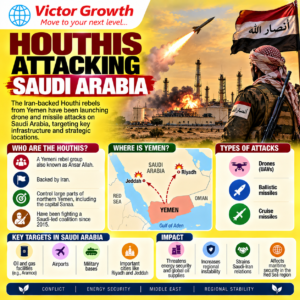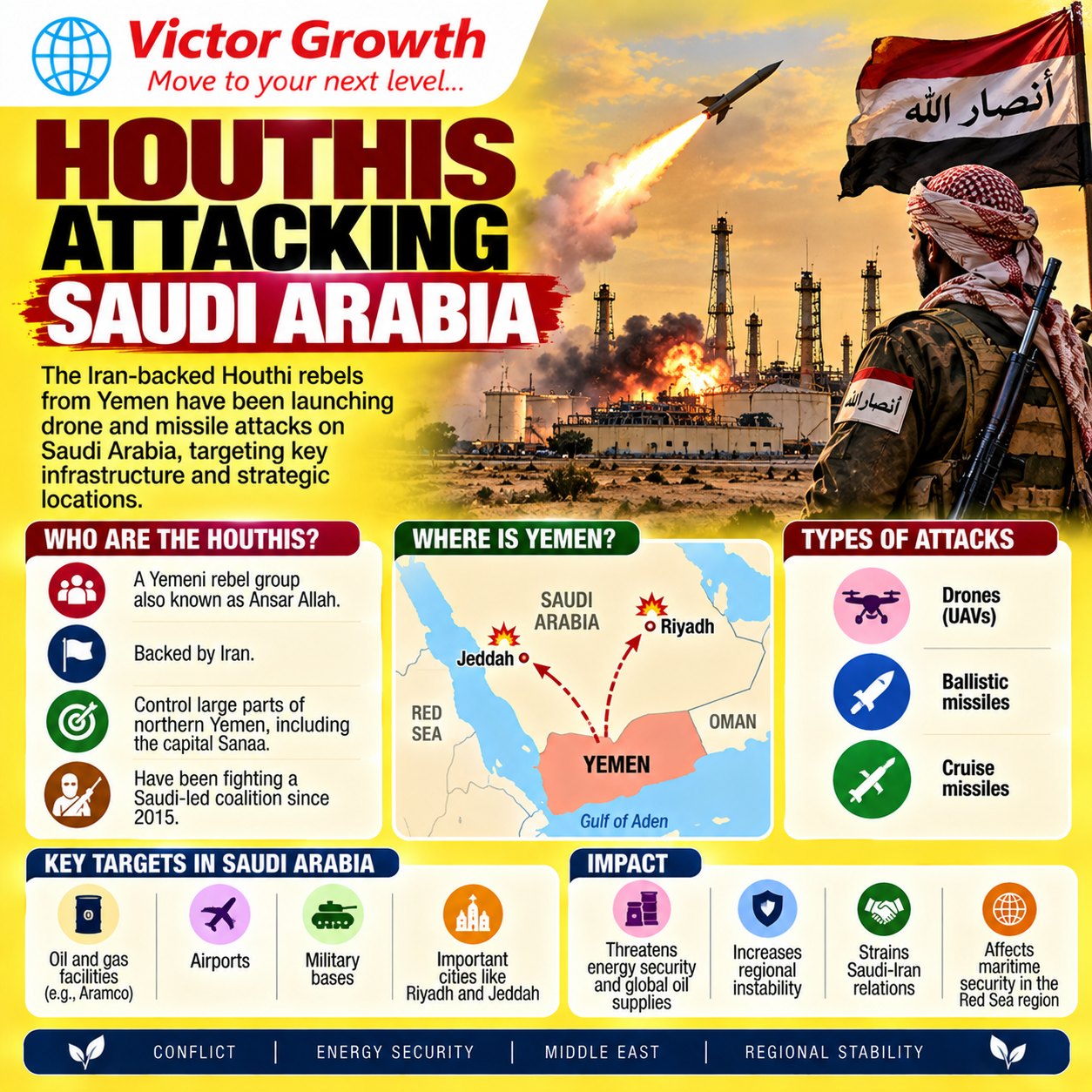
Saudi Arabia has faced renewed missile and drone attacks claimed by Yemen’s Houthi movement in October 2026. Recent incidents have involved airports, military facilities and energy infrastructure. Saudi air defences have intercepted several projectiles, while some reported attacks have caused civilian casualties and disrupted aviation. India has condemned attacks on civilian and critical infrastructure. <Cite refs={[“turn771834news4″,”turn771834news16”]}/>
Who Are the Houthis?
The Houthis, officially known as Ansar Allah, are an armed political and religious movement originating in northern Yemen. They follow the Zaydi branch of Shia Islam and control Yemen’s capital, Sanaa, along with significant parts of the country.
The movement receives support from Iran, although its capabilities and decision-making also reflect its own local interests.
Why Are the Houthis Attacking Saudi Arabia?
1. Yemen’s civil war
Saudi Arabia intervened in Yemen’s civil war in 2015, leading a coalition supporting Yemen’s internationally recognised government against the Houthis. The conflict has caused extensive destruction and a prolonged humanitarian crisis.
2. Regional geopolitical rivalry
Saudi Arabia and Iran have competed for influence across West Asia. Houthi attacks have become part of this wider regional rivalry, increasing the risk of escalation beyond Yemen.
3. Renewed fighting in Yemen
The breakdown of a fragile period of relative calm and intensified fighting between Houthi forces and Saudi-backed Yemeni government forces have contributed to the renewed attacks.
4. Strategic and economic pressure
Targeting airports, oil installations and other critical facilities can disrupt economic activity, undermine public confidence and place pressure on Saudi Arabia to change its policies.
Why Is the Red Sea Region Strategically Important?
The Red Sea connects to the Gulf of Aden through the Bab-el-Mandeb Strait, a major maritime chokepoint linking the Mediterranean and Indian Ocean trade routes through the Suez Canal.
Instability in this region can:
Disrupt international shipping and increase freight and insurance costs.
Threaten global energy supplies and raise oil-price volatility.
Increase military deployments by regional and external powers.
Affect trade between Asia and Europe.
Complicate maritime security across the western Indian Ocean.
Implications for India
Energy security: Disruption to oil infrastructure and maritime routes could increase energy costs.
Trade: Shipping delays and higher insurance premiums may affect Indian exports and imports.
Indian diaspora: Indian nationals living and working in Saudi Arabia and neighbouring countries face heightened security risks.
Maritime security: India has a strategic interest in protecting freedom of navigation and maintaining stability in the Arabian Sea and western Indian Ocean.
Diplomacy: India must balance strong ties with Saudi Arabia, relations with Iran and its broader commitment to regional peace.
Way Forward
Diplomatic engagement: Encourage dialogue involving Saudi Arabia, Iran, Yemen’s parties and relevant regional stakeholders.
Protection of civilians: Attacks on civilians and civilian infrastructure must cease in accordance with international law.
Secure maritime routes: Strengthen international cooperation to protect commercial shipping and freedom of navigation.
Humanitarian assistance: Ensure safe access for aid agencies and support civilians affected by Yemen’s conflict.
De-escalation: A sustainable political settlement in Yemen is essential to prevent a wider regional confrontation.