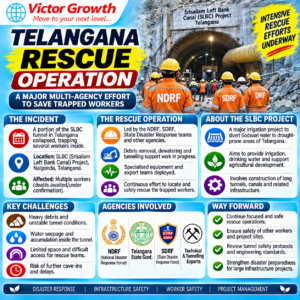
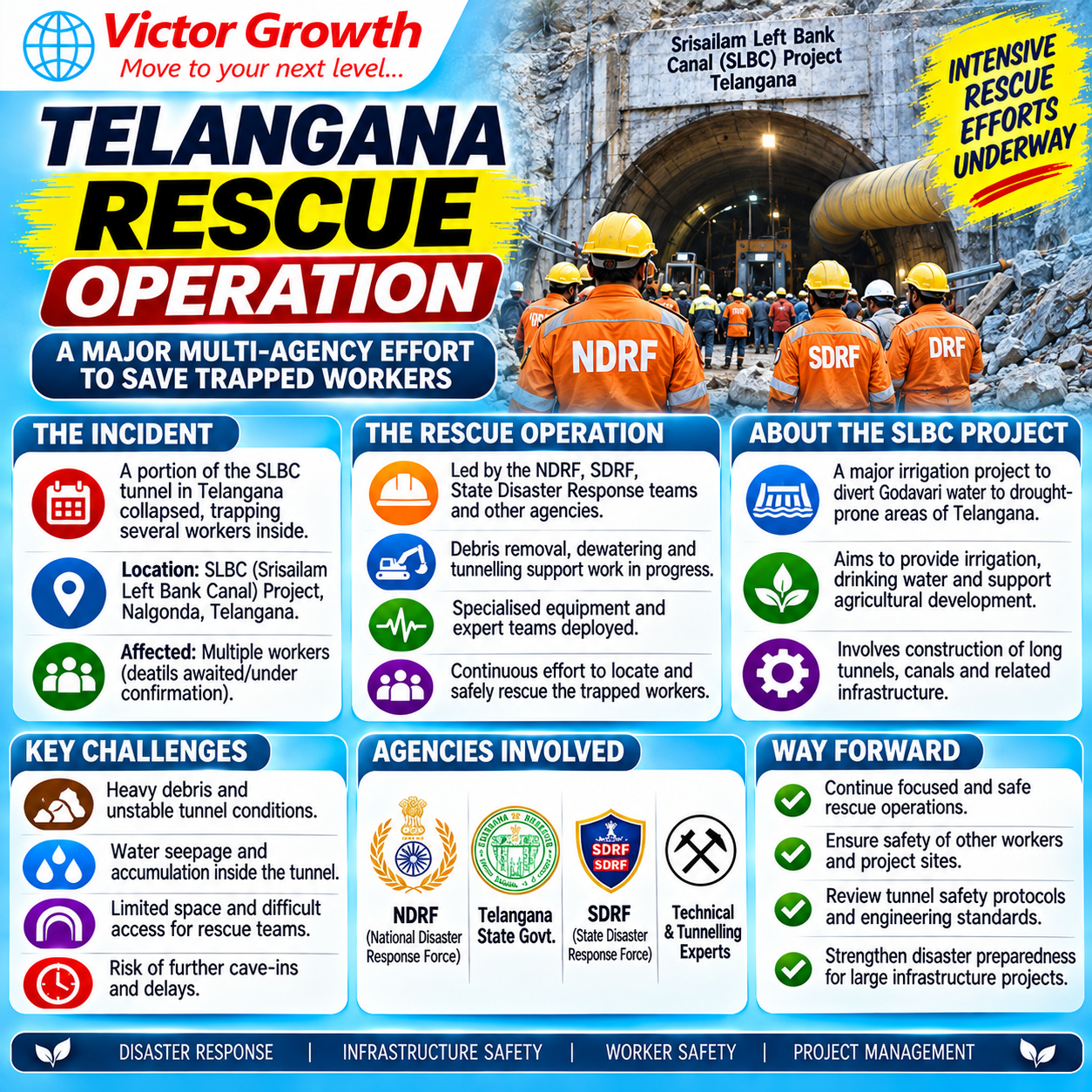
A major rescue operation was launched at Bethupalli Lake in Sathupalli mandal of Khammam district, Telangana, on 4 November 2026, after heavy rainfall caused the water body to overflow and fishermen became stranded in floodwaters.
During the rescue attempt, two boats carrying State Disaster Response Force (SDRF) and Fire Services personnel capsized in strong currents. The National Disaster Response Force (NDRF), along with other agencies, launched an extensive search and rescue operation.
By the morning of 5 November, the stranded fishermen and the missing rescue personnel had been safely recovered, with no casualties reported.
The incident highlights the importance of disaster preparedness, inter-agency coordination and safety protocols for rescue personnel during extreme weather events.
What Happened in Telangana?
Heavy rainfall associated with Cyclone Murasu caused the Bethupalli tank to overflow.
Fishermen became stranded in the swollen water body amid strong currents.
Local Fire Services and SDRF teams attempted to rescue them using boats.
Two rescue boats capsized during the operation, leaving several rescue personnel missing.
NDRF teams joined the operation and used boats, communication support and coordinated search efforts.
All stranded fishermen and missing rescue personnel were subsequently rescued safely.
The incident demonstrates that rescue operations themselves can become high-risk activities when water levels rise rapidly and currents become unpredictable.
Understanding India’s Disaster Response Forces
India has a multi-level disaster response system involving national, state and district authorities.
1. National Disaster Response Force (NDRF)
The NDRF is a specialised force established under the Disaster Management Act, 2005.
Its major responsibilities include:
Search and rescue during floods, cyclones, earthquakes and other disasters.
Deployment of specialised equipment and trained personnel.
Support for evacuation and emergency response.
Training and capacity-building for disaster management.
2. State Disaster Response Force (SDRF)
State governments establish and operate SDRF units to respond to disasters within their jurisdictions.
Their responsibilities include:
Local search and rescue operations.
Flood and water rescue.
Emergency evacuation.
Coordination with district administrations and the NDRF.
3. District Disaster Management Authority (DDMA)
The DDMA coordinates disaster response at the district level under the leadership of the District Collector or District Magistrate.
It plays an important role in evacuation, relief distribution, emergency communication and coordination among departments.
Why Are Flood Rescue Operations Challenging?
Flood rescue operations involve complex geographical and operational challenges.
1. Strong water currents: Overflowing tanks, rivers and reservoirs can create dangerous currents that make boat operations difficult.
2. Sudden rise in water levels: Heavy rainfall in catchment areas can cause rapid changes in water levels, leaving little time for evacuation.
3. Poor visibility: Night-time operations, rain and debris can make locating stranded people difficult.
4. Equipment limitations: Rescue boats, communication devices and protective equipment must be suitable for the prevailing conditions.
5. Risk to rescue personnel: First responders face significant risks while operating in unstable and rapidly changing environments.
Lessons for India’s Disaster Management System
The Telangana incident highlights several important priorities:
Early warning systems: Improve rainfall forecasting, reservoir monitoring and local flood alerts.
Rescue personnel safety: Ensure suitable boats, life jackets, communication equipment and risk assessments before deployment.
Technology integration: Use drones, satellite imagery, GPS tracking and emergency communication systems.
Community awareness: Educate fishermen and local residents about avoiding water bodies during dangerous weather conditions.
Inter-agency coordination: Strengthen cooperation among NDRF, SDRF, Fire Services, police and district administrations.
Regular training: Conduct mock drills and specialised flood-rescue exercises.
Disaster Management in India: Institutional Framework
The Disaster Management Act, 2005 provides the institutional framework for disaster management in India.
| Institution | Major Role |
|---|---|
| NDMA | National-level policy, plans and guidelines |
| NDRF | Specialised disaster response and rescue |
| SDMA | State-level disaster management |
| SDRF | State-level response and rescue |
| DDMA | District-level coordination |
The National Disaster Management Plan provides an overarching framework for prevention, mitigation, preparedness, response and recovery.
India’s disaster management approach increasingly emphasises the Sendai Framework for Disaster Risk Reduction (2015–2030), which promotes reducing disaster risks and strengthening resilience.
UPSC Examination Relevance
Prelims
Disaster Management Act, 2005
Functions of NDRF and SDRF
National Disaster Management Authority
Role of District Disaster Management Authorities
Sendai Framework for Disaster Risk Reduction
Mains – GS Paper III
Disaster and disaster management
Flood preparedness and mitigation
Role of technology in disaster response
Institutional coordination and capacity-building
Climate change and extreme weather events
Possible UPSC Mains Question:
“Recent rescue operations during extreme rainfall events highlight the operational risks faced by disaster response personnel. Discuss the importance of preparedness, technology and institutional coordination in effective flood management.”
Conclusion
The Telangana rescue operation demonstrates the courage and commitment of India’s disaster response personnel. It also underlines the need for stronger preparedness, advanced rescue equipment and effective coordination among national, state and district agencies. As extreme weather events become an increasing concern, India must move towards a proactive, technology-driven and community-centred disaster management system.