Current affairs play an important role in UPSC Civil Services Preliminary Examination preparation. Questions are connected to national and international developments, government policies, economic issues, environmental concerns, science and technology, and important reports. For beginners, the challenge is not just reading the news but identifying relevant information, understanding it, and revising it regularly.
A systematic approach can help aspirants prepare current affairs without spending too much time on unnecessary information. This guide explains how to prepare current affairs effectively for UPSC Prelims 2027.
1. Understand the Importance of Current Affairs
Current affairs help candidates connect theoretical concepts with real-world developments. Many news events are linked to static subjects such as Polity, Economy, Geography, History, and Environment.
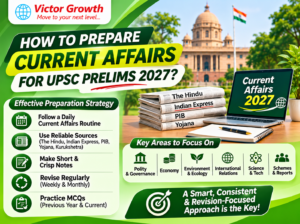
Focus on these important areas:
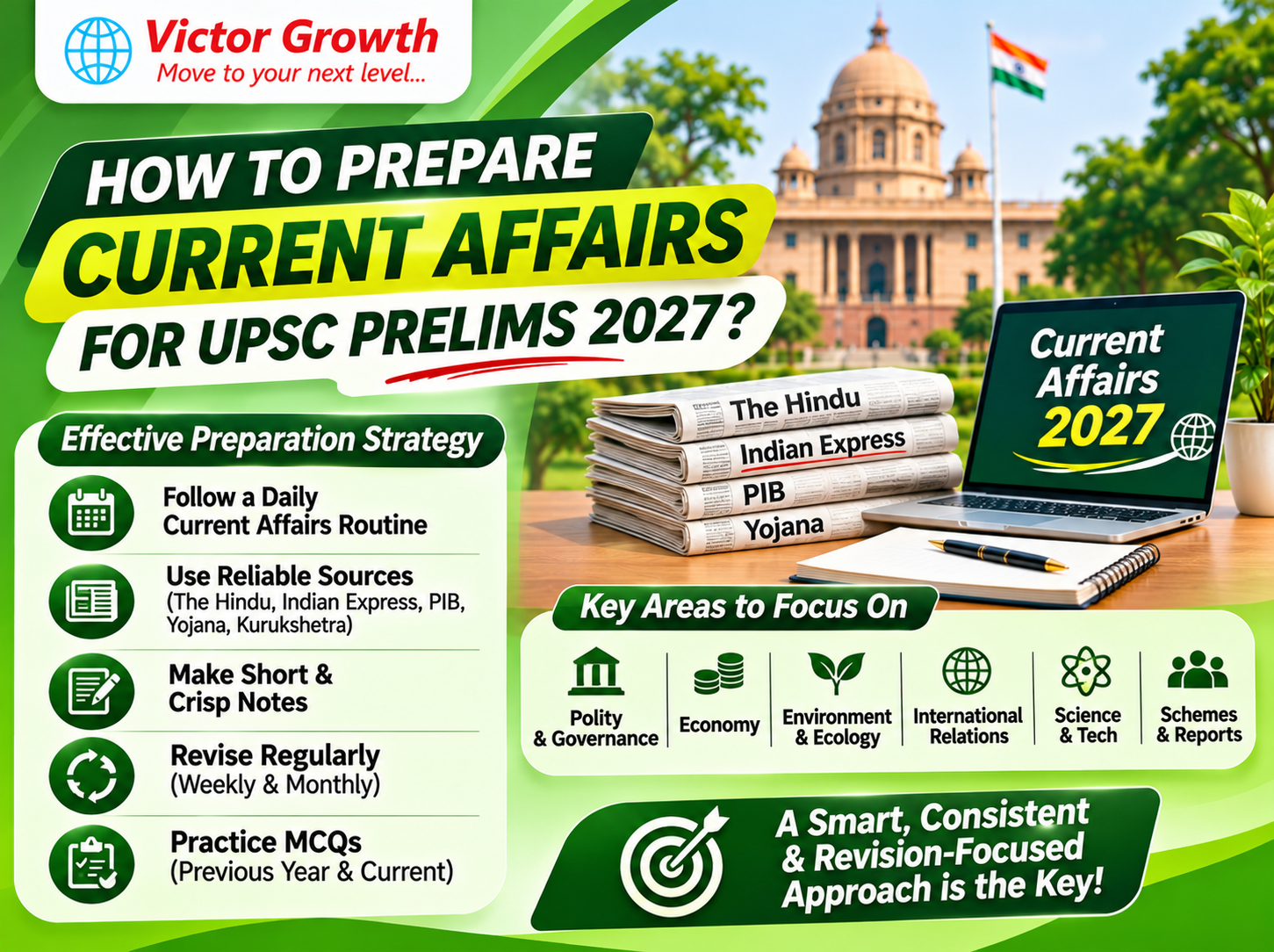
National Affairs: Government schemes, policies, constitutional developments, and important appointments.
International Relations: International organisations, summits, agreements, and India’s relations with other countries.
Economy: Union Budget, inflation, banking, taxation, and economic developments.
Environment: Climate change, biodiversity, conservation programmes, and environmental conventions.
Science and Technology: Space missions, biotechnology, artificial intelligence, and defence technology.
Reports and Indices: Important national and international reports, rankings, and publishing organisations.
2. Choose Reliable Sources for Current Affairs
One common mistake among UPSC aspirants is referring to too many newspapers, websites, and monthly magazines. Instead, select a few reliable sources and follow them consistently.
Recommended sources include:
The Hindu or The Indian Express: For important national and international news and editorials.
Press Information Bureau (PIB): For government announcements, policies, and schemes.
Monthly Current Affairs Magazines: For organised revision of important events.
Government Websites: For authentic information about policies, reports, and official initiatives.
Previous-Year Question Papers: To understand how current affairs are connected to the UPSC syllabus.
Avoid reading every news item. Give priority to information relevant to the examination syllabus.
3. Develop a Daily Newspaper Reading Habit
Reading a newspaper for around 30–45 minutes daily is a useful starting point. Focus on understanding important developments rather than memorising every detail.
While reading, pay attention to:
What happened?
Why is it important?
Which organisation or government body is involved?
Is it connected to any static subject?
What are its possible implications?
Skip unnecessary political statements, local crime reports, entertainment news, and routine announcements unless they have clear examination relevance.
4. Make Short and Effective Current Affairs Notes
Preparing notes makes revision easier, especially when the examination approaches. Avoid copying entire newspaper articles.
Organise your notes under subject-wise headings:
| Subject | Important current affairs |
|---|---|
| Polity | Constitutional amendments, Supreme Court judgments, new laws |
| Economy | Budget, inflation, RBI policies, government schemes |
| Environment | National parks, species, climate agreements |
| Geography | Natural disasters, important locations, geographical developments |
| Science and Technology | Space missions, AI, biotechnology |
| International Relations | Summits, agreements, international organisations |
Write only important facts, background information, and key developments. Keep your notes concise and easy to revise.
5. Follow Monthly Current Affairs Revision
Daily newspaper reading provides updated information, while monthly compilations help organise important events.
Follow this revision strategy:
Daily: Read important news and prepare short notes.
Weekly: Revise the week’s important topics.
Monthly: Study a reliable current affairs compilation and solve related MCQs.
Before the examination: Revise consolidated notes, important facts, reports, schemes, and previous-year questions.
Regular revision helps improve memory and reduces the pressure of last-minute preparation.
6. Practise Current Affairs MCQs and Mock Tests
Reading alone cannot ensure effective preparation. Aspirants should regularly practise objective questions to understand how UPSC tests current affairs knowledge.
Solve topic-wise current affairs MCQs.
Practise previous-year UPSC questions.
Attempt weekly quizzes.
Take full-length mock tests.
Analyse incorrect answers and revise related topics.
Do not focus only on memorising facts. Understand the background and concepts behind important developments.
7. Common Mistakes to Avoid
Many candidates spend excessive time on current affairs without following a proper strategy. Avoid these mistakes:
Reading multiple newspapers every day.
Collecting too many monthly magazines.
Making lengthy notes.
Ignoring static subjects while studying current affairs.
Memorising facts without understanding their background.
Skipping revision and MCQ practice.
A limited number of reliable resources, combined with regular revision, can make preparation more effective.
8. How to Choose the Best UPSC Coaching in Kerala
Structured guidance can help beginners identify relevant news, connect current affairs with static subjects, and follow a consistent revision schedule.
When searching for the best UPSC coaching in Kerala, consider these factors:
Experienced faculty who explain current developments clearly.
Regular current affairs discussions and analysis.
Updated subject-wise study materials.
Daily or weekly quizzes and mock tests.
Regular revision sessions.
Individual doubt-clearing support.
A good coaching programme should help aspirants develop analytical thinking and independent newspaper-reading habits.
Frequently Asked Questions (FAQs)
1. How much time should I spend on current affairs daily for UPSC Prelims 2027?
Around 30–45 minutes of focused newspaper reading and note-making is a useful starting point. Additional time can be allocated for revision and MCQ practice.
2. Which newspaper is best for UPSC current affairs?
The Hindu and The Indian Express are commonly used by UPSC aspirants. Choose one newspaper and read it consistently.
3. Are monthly current affairs magazines enough for UPSC Prelims?
Monthly compilations are useful for revision, but they should be combined with newspaper reading, conceptual study, and practice questions.
4. Should I make handwritten current affairs notes?
Handwritten notes are not compulsory. You can use digital or handwritten notes, provided they are concise, organised, and easy to revise.
5. How many months of current affairs should I prepare for UPSC Prelims 2027?
There is no fixed official month-wise current affairs limit. Cover relevant developments throughout your preparation period, revise important topics, and follow the syllabus and previous-year question trends.
6. Can UPSC coaching help with current affairs preparation?
Yes. A suitable coaching programme can provide news analysis, monthly compilations, quizzes, and revision guidance to make preparation more organised.
Conclusion
Preparing current affairs for UPSC Prelims 2027 requires consistency, understanding, and regular revision. Read a reliable newspaper, focus on syllabus-related developments, prepare concise notes, and practise MCQs regularly. Avoid unnecessary information and concentrate on connecting current events with static subjects. With a disciplined strategy and the right academic guidance, aspirants can strengthen their General Studies preparation and approach the examination with confidence.