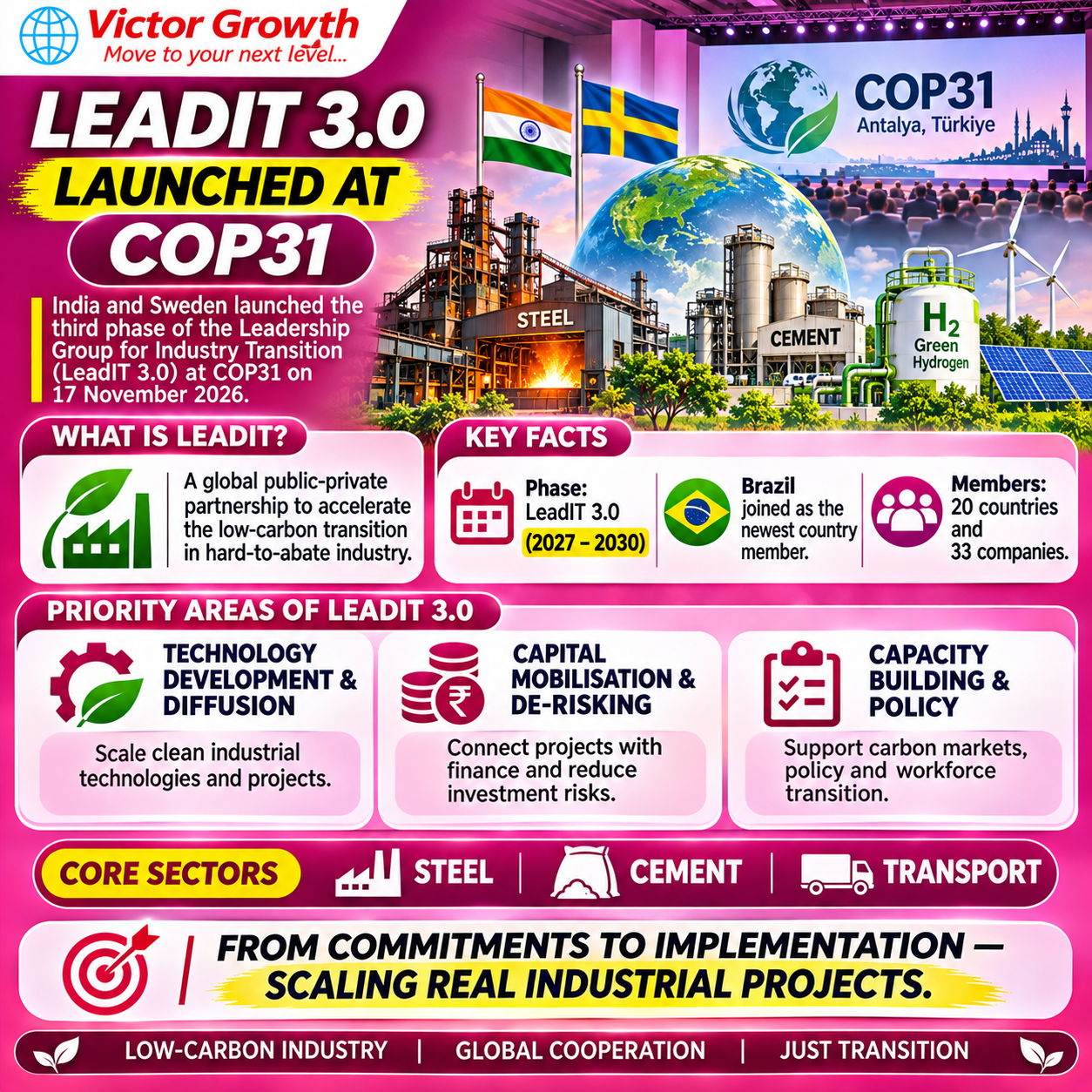
India and Sweden launched LeadIT 3.0 (Leadership Group for Industry Transition) on 17 November 2026, at the 31st United Nations Climate Change Conference (COP31) in Antalya, Türkiye.
Union Environment Minister Bhupender Yadav announced the launch at the Industry Leaders’ Roundtable. Brazil also joined the initiative as its newest country member.
The third phase will operate from 2027 to 2030, focusing on accelerating industrial decarbonisation through technology development, investment mobilisation and international cooperation. <Cite refs={[“turn923935search0″,”turn923935search1”]}/>
What Is LeadIT?
LeadIT stands for Leadership Group for Industry Transition. It is a global initiative launched jointly by India and Sweden at the UN Climate Action Summit in September 2019, with support from the World Economic Forum.
Its primary objective is to accelerate the transition of energy-intensive industries towards low-carbon and sustainable production.
LeadIT brings together governments, industries and other stakeholders to develop practical solutions for reducing industrial greenhouse gas emissions.
Key facts:
Launched: September 2019.
Founding countries: India and Sweden.
LeadIT 3.0 period: 2027–2030.
Membership at the launch of the third phase: 20 countries and 33 companies.
Newest country member: Brazil.
Core sectors: Steel, cement and transport. <Cite refs={[“turn923935search0″,”turn923935search2”]}/>
Why Is Industrial Decarbonisation Important?
Industries such as steel, cement and heavy transport are known as hard-to-abate sectors because reducing their emissions is technically and economically challenging.
For example:
Steel: Traditional steel production uses coal-intensive processes and requires high-temperature heat.
Cement: Manufacturing cement releases carbon dioxide both from fuel combustion and the chemical breakdown of limestone.
Heavy transport: Ships, trucks and other heavy-duty vehicles often depend on fossil fuels and require energy-dense alternatives.
Decarbonising these sectors requires advanced technologies, substantial investment and international cooperation.
Major Priorities of LeadIT 3.0
The third phase shifts the focus from discussions and partnerships towards implementing projects at scale.
1. Technology Development and Diffusion
Promote the development, testing and deployment of low-carbon industrial technologies through international partnerships.
Examples include:
Green hydrogen-based steel production.
Electrification of industrial heating.
Carbon capture, utilisation and storage (CCUS).
Low-carbon cement manufacturing.
Industrial recycling and circular economy practices.
2. Mobilising Capital and Reducing Investment Risks
Low-carbon industrial projects often require high initial investment. LeadIT 3.0 aims to connect projects with financial institutions, improve project preparation and attract public and private investment.
3. Capacity Building and Policy Support
The initiative will strengthen the ability of governments and industries to implement industrial transition policies.
It will also support cooperation on carbon markets, international trade frameworks and workforce skills to ensure a just transition. <Cite refs={[“turn923935search0″,”turn923935search2”]}/>
Achievements of LeadIT’s Previous Phase
The second phase of LeadIT supported 11 pre-pilot projects in steel and cement under the India–Sweden Industry Transition Partnership.
These projects explored areas such as:
Hydrogen-based ironmaking.
Electrification of industrial heat.
Carbon capture and utilisation.
Clinker substitution in cement production.
Industrial circularity.
Artificial intelligence to reduce cement demand.
The initiative also supported South Africa’s investment planning for industrial transition and Ethiopia’s engagement on low-carbon cement. <Cite refs={[“turn923935search0″,”turn923935search4”]}/>
Significance of LeadIT 3.0 for India
1. Achieving Climate Goals: Industrial decarbonisation can help India reduce greenhouse gas emissions while pursuing its long-term climate commitments.
2. Green Industrialisation: It can promote cleaner manufacturing, technological innovation and sustainable industrial growth.
3. Global Leadership: India’s partnership with Sweden strengthens its role in international climate cooperation and gives developing economies a platform to participate in industrial transition.
4. Investment and Technology: International collaboration can improve access to clean technologies, expertise and affordable finance.
5. Employment Opportunities: New industries and technologies can create green jobs, provided workers receive appropriate training and social protection.
India’s Climate Progress
At the launch, the Union Environment Minister highlighted three important achievements:
India’s emissions intensity of GDP declined by 37.38% between 2005 and 2022.
50% of installed electricity capacity was achieved from non-fossil-fuel sources, five years ahead of the 2030 target.
India’s additional forest and tree cover carbon sink reached approximately 2.44 billion tonnes of CO₂ equivalent. <Cite refs={[“turn923935search0″,”turn923935search5”]}/>
Challenges in Industrial Transition
High costs: Green technologies require substantial capital investment.
Technology gaps: Developing countries may lack access to advanced industrial technologies.
Energy security: Industries need reliable and affordable clean energy.
Employment concerns: Transitioning away from conventional industries can affect workers and local communities.
Global inequalities: Developing countries require financial and technological support to decarbonise without compromising development priorities.
Way Forward
LeadIT 3.0 should prioritise practical projects, affordable climate finance and technology transfer. Cooperation between governments, industries, research institutions and financial organisations is essential.
India must also strengthen domestic initiatives such as the National Green Hydrogen Mission, the Perform, Achieve and Trade (PAT) Scheme and the Carbon Credit Trading Scheme to support industrial decarbonisation.
A successful transition must balance environmental protection, economic growth, energy security and employment.
UPSC Examination Relevance
Prelims
LeadIT: Full form and founding countries.
Launch year: 2019.
LeadIT 3.0: 2027–2030.
Hard-to-abate sectors.
Green hydrogen and carbon capture technologies.
Mains – GS Paper II
International cooperation and global climate partnerships.
India’s role in multilateral environmental initiatives.
India–Sweden relations.
Mains – GS Paper III
Climate change and industrial pollution.
Green technology and sustainable development.
Energy security and industrial decarbonisation.
Carbon markets and just transition.
Possible UPSC Mains Question:
“Industrial decarbonisation is essential for achieving global climate goals, but hard-to-abate sectors face significant technological and financial barriers. Examine the role of LeadIT 3.0 in addressing these challenges.”
Conclusion
The launch of LeadIT 3.0 at COP31 marks an important step towards translating global climate commitments into practical industrial action. By promoting clean technologies, mobilising investment and strengthening international cooperation, the initiative seeks to make industrial growth more sustainable. Its success will depend on ensuring that developing countries receive adequate finance, technology and policy support for a fair and inclusive transition.