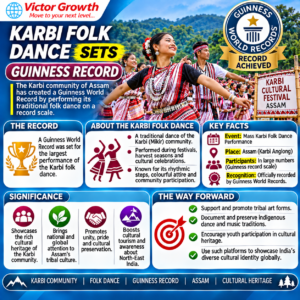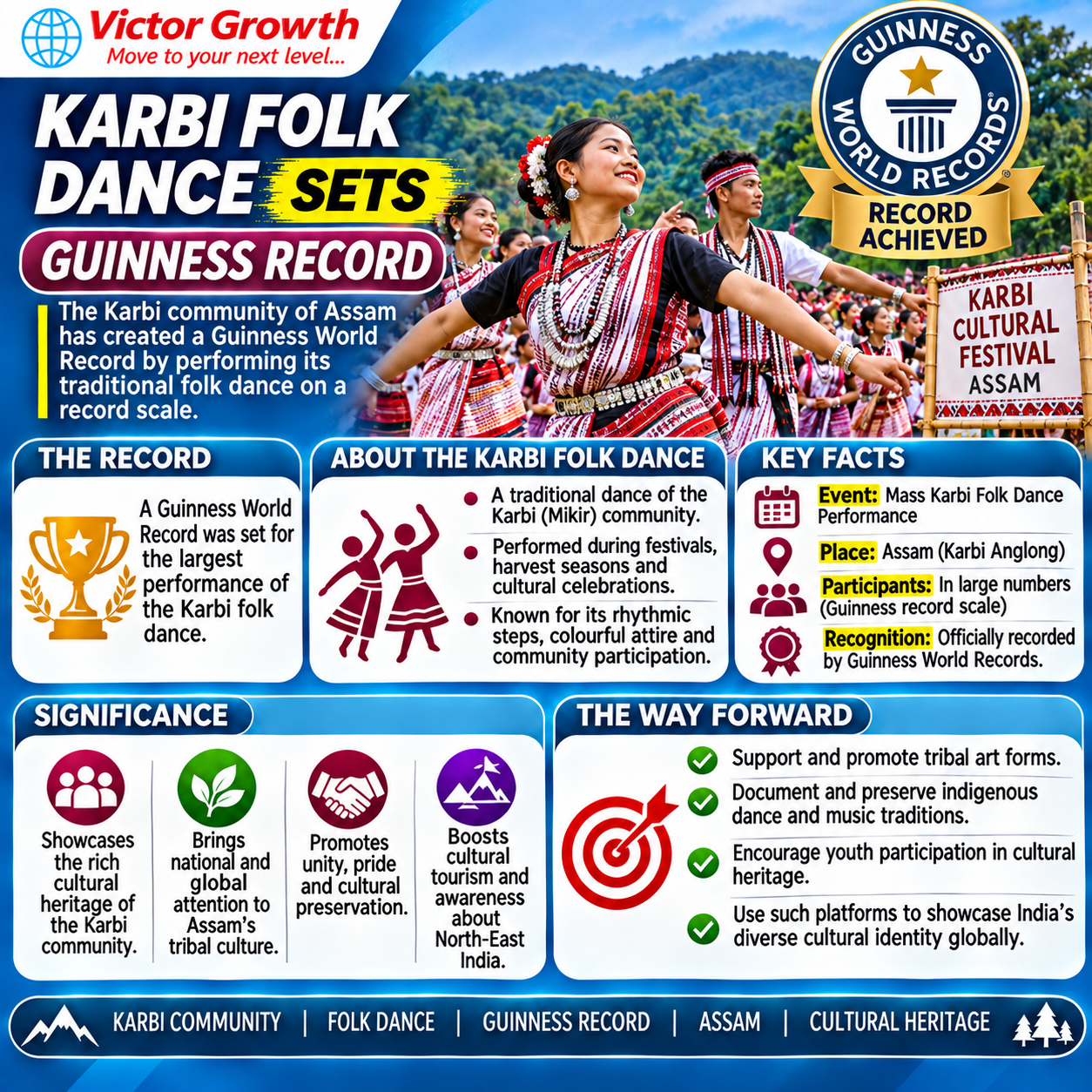
Around 15,000 dancers performed the traditional Karbi folk dance, Nimso Kerung, in Assam’s Karbi Anglong district, setting a Guinness World Record for the largest folk dance performance.
The performance took place on 16 November 2026 at KASA Stadium in Diphu, as part of the celebrations marking the 75th anniversary of Karbi Anglong. Participants from different tribes and communities came together to perform in synchronisation, showcasing Assam’s rich cultural diversity.
The achievement was announced by a Guinness World Records adjudicator and received widespread recognition. <Cite refs={[“turn120553search0″,”turn120553search1″,”turn120553search5”]}/>
What Is Nimso Kerung?
Nimso Kerung is a traditional folk dance associated with the Karbi community of Assam.
The dance reflects the community’s cultural identity, traditional practices and collective celebrations. Traditional attire and indigenous musical rhythms form an important part of such cultural performances.
The participation of thousands of dancers from different communities made the event a symbol of cultural unity, social harmony and the preservation of indigenous traditions.
Key Facts About the Record
Dance form: Nimso Kerung.
Community: Karbi community.
Location: KASA Stadium, Diphu, Karbi Anglong, Assam.
Date: 16 November 2026.
Participants: Approximately 15,000 dancers.
Occasion: 75th anniversary of Karbi Anglong.
Organiser: Karbi Anglong Autonomous Council (KAAC).
Record: Largest folk dance performance.
The three-day celebrations were organised from 15 to 17 November 2026 under the theme Together to the Future. <Cite refs={[“turn120553search2″,”turn120553search3″,”turn120553search6”]}/>
Who Are the Karbi People?
The Karbi are one of the major indigenous communities of Assam, primarily associated with the Karbi Anglong and West Karbi Anglong districts.
Their cultural traditions include distinctive languages, folk music, dances, festivals, traditional attire and community-based practices.
Important aspects of Karbi culture include:
Language: The Karbi language belongs to the Tibeto-Burman language family.
Traditional festivals: Rongker is an important traditional festival associated with community welfare and agricultural life.
Traditional religion: Karbi religious practices include indigenous beliefs, rituals and reverence for nature and ancestral traditions.
Cultural identity: Folk songs, dances and oral traditions play an important role in preserving community history and identity.
Karbi Anglong: Geographical and Administrative Importance
Karbi Anglong is a hill district located in central Assam. Its administrative headquarters is Diphu.
Important facts:
Karbi Anglong was formed as an administrative district in 1951.
It is home to several indigenous communities, including Karbis, Dimasa, Bodos, Tiwas and others.
The Karbi Anglong Autonomous Council (KAAC) administers the autonomous district.
The region has significant cultural, linguistic and ecological diversity.
The KAAC operates under the constitutional framework of the Sixth Schedule of the Indian Constitution, which provides for autonomous administration in certain tribal areas of Northeast India.
What Is the Sixth Schedule?
The Sixth Schedule of the Indian Constitution provides for autonomous administration in specified tribal areas of Assam, Meghalaya, Tripura and Mizoram.
Its main objectives include:
Protecting tribal customs, traditions and cultural identity.
Providing local self-governance through Autonomous District Councils (ADCs).
Protecting land and community resources.
Enabling councils to make laws on specified subjects.
Promoting the socio-economic development of tribal communities.
The Sixth Schedule is an important constitutional mechanism for protecting tribal autonomy and cultural diversity in Northeast India.
Significance of the Guinness World Record
1. Preservation of Indigenous Culture
The performance brings international attention to traditional dance forms and encourages younger generations to preserve their cultural heritage.
2. Promoting Cultural Tourism
Such events can strengthen tourism in Assam and create opportunities for local artists, artisans and businesses.
3. Social Harmony
Participation by different communities demonstrates how cultural celebrations can promote unity and mutual respect.
4. Recognition of Northeast India
The achievement highlights the cultural richness of Northeast India on an international platform.
5. Community Participation
Large-scale cultural events strengthen local institutions and encourage collective efforts to preserve traditional practices.
UPSC Examination Relevance
Prelims
Nimso Kerung and the Karbi community.
Location and headquarters of Karbi Anglong.
Karbi Anglong Autonomous Council.
Sixth Schedule of the Indian Constitution.
Tribal communities and folk traditions of Northeast India.
Mains – GS Paper I
Indian art and culture.
Tribal traditions and indigenous cultural heritage.
Diversity of India’s folk and performing arts.
Mains – GS Paper II
Constitutional provisions for tribal autonomy.
Sixth Schedule and Autonomous District Councils.
Protection of minority and indigenous communities.
Possible UPSC Mains Question:
“Traditional folk arts and cultural practices play an important role in preserving the identity of indigenous communities. Discuss with reference to the tribal communities of Northeast India.”
Conclusion
The Guinness World Record achieved through the performance of Nimso Kerung is more than a cultural milestone. It highlights the importance of preserving indigenous traditions, strengthening community identity and promoting cultural unity. The achievement also draws attention to the rich tribal heritage of Assam and the constitutional safeguards available for tribal self-governance in Northeast India.