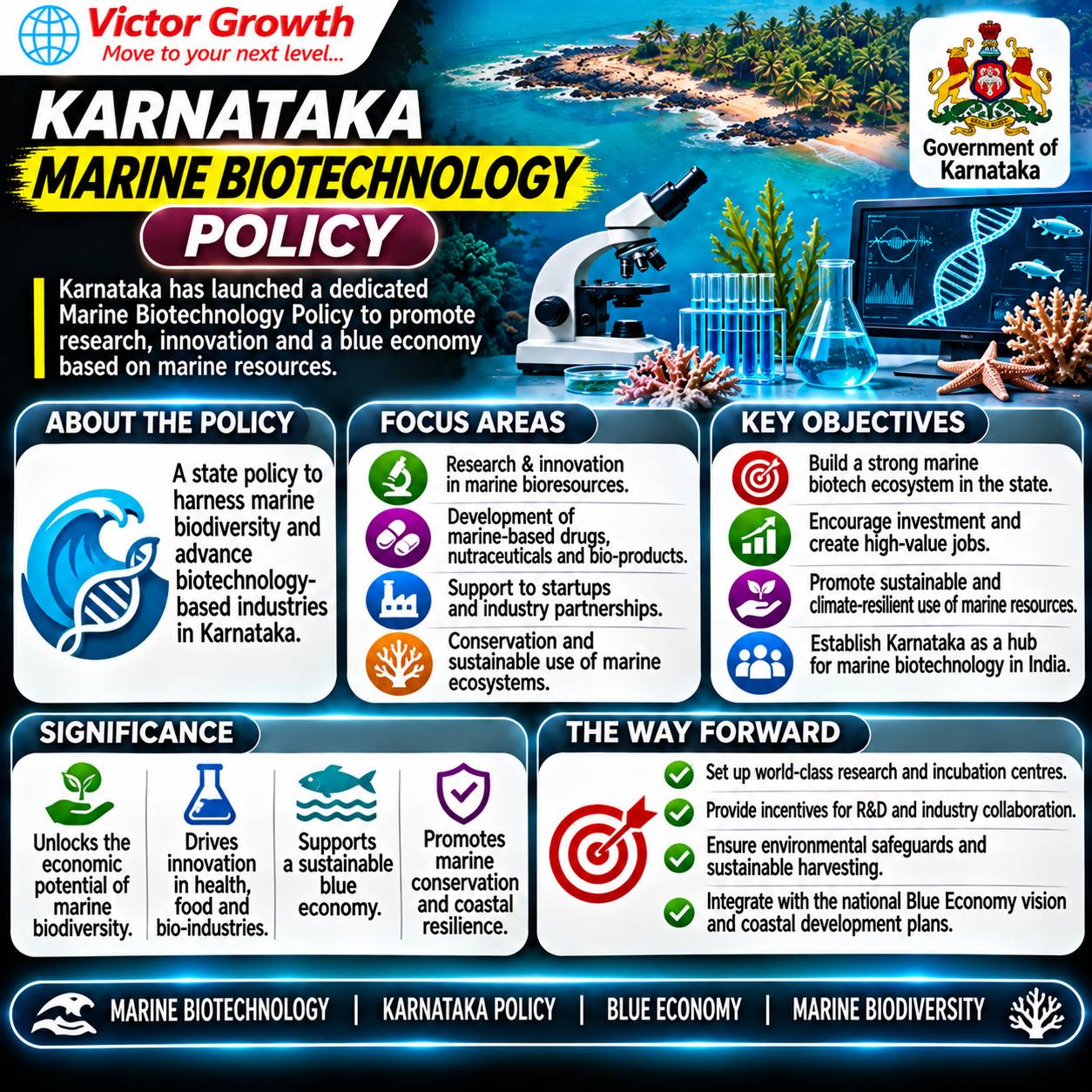
The Karnataka Government has approved the Karnataka Marine Biotechnology Policy 2026–2031, a five-year initiative aimed at transforming the state’s marine resources into high-value products, technologies and businesses.
With a proposed budget of ₹120 crore, the policy seeks to expand Karnataka’s Blue Bioeconomy from approximately US$2 billion to US$6–8 billion by 2031.
The initiative aims to promote marine biotechnology research, seaweed-based industries, marine biomanufacturing, sustainable aquaculture and coastal employment. <Cite refs={[“turn663191news8″,”turn663191search1”]}/>
What Is Marine Biotechnology?
Marine biotechnology involves the application of biological sciences and advanced technologies to marine organisms and resources for developing useful products and processes.
It uses marine plants, animals, microorganisms and genetic resources for applications in:
Pharmaceuticals and healthcare.
Food processing and nutraceuticals.
Cosmetics and personal care products.
Biofertilisers and agricultural products.
Bioplastics and biodegradable materials.
Renewable energy and industrial chemicals.
Marine organisms such as seaweed, algae, bacteria and marine microorganisms can provide valuable raw materials for sustainable industries.
What Is the Blue Bioeconomy?
The Blue Bioeconomy refers to the sustainable use of marine and aquatic biological resources to generate economic value while protecting marine ecosystems.
It is an important component of the broader Blue Economy, which includes fisheries, aquaculture, shipping, coastal tourism, marine biotechnology and ocean-based renewable energy.
The Blue Bioeconomy focuses particularly on biological resources and their conversion into high-value products through science, innovation and sustainable production.
Key Features of Karnataka Marine Biotechnology Policy 2026–2031
The policy aims to strengthen the entire value chain, from marine research and innovation to commercial production.
1. Karnataka Institute of Marine Biotechnology and Blue Economy (KIMBE)
The government plans to establish KIMBE as a major institutional centre for marine biotechnology research, innovation and commercialisation.
It will support advanced research in marine genomics, microbiology, bioinformatics, bioprocessing and marine biodiversity.
2. Marine Biotechnology Zones
Dedicated zones will provide common research infrastructure, testing facilities, logistics and industrial support to startups and companies.
These zones are expected to encourage investment and strengthen the marine biotechnology ecosystem.
3. Seaweed Value Addition – Production Linked Incentive (PLI)
The policy proposes incentives for manufacturing high-value products derived from seaweed, including:
Nutraceuticals and food ingredients.
Biofertilisers and biostimulants.
Bioplastics and marine biomaterials.
Bio-based chemicals.
Biofuels.
This aims to move the sector beyond raw seaweed production towards value-added manufacturing.
4. Blue Carbon Certification Programme
The state plans to introduce a pilot Blue Carbon Certification Programme to scientifically assess and recognise carbon sequestration through seaweed cultivation and other eligible coastal ecosystems.
This could create opportunities for carbon-related revenue while encouraging sustainable marine resource management.
5. Research, Startups and Employment
The policy seeks to connect research institutions, universities, startups and industries. It is expected to create around 10,000 direct and indirect employment opportunities. <Cite refs={[“turn663191search1″,”turn663191search2”]}/>
Why Is Karnataka Well Positioned?
Karnataka has several advantages for developing a marine biotechnology industry:
Coastline: Approximately 343 km of coastline along the Arabian Sea.
Marine biodiversity: Diverse coastal and marine ecosystems.
Research infrastructure: Existing fisheries, biotechnology and marine science institutions.
Industrial ecosystem: A strong biotechnology and startup base, particularly around Bengaluru.
Fisheries sector: Established fishing communities and marine production networks across Dakshina Kannada, Udupi and Uttara Kannada.
The policy seeks to connect these existing strengths with emerging biotechnology and manufacturing opportunities.
Significance of the Policy
1. Economic Diversification: It can help Karnataka move beyond traditional fisheries and coastal activities towards high-value biotechnology industries.
2. Employment Generation: Seaweed cultivation, processing, research and manufacturing can create new opportunities for coastal communities and skilled workers.
3. Innovation and Research: Investment in laboratories and research institutions can strengthen India’s marine biotechnology capabilities.
4. Sustainable Development: Marine biomaterials and bio-based products can provide alternatives to certain petroleum-based materials.
5. Blue Carbon Potential: Better scientific assessment of coastal carbon storage can support climate action and ecosystem conservation.
6. Support to Startups: Incubation facilities and financial incentives can encourage entrepreneurship in marine biotechnology.
Challenges and Concerns
Despite its potential, the policy faces several challenges:
Ecological risks: Unsustainable harvesting and poorly managed seaweed cultivation may affect marine ecosystems.
Technology gaps: Advanced marine biotechnology requires specialised laboratories, skilled researchers and substantial investment.
Commercialisation: Converting laboratory research into commercially viable products remains challenging.
Fisherfolk participation: Coastal communities must receive fair economic benefits and participate in decision-making.
Regulatory framework: Marine biodiversity access and commercial utilisation must comply with environmental and biodiversity regulations.
Climate risks: Ocean warming, pollution and coastal ecosystem degradation can affect marine biological resources.
Way Forward
Karnataka should strengthen collaboration between research institutions, industries, universities and coastal communities.
Priority areas should include sustainable seaweed cultivation, marine biodiversity conservation, technology transfer, startup incubation and transparent benefit-sharing mechanisms.
The policy must also ensure that economic growth does not come at the cost of marine ecosystems and traditional fishing livelihoods.
UPSC Examination Relevance
Prelims
Karnataka Marine Biotechnology Policy 2026–2031.
Blue Economy and Blue Bioeconomy.
Marine biotechnology and seaweed cultivation.
Blue carbon ecosystems.
Marine biodiversity and coastal states.
Mains – GS Paper III
Biotechnology and its applications.
Sustainable utilisation of marine resources.
Blue Economy and economic development.
Environmental conservation and climate change.
Fisheries and coastal livelihood development.
Mains – GS Paper II
Government policies and interventions.
Centre–State cooperation in environmental governance.
Inclusive development of coastal communities.
Possible UPSC Mains Question:
“Marine biotechnology has the potential to transform India’s Blue Economy by converting marine biological resources into high-value products. Examine its opportunities and challenges with reference to Karnataka’s Marine Biotechnology Policy 2026–2031.”
Conclusion
The Karnataka Marine Biotechnology Policy 2026–2031 represents an important effort to connect marine science with economic development. By supporting research, seaweed-based industries, marine biomanufacturing and blue carbon initiatives, Karnataka aims to build a stronger Blue Bioeconomy. Its long-term success will depend on scientific innovation, responsible resource utilisation and the active participation of coastal communities.