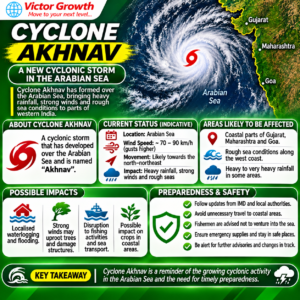
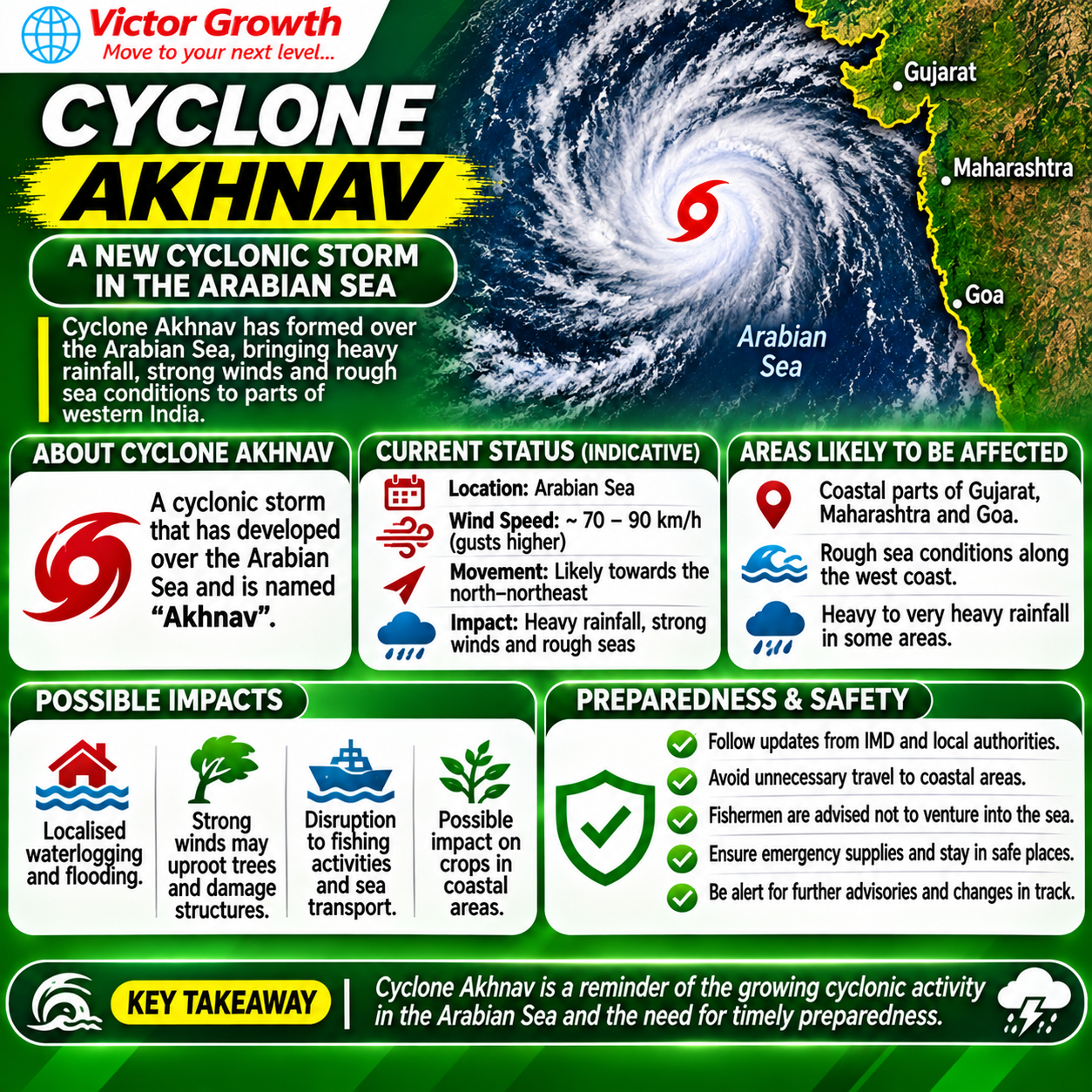
Cyclone Akvan, which developed over the Bay of Bengal in November 2026, has intensified into a Severe Cyclonic Storm and is forecast to strengthen further into a Very Severe Cyclonic Storm.
According to the India Meteorological Department (IMD), the cyclone is expected to move northwestwards and cross the Andhra Pradesh coast between Nellore and Visakhapatnam around noon on 20 November 2026.
The storm may bring destructive winds, heavy to extremely heavy rainfall and storm surges to coastal areas of Andhra Pradesh and neighbouring states. <Cite refs={[“turn140108search6″,”turn140108search0″,”turn140108search2”]}/>
What Is Cyclone Akvan?
Cyclone Akvan is a tropical cyclone that developed over the central parts of the South and adjoining Westcentral Bay of Bengal.
Important facts:
Name: Akvan (proposed by Iran).
Basin: Bay of Bengal.
Formation: 16 November 2026.
Monitoring agency: India Meteorological Department (IMD).
Expected landfall: Andhra Pradesh coast, between Nellore and Visakhapatnam.
Forecast landfall date: 20 November 2026.
The system developed from a deep depression and intensified into a cyclonic storm before strengthening further.
Latest Forecast and Expected Impact
As per the IMD forecast available on 18 November 2026:
The cyclone is expected to intensify into a Very Severe Cyclonic Storm around 19 November.
Maximum sustained wind speeds at its peak are forecast at 120–130 kmph, with gusts up to 145 kmph.
Landfall is expected around noon on 20 November.
Coastal Andhra Pradesh may experience heavy to extremely heavy rainfall.
Southern Odisha and Telangana are also likely to receive significant rainfall.
The IMD has warned of possible storm surges in low-lying coastal areas of Andhra Pradesh. Coastal communities, fishermen and disaster response agencies have been advised to follow official warnings. Forecasts may change with subsequent updates. <Cite refs={[“turn140108search0″,”turn140108search7″,”turn140108search2”]}/>
How Are Tropical Cyclones Formed?
Tropical cyclones are intense low-pressure systems that develop over warm tropical oceans.
The major conditions required for their formation are:
Warm sea surface temperatures: Generally around 26.5°C or higher, providing energy through evaporation.
Atmospheric instability: Warm, moist air rises and supports the development of thunderstorms.
Coriolis force: Helps the system develop rotation; therefore, cyclones rarely form directly at the equator.
Low vertical wind shear: Allows the storm structure to remain organised.
Pre-existing disturbance: A low-pressure system or atmospheric circulation provides the initial trigger.
As warm, moist air rises and condenses, latent heat is released, strengthening the storm’s circulation.
Why Is the Bay of Bengal Vulnerable to Cyclones?
The Bay of Bengal experiences frequent tropical cyclones due to a combination of geographical and atmospheric factors.
Warm ocean waters: High sea surface temperatures provide energy for cyclone development.
High moisture availability: The warm, humid environment supports intense convection.
Coastal vulnerability: The densely populated eastern coastline increases the potential impact of cyclones.
Shallow coastal waters: Certain coastal regions are more vulnerable to storm-surge inundation.
Seasonal conditions: The post-monsoon period, particularly October–November, is favourable for cyclone formation.
Cyclone Classification in India
The India Meteorological Department classifies cyclonic disturbances based on maximum sustained wind speed.
| Category | Wind Speed |
|---|---|
| Cyclonic Storm | 62–88 kmph |
| Severe Cyclonic Storm | 89–117 kmph |
| Very Severe Cyclonic Storm | 118–166 kmph |
| Extremely Severe Cyclonic Storm | 167–221 kmph |
| Super Cyclonic Storm | 222 kmph or more |
These categories are important for understanding the intensity and potential destructive capacity of tropical cyclones.
Major Impacts of Cyclones
1. Human and economic losses: Strong winds and flooding can damage houses, infrastructure, agriculture and livelihoods.
2. Storm surges: Abnormal rises in sea level can inundate coastal settlements and cause loss of life.
3. Agricultural damage: Heavy rainfall, flooding and saline-water intrusion can damage crops and soil.
4. Infrastructure disruption: Roads, electricity networks, telecommunications and ports may be affected.
5. Environmental impact: Coastal erosion, damage to mangroves and saltwater intrusion can affect fragile ecosystems.
India’s Cyclone Disaster Management Framework
India has developed an institutional framework for cyclone preparedness and response.
IMD: Monitors cyclones, forecasts their movement and issues weather warnings.
NDMA: Formulates disaster management policies and guidelines.
NDRF: Conducts specialised rescue and relief operations.
SDRF: Provides state-level emergency response.
State Governments: Coordinate evacuation, shelters, relief and rehabilitation.
Important initiatives include the National Cyclone Risk Mitigation Project (NCRMP), early-warning systems, coastal shelters and community-based disaster preparedness.
Lessons for Disaster Management
Cyclone Akvan highlights the importance of:
Timely evacuation of people from vulnerable coastal areas.
Effective early-warning communication in local languages.
Safe shelters and resilient coastal infrastructure.
Protection of fishermen and fishing communities.
Strengthening mangroves and natural coastal barriers.
Coordination between national, state and local disaster management agencies.
UPSC Examination Relevance
Prelims
Cyclone Akvan and the Bay of Bengal.
Conditions required for tropical cyclone formation.
IMD cyclone classification.
Storm surge and coastal vulnerability.
Role of IMD, NDMA, NDRF and SDRF.
Mains – GS Paper I
Geographical factors responsible for tropical cyclones.
Distribution of cyclones in the Indian Ocean.
Ocean-atmosphere interactions.
Mains – GS Paper III
Disaster management and cyclone preparedness.
Climate change and extreme weather events.
Coastal vulnerability and disaster-resilient infrastructure.
Possible UPSC Mains Question:
“The increasing vulnerability of India’s eastern coastline to tropical cyclones highlights the need for a comprehensive disaster management strategy. Discuss with reference to early-warning systems, coastal resilience and community preparedness.”
Conclusion
Cyclone Akvan highlights the continuing vulnerability of India’s eastern coastline to severe tropical weather systems. Although forecasting and evacuation capabilities have improved considerably, effective disaster management requires continuous investment in resilient infrastructure, early-warning systems and community preparedness. A proactive approach can significantly reduce the human and economic losses caused by cyclones.