A Complete Step-by-Step Preparation Plan for UPSC CAPF Assistant Commandant Exam
The UPSC CAPF Assistant Commandant (AC) exam is one of the most competitive paramilitary officer entry exams in India. Thousands apply each year, but only a small percentage make it to the final merit list. Clearing it in the first attempt is absolutely possible—with the right strategy, discipline, and smart guidance.
This guide provides the most effective, practical, and result-oriented strategy to crack the CAPF AC exam on your first attempt.
✅ Understanding the CAPF AC Exam Structure
Before starting preparation, know the exam pattern clearly:
1. Paper 1 – General Ability & Intelligence (Objective, 250 Marks)
Includes:
General Science
Geography
Polity
Economy
History
Current Affairs
Reasoning / Mental Ability
Quantitative Aptitude
2. Paper 2 – General Studies, Essay & Comprehension (Descriptive, 200 Marks)
Includes:
Essays (National Security, Policing, Governance, Social issues)
Reading Comprehension
Precis Writing
Report Writing
Grammar & Language skills
3. Physical Efficiency Test (PET)
100m race
800m race
Long Jump
Shot Put
4. Interview / Personality Test – 150 Marks
⭐ Best Strategy to Crack CAPF AC Exam in First Attempt
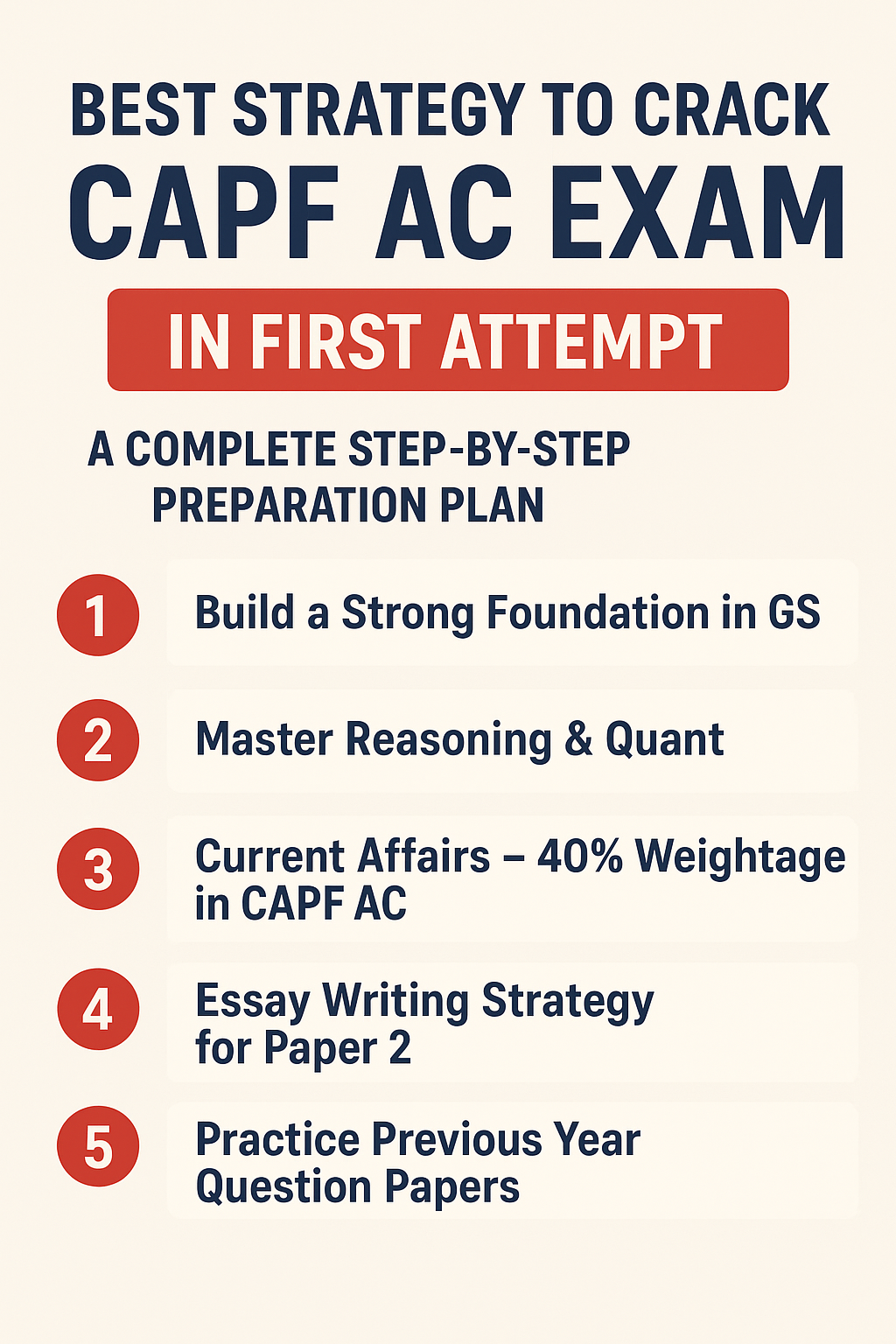
1. Build a Strong Foundation in GS (The Real Game-Changer)
A major portion of Paper 1 is static + current affairs. Preparation must include:
Recommended Books
NCERTs (6–12) – History, Geography, Polity, Economy, Science
M. Laxmikanth – Polity
Spectrum – Modern History
Lucent / NCERT Geography – Geography basics
Economic Survey & Budget (Summary)
Smart Strategy
Cover NCERTs in 8–10 weeks.
Make short notes for revision.
Solve 20 MCQs daily.
2. Master Reasoning & Quant – High Accuracy Zone
These areas guarantee marks if practiced well.
Focus Areas
Analogy, Classification
Number Series, Syllogism
Data Interpretation
Basic Arithmetic (Profit-loss, Time-distance, Ratio)
How to Prepare
Practice 50 questions daily
Use previous years’ papers to understand UPSC trend
Attempt mock tests weekly
3. Current Affairs – 40% Weightage in CAPF AC
Current affairs are heavily tested in Paper 1 + Essay.
Sources
The Hindu / Indian Express
PIB
Monthly current affairs magazine (VictorGrowth recommended)
Yojana + Kurukshetra summaries
What to Study
Defence & Security issues
IR and National Affairs
Environment & Disaster management
Government schemes
Economy basics
4. Essay Writing Strategy for Paper 2
Essay is a scoring section—but only with structured writing.
Follow the IBC Format
Introduction – Define the theme + Latest data
Body
Causes
Impacts
Measures
Government initiatives
Conclusion – Way Forward + Vision
Practice Essays On
Internal Security
Role of CAPF in Policing
Women empowerment
Disaster management
Naxalism / Terrorism
Write 1 essay every week.
5. Practice Previous Year Question Papers (PYQs)
UPSC repeats concepts often.
Solve last 10 years PYQs—both Paper 1 and Paper 2.
Benefits:
✅ Understand UPSC pattern
✅ Improve answer accuracy
❌ Avoid unnecessary topics
6. Attempt Full-Length Mock Tests
Mock tests simulate the real exam environment.
How Many Mocks?
Paper 1: 20–25 mock tests
Paper 2: 10 descriptive tests
Why Mocks Matter
Improve speed
Identify weak areas
Boost confidence
7. Physical Fitness Training for PET
Start physical training 3 months before the PET.
Daily Routine (45–60 mins)
800m stamina run
Sprint practice (100m)
Long jump drills
Strength training for shot-put
Tip: Don’t ignore fitness—the PET eliminates a lot of candidates.
8. Build Officer-Like Personality for Interview
UPSC board tests leadership qualities such as:
Communication skills
Confidence
Decision-making
Awareness about CAPFs
Positive body language
How to prepare
Practice mock interviews
Read about CAPF roles (BSF, CRPF, CISF, ITBP, SSB)
Follow national security issues
9. Follow a Timetable (Highly Result-Oriented)
Daily Study Plan (For Working / Students)
| Time | Activity |
|---|---|
| 2 hrs | GS (Static) |
| 1 hr | Current Affairs |
| 1 hr | Quant + Reasoning |
| 1 hr | Revision + Notes |
| Weekly | Essay + Mock Test |
10. Stay Consistent – The Most Important Factor
Consistency > Intelligence.
Study 4–5 hours daily
Revise weekly
Practice MCQs daily
Stay disciplined
Avoid too many materials
Conclusion
Cracking the UPSC CAPF Assistant Commandant exam in the first attempt is achievable with a smart preparation strategy. Focus equally on Paper 1, Paper 2, fitness, and interview. Stay disciplined, practice PYQs, and revise regularly.
With the right strategy and guidance, your first attempt can be your last attempt—and your journey to becoming a CAPF officer starts now.
FAQs on CAPF AC Preparation
1. Can I crack CAPF AC in the first attempt?
Yes. With a structured plan, consistent study, and mock test practice, it is absolutely possible.
2. How many months are required for CAPF preparation?
Generally, 4–6 months of focused preparation is sufficient.
3. Which book is best for CAPF AC Paper 1?
Use NCERTs, Laxmikanth, Spectrum, and any good monthly current affairs magazine.
4. Is coaching necessary for CAPF AC?
Coaching is helpful but not mandatory. Self-study + PYQs is enough.
5. How do I prepare the essay for Paper 2?
Practice weekly, use structured format (Intro–Body–Conclusion), and read on internal security issues.
6. How important is physical fitness for CAPF AC?
PET is qualifying but mandatory. Start training 2–3 months early.