India’s Central Armed Police Forces (CAPF) play a vital role in ensuring national security, internal stability, and border protection. Managed by the Ministry of Home Affairs (MHA), the CAPFs consist of five professional paramilitary forces—CRPF, BSF, ITBP, CISF, and SSB—each entrusted with specialized duties.
Whether you’re a defence aspirant, preparing for CAPF AC, or simply curious, this guide provides a clear and in-depth explanation of each force, their duties, recruitment processes, and organizational importance.
⭐ What Are CAPF Forces?
The Central Armed Police Forces (CAPF) are India’s premier paramilitary forces responsible for:
Border Security
Internal Security
Counter-terrorism
VIP Protection
Industrial Security
Disaster Response
Anti-Naxal Operations
They act as the backbone of national security in both peace and conflict scenarios.
The five CAPF forces are:
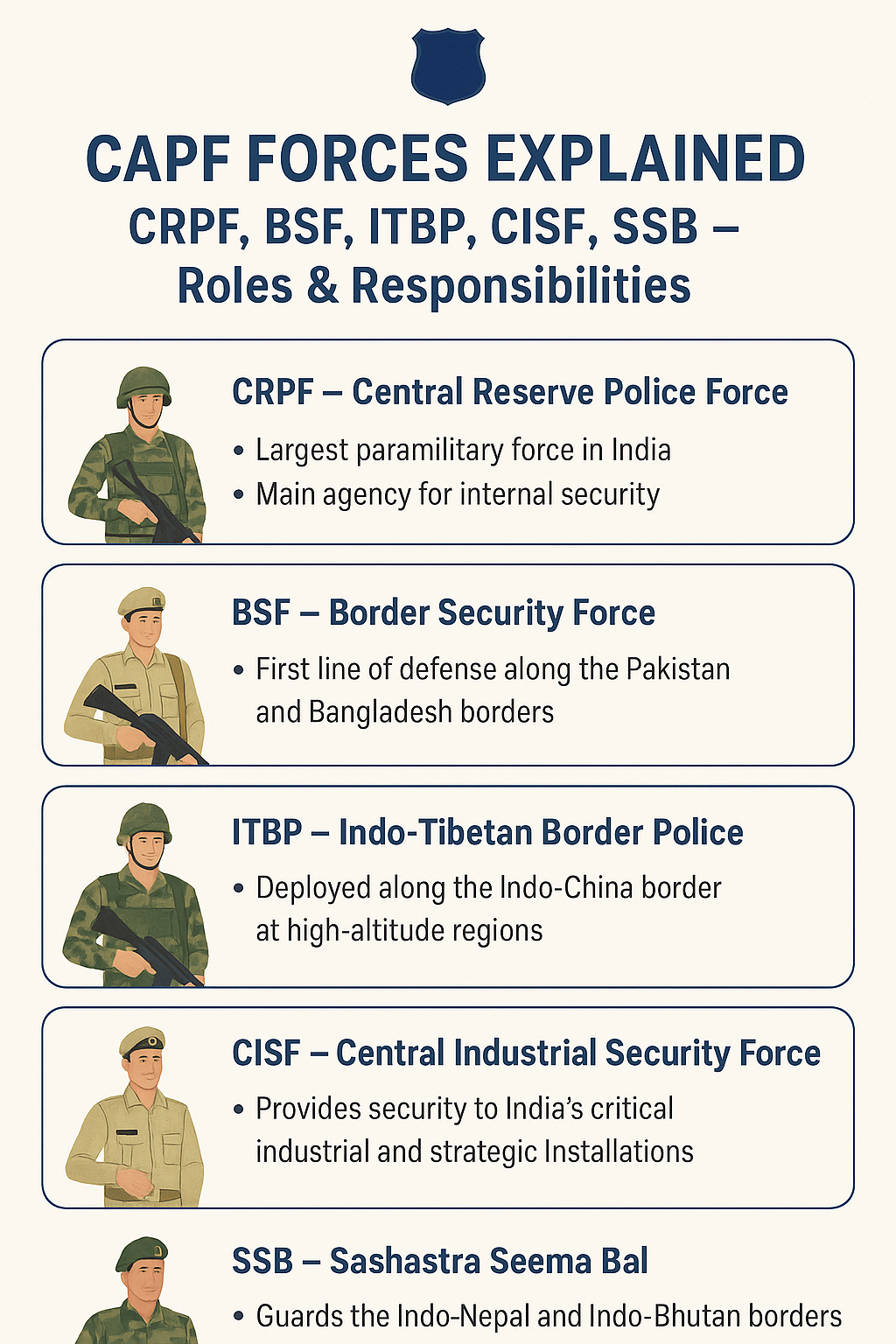
CRPF – Central Reserve Police Force
BSF – Border Security Force
ITBP – Indo-Tibetan Border Police
CISF – Central Industrial Security Force
SSB – Sashastra Seema Bal
Let’s understand each in detail.
—————————–
1. CRPF – Central Reserve Police Force
Overview
CRPF is the largest paramilitary force in India and the main agency for internal security.
Primary Roles
✔ Maintaining law & order
✔ Counter-insurgency operations (J&K, Northeast)
✔ Anti-Naxal & anti-terrorism operations
✔ Election duty nationwide
✔ Crowd & riot control
✔ VIP security under Special Protection Group (SPG & Z+ categories)
Special Units
COBRA (Commando Battalion for Resolute Action) – Anti-Naxal
RAPID – Anti-riot
Mahila Battalions – Women-led operations
—————————–
2. BSF – Border Security Force
Overview
BSF is India’s first line of defense along the Pakistan and Bangladesh borders.
Primary Roles
✔ Border surveillance and anti-infiltration
✔ Preventing trafficking, illegal migration & smuggling
✔ Anti-terror duties in border regions
✔ Riverine and coastal security
✔ Providing support during natural disasters
Special Features
Operates camel patrols in Rajasthan
Maintains water wings, air wings, and marine commando units
—————————–
3. ITBP – Indo-Tibetan Border Police
Overview
ITBP is deployed along the Indo-China border at high-altitude regions (up to 18,000 ft).
Primary Roles
✔ High-altitude border security
✔ Surveillance of the Line of Actual Control (LAC)
✔ Disaster rescue during earthquakes, avalanches
✔ Support to mountaineering expeditions
✔ Maintaining internal security during elections
Special Training
Mountain warfare
Skiing
Ice-craft and high-altitude survival
—————————–
4. CISF – Central Industrial Security Force
Overview
CISF provides security to India’s critical industrial and strategic installations.
Primary Roles
✔ Protection of PSUs, industries & power plants
✔ Airport security (all civilian airports)
✔ Metro security (Delhi, Bengaluru, etc.)
✔ Security to nuclear & space installations
✔ Fire wing for emergency management
Important Units Protected
ISRO
BARC
Airports Authority of India
Delhi Metro Rail Corporation
Oil refineries, steel plants, mines
—————————–
5. SSB – Sashastra Seema Bal
Overview
SSB guards the Indo-Nepal and Indo-Bhutan borders.
Primary Roles
✔ Prevent illegal migration & smuggling
✔ Intelligence-based operations
✔ Promoting harmony among border population
✔ Counter-insurgency & internal security roles
✔ Civic Action Programs for border communities
Unique Feature
These borders are open borders, requiring specialized human-intelligence operations.
—————————————————-
CAPF Forces at a Glance (Comparison Table)
| CAPF Force | Main Duty | Border/Area Covered | Special Units |
|---|---|---|---|
| CRPF | Internal security & anti-Naxal ops | Across India | COBRA, Rapid, Mahila Battalion |
| BSF | Border protection | Pakistan & Bangladesh borders | Water Wing, Air Wing, Camel Force |
| ITBP | High-altitude border protection | China border (LAC) | Mountaineering Units |
| CISF | Industrial & airport security | Airports, PSUs | Fire Wing, Quick Reaction Teams |
| SSB | Open border security | Nepal & Bhutan borders | Intelligence Wing |
—————————————————-
Why Are CAPF Forces Important?
CAPF forces ensure:
National security from external threats
Internal peace and stability
Safe elections in India
Protection of vital national assets
Disaster response & humanitarian aid
They act as the bridge between the military and state police, maintaining balance in times of crises.
—————————————————-
⭐ FAQs: CAPF Forces Explained
1. How many forces come under CAPF?
There are five CAPF forces: CRPF, BSF, ITBP, CISF, and SSB.
2. Which CAPF is the largest?
CRPF is the largest paramilitary force in India.
3. Who controls the CAPF forces?
They are governed by the Ministry of Home Affairs (MHA).
4. Which CAPF is best for women candidates?
CRPF, CISF, and SSB have dedicated women battalions, making them popular choices.
5. Which CAPF has the toughest training?
ITBP is known for the toughest high-altitude training.
6. Which is better: CAPF or Army?
Both have different roles—Army handles external defense, while CAPF manages internal and border security.
7. How can I join CAPF as an Assistant Commandant?
You need to clear the UPSC CAPF AC Exam, followed by Physical Tests and Medical Examination.