Introduction
The last 3 months before the UPSC examination are the most crucial phase of preparation. This period can either make or break your chances of clearing Prelims and performing well in Mains. Many aspirants panic during this stage, endlessly adding new resources instead of focusing on systematic revision.
UPSC does not reward those who study the most in the last phase, but those who revise smartly, recall faster, and apply concepts accurately under exam pressure.
This article provides a step-by-step, practical, and proven strategy to revise the entire UPSC syllabus effectively in the final 3 months, ensuring maximum retention and confidence.
Why the Last 3 Months Matter Most
During the final phase:
Memory consolidation happens
Exam temperament is built
Silly mistakes are minimized
Accuracy and speed improve
👉 Revision, not fresh learning, is the key to success in this phase.
Understand the Objective of Revision
Effective revision aims to:
Strengthen already-studied concepts
Improve recall speed
Eliminate weak areas
Fine-tune exam strategy
❌ Revision is not about reading books cover to cover again.
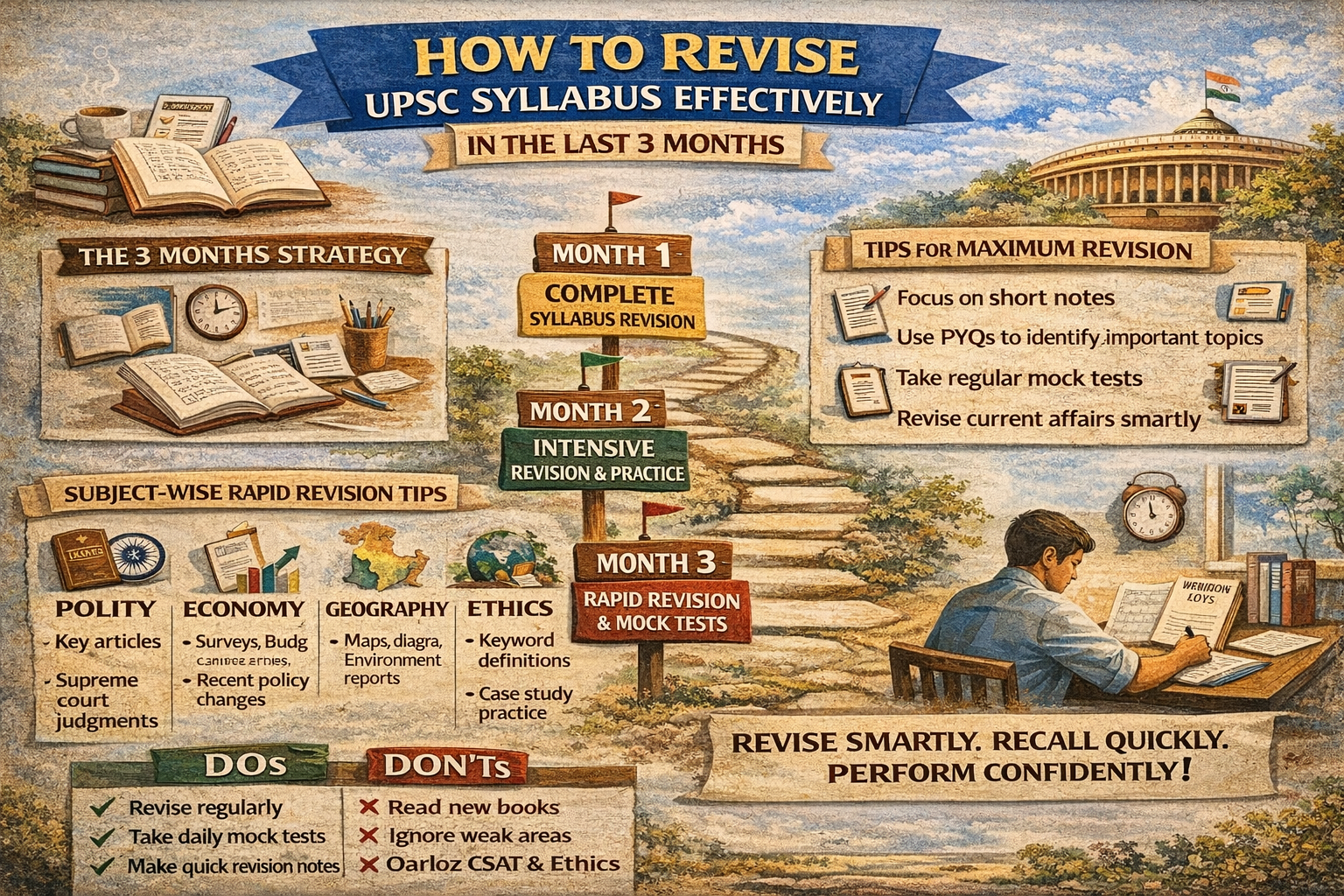
Overall 3-Month Revision Strategy (Overview)
| Month | Focus |
|---|---|
| Month 1 | Complete syllabus revision + concept clarity |
| Month 2 | Intensive revision + MCQs / answer writing |
| Month 3 | Rapid revision + mock tests + polishing |
MONTH 1: COMPLETE SYLLABUS REVISION (FOUNDATION REVISION)
Objectives
Revise all static subjects once
Integrate current affairs
Strengthen weak areas
Subject-wise Focus
Polity
Constitution articles
Supreme Court judgments
Governance issues
Economy
Basic concepts
Budget & Economic Survey highlights
Current economic issues
History
Themes, timelines
Modern history focus
Cultural aspects
Geography
Physical geography concepts
Indian maps
Environment linkages
Environment
Acts & conventions
Climate change
Biodiversity
📌 Tip: Revise using short notes, mind maps, and previous year questions (PYQs).
MONTH 2: INTENSIVE REVISION & PRACTICE
Objectives
Strengthen accuracy
Improve answer writing
Identify recurring mistakes
For Prelims Aspirants
Daily MCQ practice (80–100 questions)
Weekly full-length mock tests
CSAT practice twice a week
For Mains Aspirants
Daily answer writing (4–6 answers)
Weekly GS & Optional tests
Ethics case studies practice
📌 Maintain an error notebook for repeated mistakes.
MONTH 3: RAPID REVISION & EXAM MODE
Objectives
Quick recall
Exam temperament
Confidence building
Key Activities
Revise short notes only
2–3 full revisions of key subjects
High-quality mock tests
Focus on weak areas
❌ Avoid new books and new sources completely.
Subject-Wise Rapid Revision Tips
Polity
Revise articles through keywords
Focus on frequently asked topics
Economy
Revise formulas, definitions
Current affairs linkage
Environment
Static + current integration
Reports & conventions
Geography
Maps, diagrams, flowcharts
Ethics (GS IV)
Definitions
Case study frameworks
Real-life examples
Role of Mock Tests During Revision
Mock tests help:
Identify knowledge gaps
Improve time management
Build confidence
Ideal Mock Test Plan
| Exam | Number of Tests |
|---|---|
| Prelims | 40–50 |
| Mains GS | 10–12 |
| Optional | 6–8 |
| Essay | 4–6 |
👉 Analysis is more important than scores.
How to Revise Using Previous Year Questions (PYQs)
Identify repeated themes
Understand UPSC demand
Revise selectively
📌 PYQs act as a revision filter.
Smart Daily Revision Schedule (Sample)
| Activity | Time |
|---|---|
| Static revision | 4 hours |
| MCQs / Answer writing | 2.5 hours |
| Current affairs | 1.5 hours |
| Mock analysis | 2 hours |
Common Mistakes to Avoid in Last 3 Months
❌ Studying new books
❌ Ignoring revision
❌ Too many mock tests without analysis
❌ Panic and comparison
❌ Neglecting CSAT / Ethics
Psychological Preparation During Revision
Maintain a positive mindset
Avoid burnout
Sleep well
Trust your preparation
👉 Calm minds perform better in UPSC exams.
Final Words for UPSC Aspirants
The last 3 months are about revision, refinement, and recall.
UPSC is not cleared by those who know everything, but by those who remember the right things at the right time.
Stay disciplined, revise smartly, and walk into the exam hall with confidence.
Frequently Asked Questions (FAQ)
Q1. Is it possible to revise the entire UPSC syllabus in 3 months?
Yes, with focused revision and smart prioritization.
Q2. Should I read new current affairs in the last 3 months?
Only revise previously studied current affairs. Avoid new sources.
Q3. How many times should I revise each subject?
At least 2–3 times in the final 3 months.
Q4. Are mock tests compulsory during revision?
They are not compulsory but highly recommended for exam readiness.
Q5. How do I revise without forgetting?
Use active recall, short notes, PYQs, and repeated revisions.
Q6. What should I do if I feel anxious during revision?
Reduce workload slightly, revise familiar topics, and trust your effort.
Q7. Should working professionals revise differently?
Yes, they should focus on high-yield topics and PYQs.