For many aspirants, especially those from Arts, Commerce, or non-Math backgrounds, the CDS Mathematics paper appears to be the toughest hurdle in clearing the Combined Defence Services Examination. However, with the right strategy, basics-first approach, and consistent practice, even non-Math students can score well in CDS Mathematics.
This article provides a step-by-step, non-Math friendly CDS Mathematics preparation strategy, covering syllabus understanding, topic-wise approach, study methods, common mistakes, and confidence-building tips.
CDS Mathematics Exam – Overview
Before starting preparation, understanding the exam structure is essential.
CDS Mathematics Exam Pattern
Total Questions: 100
Total Marks: 100
Time Duration: 2 Hours
Negative Marking: 1/3 mark for each wrong answer
Question Type: Objective (MCQs)
Difficulty Level: Up to Class 10 standard
Important: CDS Mathematics is based on basic concepts, not advanced calculations.
CDS Mathematics Syllabus (For Non-Math Students)
The CDS Mathematics syllabus includes:
Arithmetic (Percentages, Profit & Loss, Time & Work)
Algebra (Basic equations, Polynomials)
Trigonometry (Ratios, Identities)
Geometry (Lines, Angles, Triangles, Circles)
Mensuration (Areas & Volumes)
Statistics (Mean, Median, Mode)
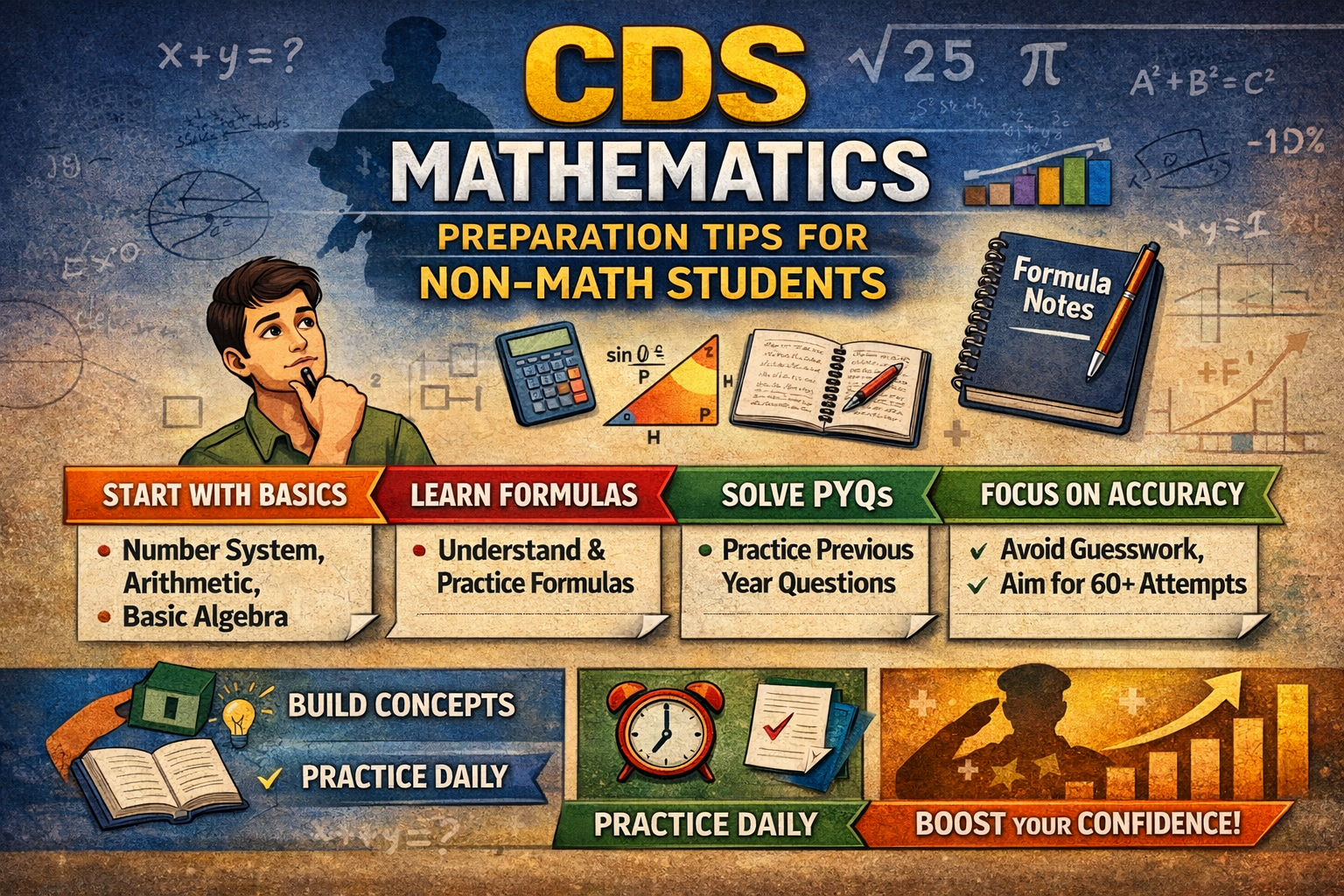
CDS Mathematics Preparation Tips for Non-Math Students
1. Start with Absolute Basics
Non-Math students should rebuild fundamentals from scratch.
Focus on:
Number system basics
Tables (up to 20)
Squares & cubes
Fractions and decimals
Tip: Do not rush into formulas without understanding concepts.
2. Prioritise High-Scoring & Easy Topics
Some topics are easier and more scoring for beginners:
High-priority topics:
Arithmetic (Very important)
Statistics
Basic Algebra
Mensuration
Low-priority (initially):
Complex Trigonometry
Advanced Geometry
3. Master Arithmetic First
Arithmetic forms the backbone of CDS Mathematics.
Key topics:
Percentage
Ratio & Proportion
Simple & Compound Interest
Time, Speed & Distance
Time & Work
These topics:
Are calculation-based
Have predictable question types
Require limited formulas
4. Learn Formulas with Application
Instead of memorising blindly:
Understand where the formula comes from
Solve 10–15 questions per formula
Maintain a formula notebook
Daily revision of formulas is essential.
5. Use CDS Previous Year Maths Question Papers
PYQs are a game-changer for non-Math students.
Benefits:
Understand difficulty level
Identify repeated concepts
Gain confidence
Solve last 10–15 years of CDS Maths PYQs topic-wise.
6. Practice with Time Limit Gradually
Initially:
Solve without time pressure
Later:Apply time limits
Target:
1 question in 1–1.2 minutes
7. Avoid Over-Attempting Due to Negative Marking
One wrong answer can cancel correct marks.
Exam strategy:
Attempt only sure questions
Skip lengthy or confusing questions
Use option elimination wisely
8. Focus on Accuracy Over Speed
Non-Math students should aim for:
70–75% accuracy
Moderate attempts
Strong concept clarity
Accuracy matters more than attempting all questions.
Recommended Study Plan for Non-Math Students
Phase 1 (Basics – 30 Days)
Arithmetic fundamentals
Basic Algebra
Formula learning
Phase 2 (Practice – 30 Days)
Topic-wise MCQs
PYQs
Weak area improvement
Phase 3 (Revision & Testing – 30 Days)
Full-length mock tests
Formula revision
Speed improvement
Common Mistakes Non-Math Students Must Avoid
Jumping to advanced topics early
Ignoring arithmetic basics
Memorising formulas without practice
Avoiding PYQs
Fear-based preparation
Last-Month Strategy for CDS Mathematics
Revise all formulas daily
Solve previous year papers
Focus on strong areas
Avoid learning new concepts
Practice mental calculation
Frequently Asked Questions (FAQs) – CDS Mathematics for Non-Math Students
Q1. Is CDS Mathematics compulsory for all candidates?
Yes, Mathematics is compulsory for IMA, INA, and AFA. OTA candidates do not have a Mathematics paper.
Q2. Can a non-Math student clear CDS Mathematics?
Yes, many non-Math students clear CDS every year with focused preparation and PYQ practice.
Q3. Is CDS Maths difficult compared to NDA Maths?
CDS Maths is slightly easier than NDA Maths and is limited to Class 10 level.
Q4. How many questions should a non-Math student attempt?
Attempt 55–65 questions with high accuracy for a safe score.
Q5. How much time is required to prepare CDS Mathematics from scratch?
With consistent effort, 3–4 months are sufficient for non-Math students.
Q6. Is calculator allowed in CDS Maths exam?
No, calculators or electronic devices are strictly prohibited.
Conclusion
For non-Math students, CDS Mathematics is not an enemy—it is a manageable challenge. With a basics-first approach, smart topic selection, and regular practice, even candidates with weak Math backgrounds can score confidently. The key lies in consistency, concept clarity, and confidence.