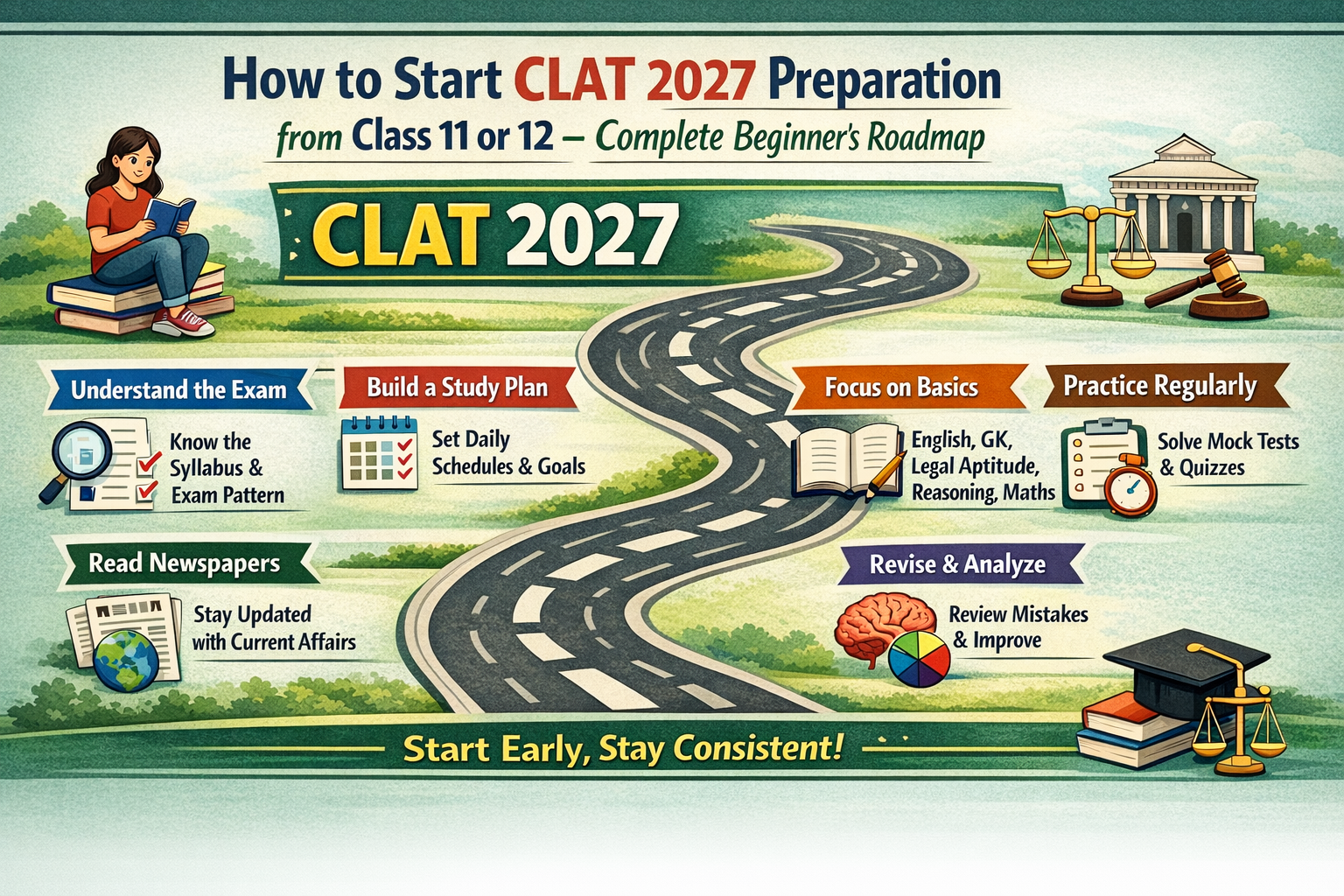
Starting CLAT 2027 preparation from Class 11 or Class 12 gives aspirants a major edge over last-minute starters. With the right strategy, consistent reading habits, and smart practice, students can secure admission into top NLUs without stress. This guide explains how to start CLAT 2027 preparation step-by-step, covering syllabus understanding, section-wise strategy, study plans, mistakes to avoid, and expert tips.
Why Start CLAT 2027 Preparation Early?
CLAT is not a rote-learning exam. It tests:
Reading comprehension
Logical reasoning
Legal aptitude
General awareness
Quantitative techniques
Starting early allows you to:
Build strong reading and reasoning skills
Avoid pressure in Class 12 boards
Improve accuracy and speed gradually
Attempt CLAT with confidence
CLAT 2027 Exam Overview (For Beginners)
Mode: Offline (pen and paper)
Duration: 2 hours
Total Questions: 120 (approx.)
Question Type: Passage-based MCQs
Marking Scheme: +1 for correct, −0.25 for wrong
Understanding the pattern early helps you prepare smartly.
Class 11 vs Class 12 – When Should You Start?
If You Are in Class 11
Focus on reading, basics, and concept clarity
No pressure of results
Ideal time to build long-term skills
If You Are in Class 12
Balance board exams with CLAT prep
Focus on accuracy, mocks, and time management
Prioritise high-weight sections
Both can crack CLAT 2027 with the right plan.
Step-by-Step CLAT 2027 Preparation Strategy
Step 1: Understand CLAT Syllabus & Sections
CLAT has 5 sections:
English Language
Current Affairs & General Knowledge
Legal Reasoning
Logical Reasoning
Quantitative Techniques
Each section is passage-based and tests comprehension + application.
Section-Wise Preparation Strategy
1. English Language
Read newspapers daily
Improve vocabulary through context
Practice reading comprehension passages
Focus Areas:
Tone & inference
Vocabulary in context
Main idea questions
2. Current Affairs & General Knowledge
Daily newspaper reading (national + international)
Monthly current affairs notes
Static GK linked with news
Key Areas:
Polity
International relations
Awards, appointments
Legal current affairs
3. Legal Reasoning
Understand legal principles
Practice application-based questions
Read legal news and landmark judgments
No prior law knowledge required
4. Logical Reasoning
Practice passage-based reasoning
Focus on arguments, assumptions, conclusions
Improve analytical thinking
5. Quantitative Techniques
Basic math (Class 6–10 level)
Practice calculations regularly
Interpret graphs, tables, and charts
Daily Study Routine for Class 11 & 12 Students
Class 11 (2–3 Hours/Day)
English & Reading: 45 minutes
Current Affairs: 30 minutes
Logical/Legal Reasoning: 45 minutes
Light Quant practice: 30 minutes
Class 12 (3–4 Hours/Day)
English + Legal Reasoning: 1.5 hours
GK & Current Affairs: 1 hour
Logical & Quant: 1 hour
Revision: 30 minutes
Consistency matters more than long hours.
Importance of Reading Habit in CLAT Preparation
Reading is the backbone of CLAT.
Best Reading Sources:
Newspapers (daily)
Editorials
Legal articles
Opinion columns
Reading improves:
Speed
Comprehension
Vocabulary
Reasoning ability
When to Start Mock Tests?
Class 11: Sectional tests after basics
Class 12: Regular mock tests (weekly → bi-weekly)
Mock Test Analysis Is Mandatory
Analyse mistakes
Track weak sections
Improve time management
Common Mistakes to Avoid
Ignoring reading practice
Mugging GK without understanding
Avoiding mock tests
Focusing only on one section
Starting preparation too late
Best Advice for CLAT 2027 Aspirants
CLAT is about smart thinking, not memorisation
Start early, stay consistent
Focus on accuracy, not attempts
Balance boards and CLAT wisely
Believe in gradual improvement
Conclusion
Starting CLAT 2027 preparation from Class 11 or 12 is a smart decision that builds confidence and competence over time. With structured planning, daily reading, regular practice, and mock analysis, cracking CLAT 2027 and securing a seat in a top National Law University is absolutely achievable.
Frequently Asked Questions (FAQs)
Q1. Can I start CLAT 2027 preparation from Class 11?
Yes, Class 11 is the best time to build strong reading and reasoning skills.
Q2. Is coaching necessary for CLAT 2027?
Not compulsory. Self-study with mock tests can also yield excellent results.
Q3. How many hours should Class 12 students study for CLAT?
3–4 focused hours daily along with board preparation.
Q4. Is math compulsory in CLAT?
Yes, but only basic math up to Class 10 level.
Q5. When should I start mock tests for CLAT 2027?
After basic preparation, preferably in early Class 12.