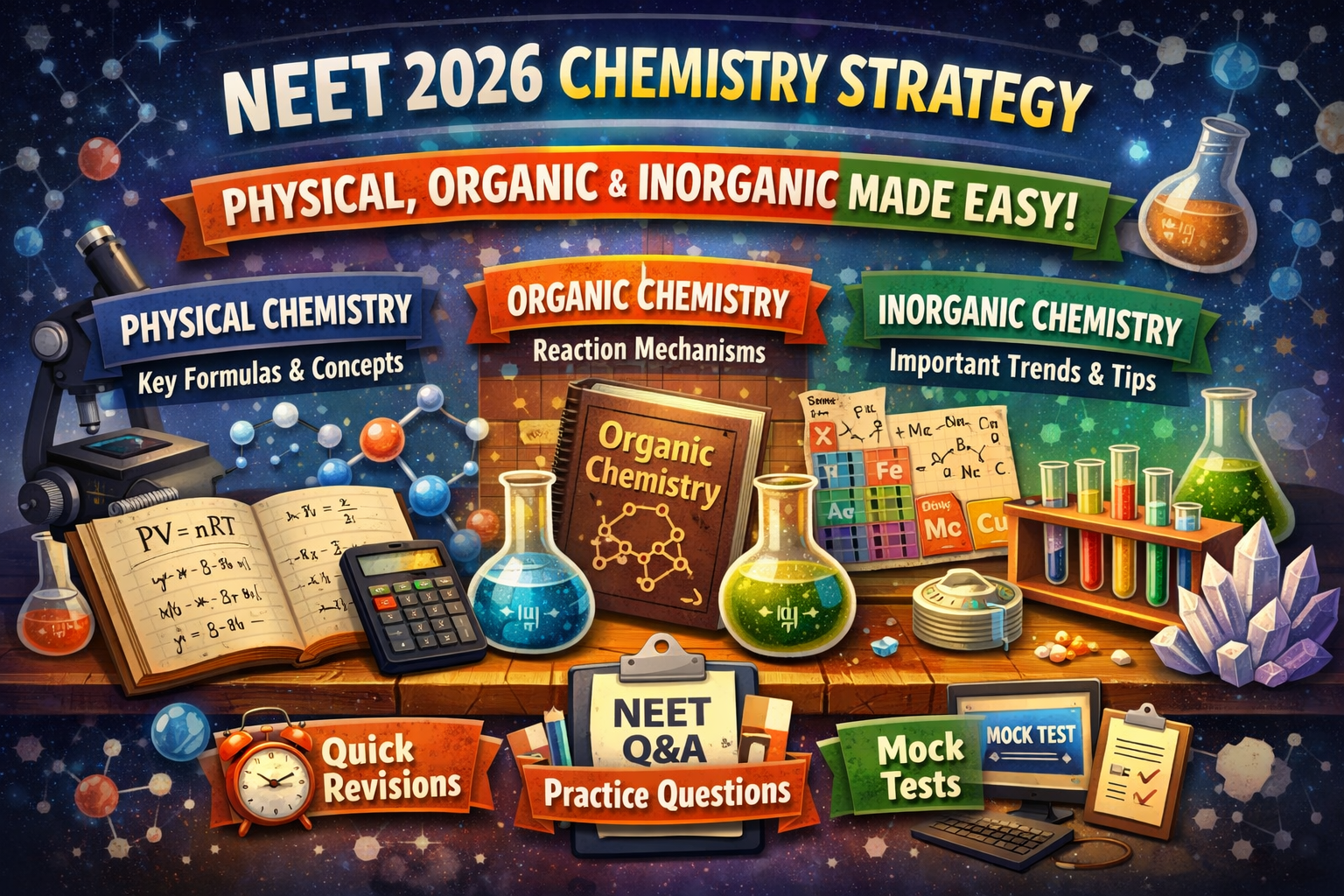
Chemistry is often called the most scoring subject in NEET if prepared with the right balance of concept clarity, practice, and revision. With 180 marks (45 questions), Chemistry can significantly boost your NEET 2026 rank when approached strategically.
This complete guide explains how to prepare Chemistry for NEET 2026, covering Physical, Organic, and Inorganic Chemistry with practical tips, book recommendations, revision plans, and topper-approved strategies.
Why Chemistry Is Crucial for NEET 2026
Chemistry questions are direct and predictable
NCERT-based questions dominate the exam
Less time-consuming compared to Physics
High accuracy = high score
👉 A strong Chemistry score can compensate for mistakes in Physics.
NEET 2026 Chemistry Syllabus Overview
The NEET Chemistry syllabus is based on Class 11 and Class 12 NCERT and divided into three parts:
Physical Chemistry
Organic Chemistry
Inorganic Chemistry
Each section contributes almost equal weightage in NEET.
NEET 2026 Physical Chemistry Strategy
Physical Chemistry is numerical-based and requires concept clarity + calculation skills.
Important Physical Chemistry Topics
Mole Concept & Stoichiometry
Atomic Structure
Thermodynamics
Chemical Equilibrium
Ionic Equilibrium
Electrochemistry
Chemical Kinetics
Solutions
Solid State
How to Prepare Physical Chemistry Effectively
✔ Understand formulas and derivations
✔ Practice numericals daily
✔ Focus on units and calculations
✔ Solve NEET previous year questions
Daily Practice Plan
30–40 numericals per day
Maintain a formula notebook
Revisit weak chapters weekly
📌 Physical Chemistry becomes easy with regular numerical practice.
NEET 2026 Organic Chemistry Strategy
Organic Chemistry is logic-based, not memorisation-based.
Important Organic Chemistry Topics
General Organic Chemistry (GOC)
Hydrocarbons
Haloalkanes & Haloarenes
Alcohols, Phenols & Ethers
Aldehydes, Ketones & Carboxylic Acids
Amines
Biomolecules
Polymers
Chemistry in Everyday Life
How to Master Organic Chemistry
✔ Build strong GOC fundamentals
✔ Understand reaction mechanisms
✔ Practice reactions regularly
✔ Make short reaction notes
Smart Organic Study Tips
Learn reactions with mechanism + reason
Focus on named reactions
Practice assertion-reason questions
Revise reactions weekly
📌 Strong GOC = Easy Organic Chemistry.
NEET 2026 Inorganic Chemistry Strategy
Inorganic Chemistry is NCERT-dependent and requires smart memorisation.
Important Inorganic Chemistry Topics
Periodic Table & Trends
Chemical Bonding
Coordination Compounds
p-Block Elements
d & f Block Elements
Metallurgy
How to Prepare Inorganic Chemistry Easily
✔ Read NCERT line by line
✔ Focus on tables, diagrams, and exceptions
✔ Use mnemonics for memorisation
✔ Revise frequently
Inorganic Study Technique
Read NCERT → revise → test yourself
Highlight key points
Daily 20–30 minutes revision
📌 Multiple revisions are the key to Inorganic Chemistry.
Best Books for NEET 2026 Chemistry
Must-Have Books
NCERT Chemistry (Class 11 & 12)
Reference Books
Physical Chemistry – O.P. Tandon / N. Awasthi
Organic Chemistry – M.S. Chouhan
Inorganic Chemistry – V.K. Jaiswal
NEET Previous Year Questions (PYQs)
👉 Do not follow too many books. Stick to limited, high-quality resources.
Time Management Strategy for Chemistry
Daily Study Time
Class 11 students: 2–2.5 hours/day
Droppers: 3 hours/day
Ideal Time Division
Physical Chemistry – 40%
Organic Chemistry – 35%
Inorganic Chemistry – 25%
Revision Strategy for NEET 2026 Chemistry
Without revision, Chemistry cannot be retained.
✔ Weekly revision of studied chapters
✔ Monthly full syllabus revision
✔ Daily formula/reaction review
✔ Revise NCERT before every mock test
📌 Last 2 months should be revision + mock tests only.
Importance of Mock Tests & PYQs
Solve last 15 years NEET PYQs
Attempt full-length mock tests regularly
Analyse mistakes topic-wise
Improve speed and accuracy
Chemistry is a time-saving section in NEET if practiced well.
Common Mistakes to Avoid in NEET Chemistry
❌ Ignoring NCERT
❌ Rote learning without understanding
❌ Skipping revision
❌ Not practicing numericals
❌ Avoiding mock test analysis
Final Tips to Score 160+ in NEET 2026 Chemistry
✔ NCERT is your Bible
✔ Practice Physical Chemistry daily
✔ Strengthen GOC for Organic
✔ Revise Inorganic frequently
✔ Stay consistent and disciplined
Chemistry is the easiest subject to score high in NEET if prepared smartly.
Frequently Asked Questions (FAQs)
Q1. Is Chemistry scoring in NEET 2026?
Yes, Chemistry is considered the most scoring subject due to direct NCERT-based questions.
Q2. How many questions come from NCERT in NEET Chemistry?
Around 80–90% questions are directly or indirectly from NCERT.
Q3. Which Chemistry section is easiest for NEET?
Inorganic Chemistry is easiest if NCERT is revised multiple times.
Q4. How much time is enough to complete Chemistry syllabus?
6–8 months with proper revision and practice is sufficient.
Q5. Can I score full marks in NEET Chemistry?
Yes, many toppers score 170–180 marks with consistent practice and revision.
Q6. Which section should I start first in Chemistry?
Start with Physical Chemistry basics, then Organic (GOC), followed by Inorganic.