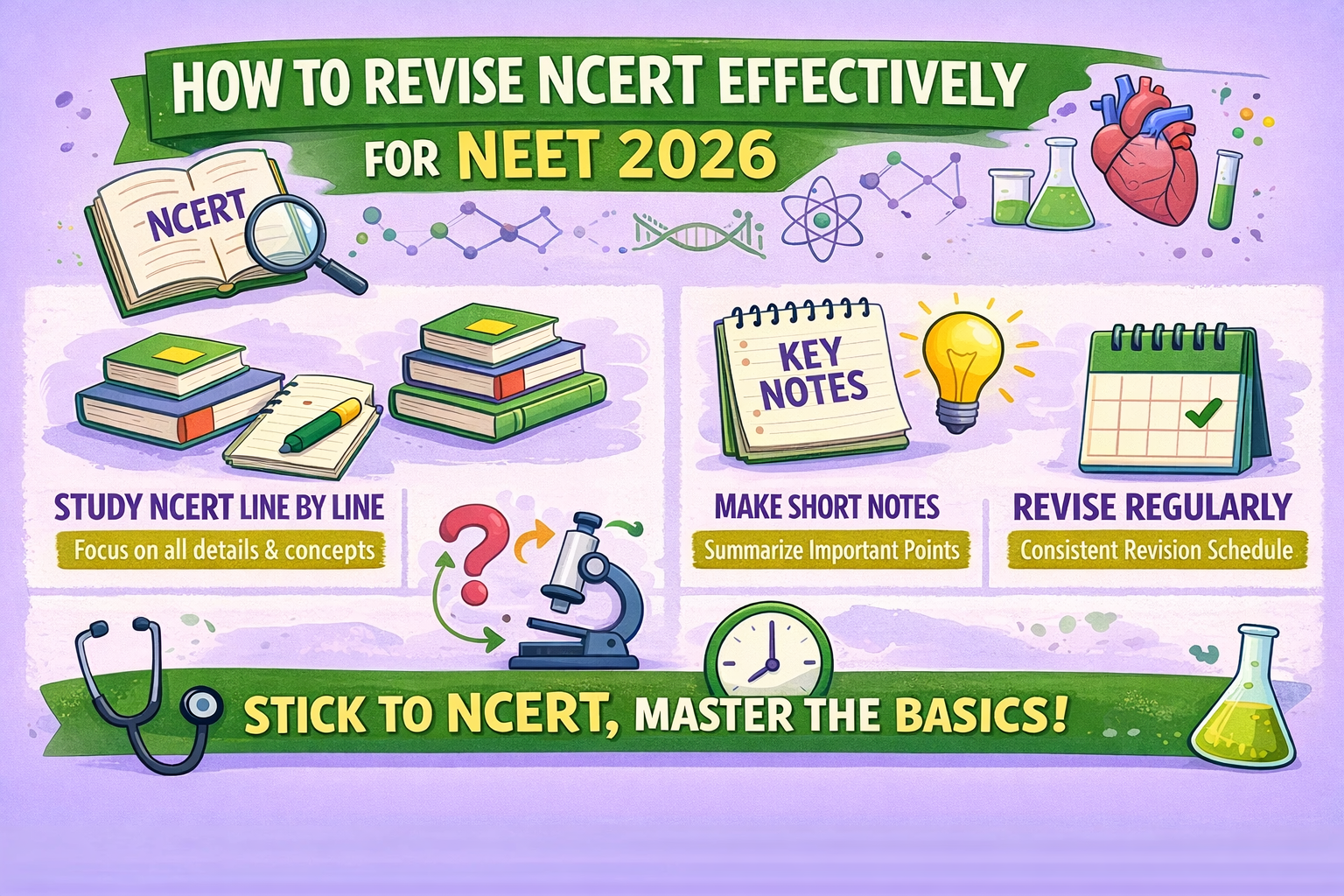
NCERT is the backbone of NEET preparation. Every year, 85–90% of NEET Biology, 60–70% of Chemistry, and a significant portion of Physics theory-based questions are asked directly or indirectly from NCERT.
If you want a high NEET 2026 score, revising NCERT effectively is not optional — it is mandatory.
This guide explains how to revise NCERT smartly, subject-wise strategies, common mistakes, and a proven revision framework followed by NEET toppers.
Why NCERT Revision Is Crucial for NEET 2026
Direct questions from NCERT lines
Biology questions are almost 100% NCERT-based
Inorganic Chemistry comes word-to-word from NCERT
Concept clarity in Physics depends on NCERT theory
🎯 One NCERT revision is never enough — multiple revisions create rankers.
How Many Times Should You Revise NCERT for NEET 2026?
| Subject | Ideal Revisions |
|---|---|
| Biology | 6–8 times |
| Chemistry | 4–6 times |
| Physics | 3–4 times |
📌 Quality of revision matters more than quantity.
SUBJECT-WISE NCERT REVISION STRATEGY
NCERT REVISION STRATEGY FOR BIOLOGY (MOST IMPORTANT)
Step-by-Step Biology Revision Method
1. Read NCERT Line by Line
Read every sentence, including examples
Don’t skip small paragraphs or footnotes
Focus on definitions & keywords
2. Master NCERT Diagrams
Label diagrams yourself
Understand process-based diagrams
Expect direct diagram-based questions
3. Highlight Smartly
Use 3-color method:
Yellow → Definitions
Blue → Examples & facts
Pink → Confusing lines
4. Make NCERT-Based Notes
One-page summary per chapter
Flowcharts for processes
Tables for comparisons
5. Solve PYQs from NCERT Chapters
Identify repeated lines
Mark confusing statements
📌 Biology Golden Rule:
👉 If it’s not in NCERT, don’t overthink it.
NCERT REVISION STRATEGY FOR CHEMISTRY
Chemistry requires different approaches for each part.
Inorganic Chemistry (100% NCERT-Based)
Memorize tables, trends, exceptions
Revise:
Coordination compounds
p-Block elements
d- & f-block elements
Learn color, reactions, uses, exceptions
📌 Read NCERT word-by-word, even summaries.
Organic Chemistry (Concept + NCERT)
Revise:
Reaction mechanisms
Named reactions
Reagents & conditions
Link NCERT reactions with GOC concepts
Practice conversions after revision
📌 Use NCERT examples as core practice.
Physical Chemistry (Formula-Focused)
Revise:
Formulas
Graphs
NCERT derivations
Solve numericals immediately after reading
📌 Revision = Formula + Application
NCERT REVISION STRATEGY FOR PHYSICS
Physics NCERT is mainly concept-based.
Effective Physics Revision Steps
Read theory for:
Laws
Assumptions
Limitations
Memorize formulas with units
Practice NCERT examples & exercises
Create a formula notebook
📌 Revise Modern Physics & Semiconductors directly from NCERT.
SMART NCERT REVISION TECHNIQUES FOR NEET 2026
1. Active Recall Method
Close the book and recall points
Write keywords from memory
Improves long-term retention
2. Spaced Revision Formula
| Revision | Time Gap |
|---|---|
| 1st | Same day |
| 2nd | After 3 days |
| 3rd | After 10 days |
| 4th | After 30 days |
3. NCERT + PYQ Integration
Revise NCERT
Solve PYQs immediately
Highlight repeated lines
4. Last 60 Days NCERT Strategy
Biology → Daily revision
Chemistry → Alternate days
Physics → Concept + formula revision
COMMON MISTAKES TO AVOID WHILE REVISING NCERT
❌ Reading passively without recall
❌ Ignoring diagrams and tables
❌ Skipping examples
❌ Studying reference books before NCERT
❌ Not revising highlighted points
LAST-MONTH NCERT REVISION PLAN
Biology
2 chapters/day
Focus on diagrams & definitions
Chemistry
1–2 chapters/day
Revise reactions & formulas
Physics
Formula + PYQs
Weak chapters first
FINAL TOPPER TIPS FOR NCERT REVISION
✔ Revise NCERT before every mock test
✔ Highlight only once — revise many times
✔ Trust NCERT more than coaching notes
✔ Accuracy > Speed
🎯 NCERT mastery alone can fetch you 600+ marks in NEET.
Frequently Asked Questions (FAQs)
Q1. Is NCERT enough for NEET 2026?
Yes, NCERT is sufficient for Biology & Inorganic Chemistry. Physics and Physical Chemistry need extra practice.
Q2. How many hours daily should I revise NCERT?
Minimum 3–4 hours daily, more during the last 3 months.
Q3. Should I make notes from NCERT?
Yes, but keep them short, chapter-wise, and revision-friendly.
Q4. How to remember NCERT Biology better?
Use diagrams, active recall, and multiple revisions.
Q5. Is highlighting important?
Yes, but over-highlighting is harmful. Highlight only exam-relevant lines.