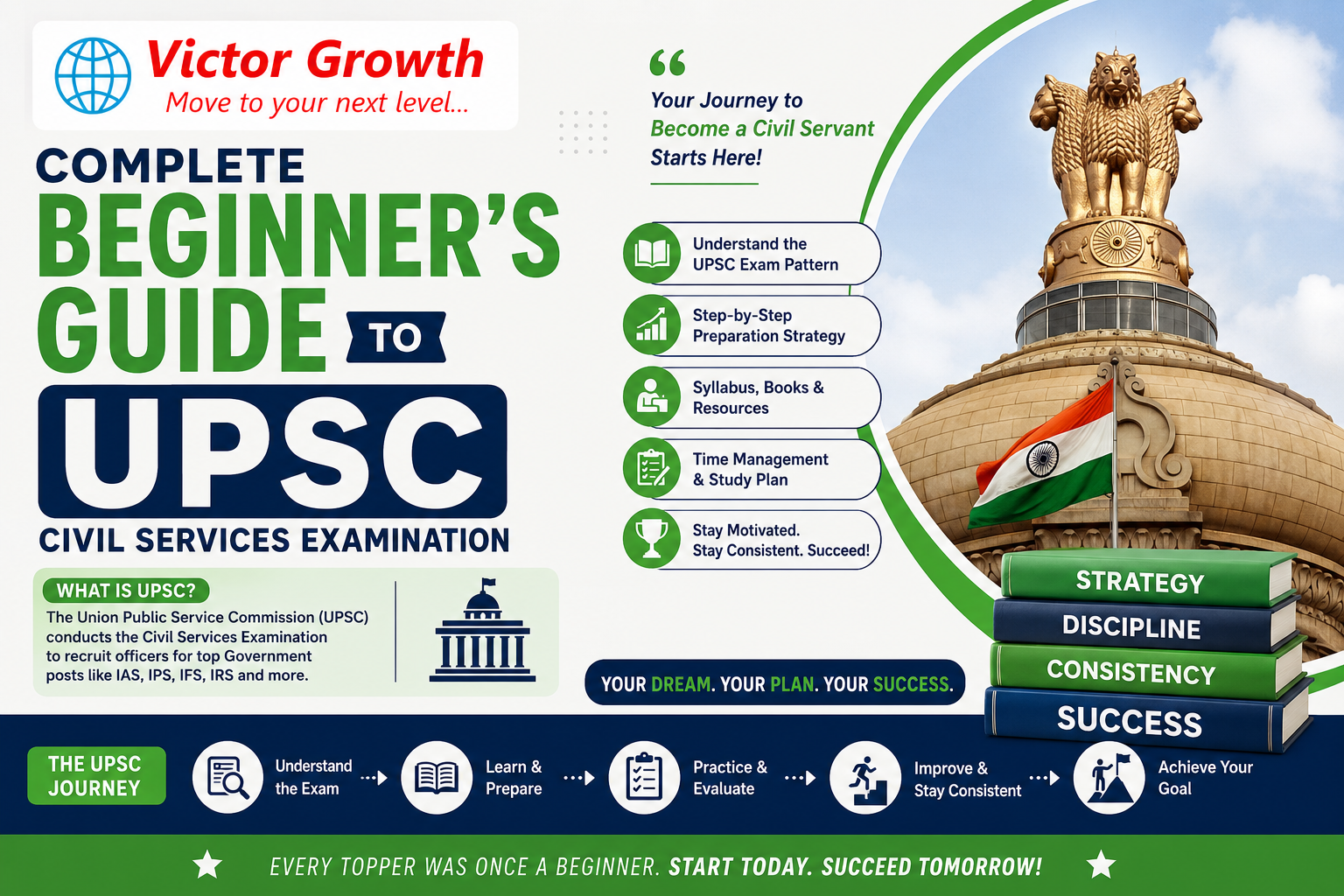
The Union Public Service Commission (UPSC) Civil Services Examination (CSE) is India’s most prestigious and competitive examination. Every year, more than 10 lakh candidates apply for the examination with the dream of serving the nation as Indian Administrative Service (IAS), Indian Police Service (IPS), Indian Foreign Service (IFS), Indian Revenue Service (IRS), and several other Central Civil Services.
The UPSC examination is not merely an academic test—it evaluates a candidate’s knowledge, analytical thinking, decision-making ability, communication skills, ethics, leadership qualities, and overall personality.
For beginners, the examination may appear overwhelming due to its vast syllabus and multi-stage selection process. However, with the right strategy, proper guidance, and consistent preparation, clearing UPSC is an achievable goal.
If you’re searching for the best IAS coaching in Kerala, this comprehensive guide will help you understand every aspect of the UPSC Civil Services Examination and prepare confidently.
What is the UPSC Civil Services Examination?
The UPSC Civil Services Examination (CSE) is conducted annually by the Union Public Service Commission to recruit officers for India’s premier civil services.
Successful candidates are appointed to various services, including:
- Indian Administrative Service (IAS)
- Indian Police Service (IPS)
- Indian Foreign Service (IFS)
- Indian Revenue Service (IRS)
- Indian Audit & Accounts Service (IA&AS)
- Indian Railway Management Service (IRMS)
- Indian Defence Accounts Service (IDAS)
- Indian Information Service (IIS)
- Indian Postal Service (IPoS)
- Indian Trade Service (ITS)
- And several other Group A and Group B services.
Why Choose a Career in Civil Services?
Civil Services offer:
- Opportunity to serve society
- Leadership roles in governance
- Job security
- Attractive salary and allowances
- Prestige and respect
- Diverse career opportunities
- Nation-building responsibilities
- Continuous learning and professional growth
For many aspirants, becoming an IAS officer is more than a career—it is a mission to create positive change.
Eligibility Criteria
Before beginning your preparation, ensure you meet the eligibility requirements.
Nationality
For IAS, IPS, and IFS:
- Must be an Indian citizen.
For certain other services, additional nationality provisions may apply as notified by UPSC.
Educational Qualification
Candidates must possess a Bachelor’s Degree from a recognized university.
Students in the final year of graduation can also apply, subject to fulfilling the required conditions before the Mains examination.
Age Limit
The age limit varies according to the candidate’s category as specified in the official UPSC notification. Age relaxations are available for eligible reserved categories.
Always refer to the latest UPSC notification for current eligibility details.
Number of Attempts
The number of permitted attempts depends on the candidate’s category and applicable government rules. Refer to the latest UPSC notification for updated information.
Stages of the UPSC Civil Services Examination
The examination consists of three stages.
Stage 1: Preliminary Examination (Objective)
The Preliminary Examination serves as the screening stage.
It consists of two papers:
Paper I – General Studies (GS)
Subjects include:
- History
- Geography
- Indian Polity
- Economy
- Environment
- Science & Technology
- Current Affairs
- International Relations
- Government Schemes
Marks: 200
Paper II – CSAT
Includes:
- Reading Comprehension
- Logical Reasoning
- Decision Making
- Quantitative Aptitude
- Data Interpretation
Marks: 200
CSAT is qualifying in nature, subject to UPSC rules.
Stage 2: Main Examination (Descriptive)
Candidates who qualify Prelims appear for the Mains examination.
It includes:
- Essay
- General Studies Paper I
- General Studies Paper II
- General Studies Paper III
- General Studies Paper IV (Ethics)
- Optional Subject Paper I
- Optional Subject Paper II
- Indian Language Paper (Qualifying)
- English Paper (Qualifying)
Mains evaluates analytical ability, writing skills, conceptual clarity, and balanced thinking.
Stage 3: Personality Test (Interview)
Candidates qualifying Mains appear for the Personality Test.
The interview assesses:
- Communication skills
- Leadership qualities
- Ethical values
- Decision-making ability
- Presence of mind
- General awareness
- Emotional intelligence
- Confidence
Understanding the UPSC Syllabus
One of the biggest mistakes beginners make is starting preparation without studying the syllabus.
The syllabus should be your roadmap.
Major subjects include:
- Indian History
- Geography
- Indian Constitution
- Governance
- Economy
- Environment & Ecology
- Science & Technology
- Ethics
- Internal Security
- Disaster Management
- International Relations
- Agriculture
- Current Affairs
Print the syllabus and keep it with you throughout your preparation.
Standard Books for Beginners
A beginner should start with trusted and standard resources.
Recommended categories include:
- NCERT textbooks
- Indian Polity
- Modern Indian History
- Geography
- Indian Economy
- Environment
- Ethics
- Atlas
- Current Affairs magazines
- Government reports
- Economic Survey
- Union Budget
Avoid collecting too many books. Revise a limited set of reliable resources multiple times.
Importance of Current Affairs
Current Affairs form the backbone of UPSC preparation.
Read a national newspaper daily and supplement it with:
- Government reports
- PIB releases
- Monthly current affairs compilations
- Budget highlights
- Economic Survey
- International developments
Relate current events to the static syllabus for better understanding.
Importance of Answer Writing
Many aspirants postpone answer writing until completing the syllabus.
This is a mistake.
Start writing answers early.
Practice:
- 150-word answers
- 250-word answers
- Essay writing
- Ethics case studies
Regular evaluation helps improve structure, clarity, and time management.
Role of Mock Tests
Mock tests help aspirants:
- Improve accuracy
- Build confidence
- Manage time effectively
- Identify weak areas
- Familiarize themselves with exam conditions
Analyze every mock test thoroughly to learn from mistakes.
Importance of Revision
Revision is the key to long-term retention.
A simple revision strategy:
- Daily revision
- Weekly revision
- Monthly revision
- Full syllabus revision before the examination
Most toppers revise the same resources multiple times instead of constantly adding new ones.
Common Mistakes Beginners Should Avoid
- Ignoring the syllabus
- Reading too many books
- Skipping NCERTs
- Neglecting Current Affairs
- Avoiding answer writing
- Ignoring CSAT
- Following multiple online sources
- Not revising regularly
- Studying without a timetable
- Comparing yourself with others
Avoiding these mistakes can save months of preparation time.
Suggested Daily Study Plan for Beginners
A balanced daily schedule may include:
| Activity | Duration |
|---|---|
| Newspaper & Current Affairs | 1 Hour |
| General Studies Subject 1 | 2 Hours |
| General Studies Subject 2 | 2 Hours |
| Optional Subject | 2 Hours |
| Answer Writing Practice | 1 Hour |
| Revision | 1 Hour |
| Mock Test / CSAT Practice | 1 Hour |
Adjust the schedule according to your personal commitments and productivity.
How Long Should You Prepare?
Most successful candidates prepare consistently for 12–24 months.
The duration depends on:
- Educational background
- Familiarity with subjects
- Available study time
- Previous preparation
- Writing skills
- Consistency
Quality of study is more important than the number of hours.
Self-Study or Coaching?
Both approaches have advantages.
Self-study offers:
- Flexibility
- Lower cost
- Personalized learning
Coaching provides:
- Structured guidance
- Expert mentorship
- Answer writing evaluation
- Regular tests
- Interview preparation
Many successful candidates combine coaching with disciplined self-study.
Why the Best IAS Coaching in Kerala Can Make a Difference
A reputed institute provides:
- Experienced faculty
- Comprehensive study materials
- Structured classroom programme
- Personalized mentorship
- Regular Prelims and Mains test series
- Current affairs discussions
- Essay and Ethics guidance
- Interview preparation
- Performance tracking
- Doubt-clearing sessions
For beginners, choosing the best IAS coaching in Kerala can provide clarity, confidence, and a systematic approach to preparation.
Tips for UPSC Beginners
✔ Understand the syllabus before starting.
✔ Read standard books instead of too many resources.
✔ Build strong fundamentals with NCERTs.
✔ Practice answer writing from the beginning.
✔ Read newspapers every day.
✔ Revise consistently.
✔ Take regular mock tests.
✔ Maintain physical and mental health.
✔ Stay disciplined and patient.
✔ Learn from your mistakes and keep improving.
Final Thoughts
The UPSC Civil Services Examination is undoubtedly challenging, but it is also one of the most rewarding career paths in India. Success does not depend on extraordinary intelligence alone—it depends on consistent effort, smart planning, conceptual clarity, disciplined revision, and continuous self-improvement.
As a beginner, focus on building strong fundamentals rather than rushing through the syllabus. Follow standard resources, practice answer writing regularly, stay updated with current affairs, and evaluate your progress through mock tests.
If you need structured guidance, personalized mentorship, and systematic preparation, enrolling in the best IAS coaching in Kerala can significantly improve your learning experience and help you avoid common mistakes. With determination, patience, and the right strategy, your dream of becoming a civil servant can become a reality.
Frequently Asked Questions (FAQs)
1. What is the UPSC Civil Services Examination?
The UPSC Civil Services Examination is a national-level competitive examination conducted to recruit officers for prestigious services such as IAS, IPS, IFS, IRS, and other Group A and Group B Central Services.
2. Who can apply for the UPSC Civil Services Examination?
Candidates who hold a Bachelor’s degree from a recognized university and meet the age, nationality, and other eligibility conditions mentioned in the latest UPSC notification can apply.
3. How many stages are there in the UPSC examination?
The examination has three stages:
- Preliminary Examination
- Main Examination
- Personality Test (Interview)
4. How long does UPSC preparation usually take?
Most successful candidates prepare consistently for 12 to 24 months, depending on their academic background and available study time.
5. Is coaching necessary for UPSC preparation?
No. Coaching is not compulsory, but it provides structured guidance, mentorship, test series, answer writing practice, and interview preparation, which can improve your chances of success.
6. Which books should beginners start with?
Beginners should begin with NCERT textbooks, followed by standard reference books for Polity, History, Geography, Economy, Environment, and Current Affairs. Avoid collecting too many resources.
7. How important are mock tests and answer writing?
They are extremely important. Mock tests improve exam temperament, while answer writing enhances analytical thinking, presentation skills, and time management for the Mains examination.
8. How can the best IAS coaching in Kerala help beginners?
The best IAS coaching in Kerala offers experienced faculty, structured study plans, updated study materials, regular test series, answer writing evaluation, current affairs guidance, personalized mentorship, and interview preparation, helping beginners prepare confidently and systematically.