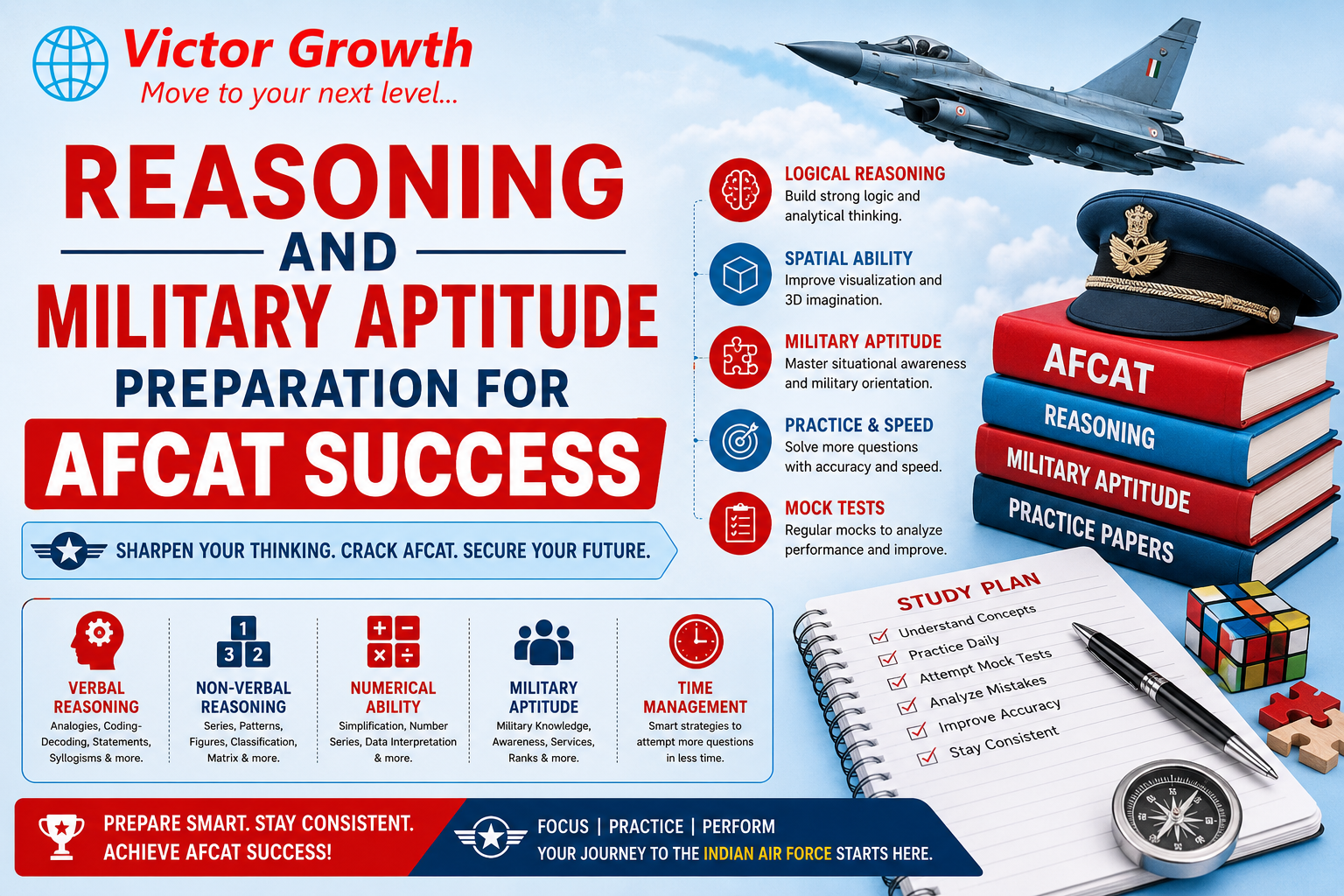
Reasoning and Military Aptitude are important areas of AFCAT preparation that test a candidate’s logical thinking, analytical ability, pattern recognition, spatial understanding, decision-making and problem-solving skills. Unlike subjects that depend heavily on memorisation, these areas improve significantly through consistent practice, familiarity with question patterns, speed-building exercises and regular mock tests.
For aspirants searching for the best AFCAT coaching in Kerala, choosing a preparation programme that provides structured Reasoning and Military Aptitude training can make the learning process more systematic. However, coaching alone is not enough. Regular individual practice is essential to develop the speed and accuracy required in a competitive examination.
This comprehensive guide explains how to prepare for AFCAT Reasoning and Military Aptitude, important topics to study, effective preparation techniques, time-management strategies, common mistakes and how to choose the right AFCAT coaching support.
What Are Reasoning and Military Aptitude in AFCAT?
Reasoning and Military Aptitude primarily assess your ability to:
- Identify patterns
- Analyse information
- Establish logical relationships
- Interpret figures
- Solve problems
- Understand sequences
- Recognise spatial relationships
- Make decisions quickly
- Apply logical thinking under time pressure
These skills are not developed simply by reading theory.
The most effective preparation cycle is:
Understand → Practise → Time Yourself → Analyse → Improve
Why Is Reasoning Important for AFCAT?
Reasoning questions can become scoring opportunities when you are familiar with common patterns.
Unlike General Awareness, where you need to remember factual information, reasoning often allows you to arrive at the answer through logic.
Regular practice can improve:
- Problem-solving speed
- Logical thinking
- Pattern recognition
- Accuracy
- Confidence
- Question-selection ability
The more different types of questions you practise, the easier it becomes to recognise familiar patterns during the examination.
Important AFCAT Reasoning Topics
Aspirants should build preparation around the major reasoning areas relevant to the examination.
1. Analogy
Analogy questions require you to identify the relationship between two items and apply the same relationship to another pair.
Examples may involve:
- Words
- Numbers
- Letters
- Figures
Preparation Tip
Don’t simply memorise patterns.
Ask:
What is the relationship between the first pair?
Once you identify the relationship, apply the same logic to the second pair.
2. Classification
Classification questions ask you to identify the item that does not belong to a particular group.
These may be based on:
- Numbers
- Letters
- Words
- Shapes
- Logical properties
How to Practise
Look for:
- Common characteristics
- Numerical relationships
- Alphabetical patterns
- Shape differences
- Logical categories
3. Series
Series questions are common in reasoning practice.
They can involve:
- Number series
- Alphabet series
- Mixed series
- Figure series
Strategy
Look for:
- Addition
- Subtraction
- Multiplication
- Division
- Alternating patterns
- Position changes
- Increasing/decreasing differences
Start with simple patterns and gradually move to more complex ones.
4. Coding-Decoding
Coding-decoding questions test your ability to identify relationships between letters, numbers or words.
Possible patterns include:
- Alphabet shifts
- Reverse order
- Position changes
- Symbol substitution
- Number-letter relationships
Preparation Tip
Practise different coding patterns rather than trying to memorise individual examples.
The objective is to develop pattern recognition.
5. Blood Relations
Blood-relation questions test your ability to understand family relationships.
They may involve:
- Parents
- Siblings
- Children
- Grandparents
- Uncles and aunts
- Cousins
Best Technique
Draw a simple family tree instead of trying to solve complicated relationships entirely in your head.
For example:
Grandparent → Parent → Child
Visual representation can reduce confusion and save time.
6. Direction Sense
These questions test your understanding of directions and movement.
Important directions include:
- North
- South
- East
- West
- North-East
- North-West
- South-East
- South-West
Preparation Tip
Draw a quick directional diagram.
This can help you avoid mental confusion when several movements are involved.
7. Venn Diagrams
Venn diagrams help represent relationships between different groups.
Practise identifying:
- Common elements
- Separate groups
- Overlapping groups
- Logical relationships
Understanding the basic structure makes these questions easier to solve.
8. Logical Reasoning
Logical reasoning requires you to analyse information and arrive at a conclusion.
Questions may involve:
- Statements
- Conclusions
- Arguments
- Conditions
- Relationships
- Logical sequences
Preparation Strategy
Read the question carefully before making assumptions.
Base your answer on the information provided rather than outside knowledge.
9. Non-Verbal Reasoning
Non-verbal reasoning uses figures, shapes and visual patterns.
Topics may include:
- Figure series
- Figure classification
- Mirror images
- Water images
- Embedded figures
- Paper folding
- Figure completion
- Pattern recognition
Best Way to Improve
Regular visual practice is essential.
The more figures you solve, the faster you become at identifying patterns.
10. Spatial Ability
Spatial reasoning is particularly relevant to aptitude-based examination preparation.
It involves understanding:
- Position
- Direction
- Rotation
- Distance
- Shapes
- Relative location
Preparation Tip
Practise visualising objects from different orientations.
Diagrams and figure-based practice are especially useful.
Military Aptitude Preparation for AFCAT
Military Aptitude preparation is closely associated with the ability to process information and solve aptitude-oriented problems efficiently.
Candidates should focus on developing:
- Spatial awareness
- Logical thinking
- Visual reasoning
- Pattern recognition
- Analytical thinking
- Quick decision-making
Do not approach aptitude preparation as something that can be mastered through memorisation alone.
The skill develops through repeated exposure to different question types.
How to Prepare for AFCAT Reasoning and Military Aptitude
1. Start With the Basics
If you are a beginner, don’t immediately attempt difficult questions.
Start with:
Basic Concepts → Easy Questions → Moderate Questions → Timed Questions → Mixed Tests
This progression allows you to build confidence gradually.
2. Learn the Logic Behind Each Question Type
When you solve a reasoning question, don’t just remember the answer.
Understand:
- What pattern was used?
- Why does the solution work?
- Could there be a faster method?
- What clues should you look for next time?
This develops transferable reasoning skills.
3. Practise Every Day
Reasoning improves with regular practice.
Even 30–60 minutes of daily practice can be useful if maintained consistently.
For example:
Monday
Series
Tuesday
Analogy + Classification
Wednesday
Coding-Decoding
Thursday
Blood Relations + Direction Sense
Friday
Logical Reasoning
Saturday
Non-Verbal Reasoning
Sunday
Mixed Test + Analysis
4. Focus on Accuracy First
Beginners often make the mistake of trying to solve questions as quickly as possible.
First develop accuracy.
Use this progression:
Accuracy → Consistency → Speed
Once you consistently solve questions correctly, start reducing the time taken.
5. Use a Timer
Timed practice is essential.
For example:
Instead of solving 20 questions without a time limit, set a realistic time limit and attempt them.
Then gradually reduce the available time while maintaining accuracy.
This trains your brain to work under examination pressure.
6. Solve Previous-Year Questions
Previous-year questions help you become familiar with the style and difficulty of competitive examination questions.
When practising, identify:
- Repeated concepts
- Common patterns
- Frequently tested areas
- Question difficulty
- Time-consuming question types
Do not simply solve them once.
Revisit difficult questions during revision.
7. Take Sectional Tests
Sectional tests allow you to focus specifically on Reasoning and Military Aptitude.
After every test, analyse:
- Total attempts
- Correct answers
- Incorrect answers
- Accuracy
- Time taken
- Weak topics
This helps you identify exactly where improvement is required.
8. Maintain a Reasoning Mistake Notebook
Create a separate notebook for mistakes.
For every incorrect question, record:
Question Type: Coding-Decoding
Mistake: Misidentified the alphabet pattern
Correct Approach: Check positional difference
This allows you to recognise repeated mistakes.
How to Improve Reasoning Speed for AFCAT
Speed is developed through familiarity.
Suppose you have solved hundreds of series questions.
When you encounter another series during the examination, your brain is more likely to recognise familiar patterns quickly.
To improve speed:
- Practise regularly
- Use a timer
- Solve previous-year questions
- Learn efficient approaches
- Avoid unnecessary calculations
- Analyse slow questions
Question Selection Strategy for Reasoning
Not every reasoning question deserves the same amount of time.
Easy Questions
Solve immediately.
Moderate Questions
Attempt if the method is clear.
Difficult Questions
Skip temporarily if they are consuming excessive time.
This strategy protects valuable examination time.
How Mock Tests Improve Reasoning Performance
Mock tests are one of the most effective tools for improving reasoning performance.
They help you practise:
- Speed
- Accuracy
- Question selection
- Pattern recognition
- Time management
- Exam pressure
After each mock test, identify your top three reasoning weaknesses.
For example:
- Coding-decoding
- Non-verbal reasoning
- Direction sense
Spend additional practice time on those areas.
How to Combine Reasoning and Military Aptitude With Other AFCAT Subjects
Don’t study Reasoning in isolation.
A balanced AFCAT schedule could include:
| Activity | Suggested Focus |
|---|---|
| English | Vocabulary + Grammar |
| General Awareness | Static GK + Current Affairs |
| Numerical Ability | Concepts + Practice |
| Reasoning | Logical + Non-verbal questions |
| Military Aptitude | Spatial + Visual reasoning |
| PYQs | Mixed practice |
| Mock Tests | Full examination practice |
| Revision | Mistake notebook + Weak topics |
This prevents you from becoming strong in one area while neglecting others.
AFCAT Reasoning Study Plan for Beginners
Week 1: Fundamentals
Focus on:
- Analogy
- Classification
- Series
- Basic coding-decoding
The objective is to understand common patterns.
Week 2: Logical Reasoning
Focus on:
- Blood relations
- Direction sense
- Venn diagrams
- Logical relationships
Start timed practice.
Week 3: Non-Verbal Reasoning
Focus on:
- Figure series
- Figure classification
- Mirror images
- Water images
- Embedded figures
- Spatial problems
Week 4: Mixed Practice
Focus on:
- Previous-year questions
- Sectional tests
- Mixed reasoning sets
- Mock tests
- Mistake analysis
30-Day AFCAT Reasoning and Military Aptitude Strategy
Days 1–7
Build basic concepts and solve easy questions.
Days 8–14
Move to moderate-level questions and timed practice.
Days 15–21
Focus on non-verbal and spatial reasoning along with previous-year questions.
Days 22–26
Take sectional tests and analyse performance.
Days 27–30
Focus on:
- Mixed practice
- Full-length mock tests
- Weak topics
- Speed
- Accuracy
- Revision
Common Mistakes in AFCAT Reasoning Preparation
1. Memorising Solutions
Understanding the logic is more valuable than memorising answers.
2. Ignoring Non-Verbal Questions
Visual reasoning requires regular practice.
3. Practising Without a Timer
You may become accurate but remain too slow.
4. Not Reviewing Mistakes
Repeated mistakes indicate areas that need targeted practice.
5. Starting With Difficult Questions
Build your fundamentals first.
6. Spending Too Long on One Problem
Learn when to move on.
7. Ignoring Previous-Year Questions
PYQs provide valuable exam-oriented practice.
8. Taking Mock Tests Without Analysis
The score alone doesn’t tell you how to improve.
Best Books and Resources for AFCAT Reasoning
Aspirants should avoid collecting too many books.
Useful resources can include:
Reasoning
A standard verbal and non-verbal reasoning book such as A Modern Approach to Verbal & Non-Verbal Reasoning by R.S. Aggarwal can provide extensive practice.
AFCAT-Specific Practice
Use AFCAT-oriented question banks and previous-year questions.
Mock Tests
Include both sectional and full-length mock tests.
Visual Practice
For Military Aptitude and non-verbal reasoning, use resources containing adequate figure-based questions.
The goal should be:
One good resource + repeated practice + PYQs + mock tests
How the Best AFCAT Coaching in Kerala Can Help With Reasoning and Military Aptitude
For aspirants searching for the best AFCAT coaching in Kerala, evaluate the quality of Reasoning and Military Aptitude preparation offered by the institute.
A strong programme should ideally include:
1. Experienced Faculty
Teachers should be able to explain logical approaches clearly and demonstrate efficient problem-solving methods.
2. Topic-Wise Classes
The syllabus should be divided into manageable topics.
3. Regular Practice
Students should receive sufficient questions after each topic.
4. Previous-Year Questions
AFCAT-oriented questions should be incorporated into preparation.
5. Sectional Tests
These help students measure subject-specific progress.
6. Full-Length Mock Tests
These help candidates practise the complete examination environment.
7. Detailed Solutions
Students should understand the reasoning behind every answer.
8. Performance Analysis
The institute should help identify:
- Weak topics
- Accuracy problems
- Time-management issues
- Repeated mistakes
How to Choose the Best AFCAT Coaching in Kerala for Reasoning
Don’t select a coaching institute based only on marketing claims.
Consider:
- Faculty experience
- Quality of reasoning classes
- Military Aptitude coverage
- Study materials
- Number and quality of practice questions
- Previous-year question practice
- Mock-test frequency
- Doubt-clearing support
- Performance analysis
- Individual guidance
A good coaching programme should help you become faster and more accurate, not simply give you more questions to solve.
AFCAT Reasoning Time-Management Strategy
During preparation, track how long you take to solve different question types.
For example:
| Question Type | Performance |
|---|---|
| Analogy | Fast |
| Series | Moderate |
| Coding-Decoding | Fast |
| Blood Relations | Moderate |
| Non-Verbal | Slow |
| Spatial Questions | Slow |
This immediately tells you where additional practice is required.
The objective is to gradually turn:
Slow → Moderate → Fast
without sacrificing accuracy.
The 3-Step Rule for Difficult Reasoning Questions
When you encounter a difficult question:
Step 1: Identify
What type of question is this?
Step 2: Estimate
Can you solve it efficiently with the method you know?
Step 3: Decide
If it appears excessively time-consuming, move on and return later if appropriate.
This prevents one difficult question from affecting your entire paper.
How to Build Strong Military Aptitude Skills
Military Aptitude-related preparation benefits from consistent visual and analytical practice.
Develop the habit of:
- Observing figures carefully
- Comparing shapes
- Visualising rotations
- Understanding spatial relationships
- Recognising patterns
- Working with directional information
- Solving visual puzzles
Avoid relying only on theoretical explanations.
Visual aptitude improves through visual practice.
AFCAT Reasoning Preparation for Students in Kerala
Aspirants preparing from Kerala may be balancing AFCAT preparation with:
- College
- Work
- Coaching
- Other competitive examinations
- Travel
- Personal commitments
A flexible but consistent routine is therefore important.
Even if you have limited time, aim for:
30–60 minutes of reasoning practice every day
and use weekends for longer practice sessions and mock tests.
If you attend the best AFCAT coaching in Kerala, revise the topics taught in class on the same day whenever possible.
Daily Reasoning Practice Routine
A practical one-hour routine could be:
15 Minutes
Learn/revise a concept
25 Minutes
Solve topic-wise questions
10 Minutes
Timed practice
10 Minutes
Analyse mistakes
This approach is generally more productive than spending an hour simply reading solutions.
AFCAT Reasoning Improvement Formula
Remember:
Concept + Practice + Speed + Accuracy + Analysis = Strong Reasoning Performance
If your score is low, don’t simply solve more questions.
First identify why your score is low.
- Weak concepts → Study fundamentals
- Low accuracy → Slow down and analyse
- Low speed → Timed practice
- Pattern recognition problem → More varied questions
- Careless mistakes → Improve question reading
Final AFCAT Reasoning Checklist
Before the examination, make sure you have practised:
- Analogy
- Classification
- Series
- Coding-decoding
- Blood relations
- Direction sense
- Venn diagrams
- Logical reasoning
- Non-verbal reasoning
- Figure-based questions
- Spatial reasoning
- Previous-year questions
- Sectional tests
- Full-length mock tests
- Timed practice
- Mistake analysis
Final Thoughts
Reasoning and Military Aptitude can become strong scoring areas for AFCAT aspirants when approached systematically. The key is not to memorise solutions but to develop the ability to recognise patterns, understand relationships, solve problems efficiently and make quick decisions.
A successful preparation strategy combines:
Strong Fundamentals + Daily Practice + Previous-Year Questions + Timed Tests + Mock Tests + Mistake Analysis
For aspirants looking for the best AFCAT coaching in Kerala, consider institutes that provide structured Reasoning and Military Aptitude classes, experienced faculty, quality study materials, regular practice, mock tests and individual performance feedback.
However, coaching is only one part of the journey. Your own daily practice determines how quickly your reasoning ability develops.
Start with simple questions, build accuracy, gradually increase speed and consistently analyse your mistakes.
Remember:
Don’t try to become fast by rushing. Become fast by becoming familiar with the right question patterns.
With disciplined preparation and smart practice, you can strengthen your Reasoning and Military Aptitude skills and approach the AFCAT examination with greater confidence.
Frequently Asked Questions (FAQs)
1. How should I prepare for Reasoning and Military Aptitude for AFCAT?
Start with basic concepts, practise topic-wise questions, solve previous-year questions, take timed tests and regularly analyse your mistakes.
2. What are the important AFCAT Reasoning topics?
Important areas include analogy, classification, series, coding-decoding, blood relations, direction sense, Venn diagrams, logical reasoning, non-verbal reasoning and spatial ability.
3. Is Reasoning difficult for AFCAT?
The difficulty level varies, but Reasoning can become easier with consistent practice. Familiarity with common question patterns can significantly improve speed and accuracy.
4. How can I improve my AFCAT Reasoning speed?
Practise regularly under time limits, learn efficient approaches, solve previous-year questions and focus on recognising common patterns quickly.
5. How important is non-verbal reasoning for AFCAT?
Non-verbal and visual reasoning should not be neglected. Regular practice with figures, patterns and spatial questions can improve familiarity and speed.
6. How many hours should I spend on Reasoning every day?
Around 30–60 minutes of focused daily practice can be a useful starting point. Increase the time if Reasoning is one of your weaker areas.
7. Are AFCAT previous-year questions important for Reasoning?
Yes. They help you understand the style of questions and provide exam-oriented practice.
8. Can mock tests improve AFCAT Reasoning scores?
Yes. Mock tests help improve speed, accuracy, time management, question selection and familiarity with examination pressure.
9. What should I do if I repeatedly get Reasoning questions wrong?
Identify the exact question type causing problems. Review the concept, solve simpler examples, practise additional questions and then retest yourself.
10. Should I join the best AFCAT coaching in Kerala for Reasoning?
Coaching is not compulsory, but it can provide structured lessons, expert guidance, practice material, mock tests and performance analysis. Your choice should depend on your individual preparation requirements.
11. How do I choose the best AFCAT coaching in Kerala?
Look at faculty experience, Reasoning and Military Aptitude coverage, study materials, practice questions, previous-year questions, mock tests, doubt-clearing support and performance analysis.
12. What is the biggest mistake AFCAT aspirants make in Reasoning preparation?
One of the biggest mistakes is solving questions without understanding the underlying logic. Focus on understanding patterns and methods rather than memorising individual solutions.