Preparing for the UPSC Civil Services Preliminary Examination in just six months may seem like a daunting task, but it is absolutely achievable with the right strategy, consistency, and disciplined execution.
Every year, thousands of aspirants begin their preparation late yet successfully clear the Preliminary Examination through focused study and smart planning. The key is not studying everything, but studying the right resources multiple times.
If you are looking for a practical roadmap that maximizes your chances of success, this guide is for you.
At Victor Growth, widely regarded as one of the Best IAS Coaching in Kerala, we have mentored aspirants who successfully cleared the UPSC examination by following structured preparation plans even with limited preparation time.
Is 6 Months Enough for UPSC Prelims?
The answer is Yes—but only if you study smart.
Six months is sufficient because:
- UPSC Prelims has a defined syllabus.
- Most questions come from standard sources.
- Current affairs generally cover the previous 12–18 months.
- Revision matters far more than collecting new books.
Your objective should not be to become an expert in every subject but to become proficient in answering objective MCQs with high accuracy.
Understanding the UPSC Prelims Examination
The Preliminary Examination consists of two papers.
Paper I – General Studies (Qualifying for Merit)
- 100 Questions
- 200 Marks
- Negative Marking: 1/3
- Duration: 2 Hours
Subjects include:
- History
- Geography
- Indian Polity
- Economy
- Environment & Ecology
- Science & Technology
- Current Affairs
- International Relations
- Government Schemes
Paper II – CSAT
- 80 Questions
- 200 Marks
- Qualifying (33%)
Subjects include:
- Reading Comprehension
- Logical Reasoning
- Quantitative Aptitude
- Decision Making
Many aspirants underestimate CSAT and fail despite scoring well in GS. Never ignore CSAT preparation.
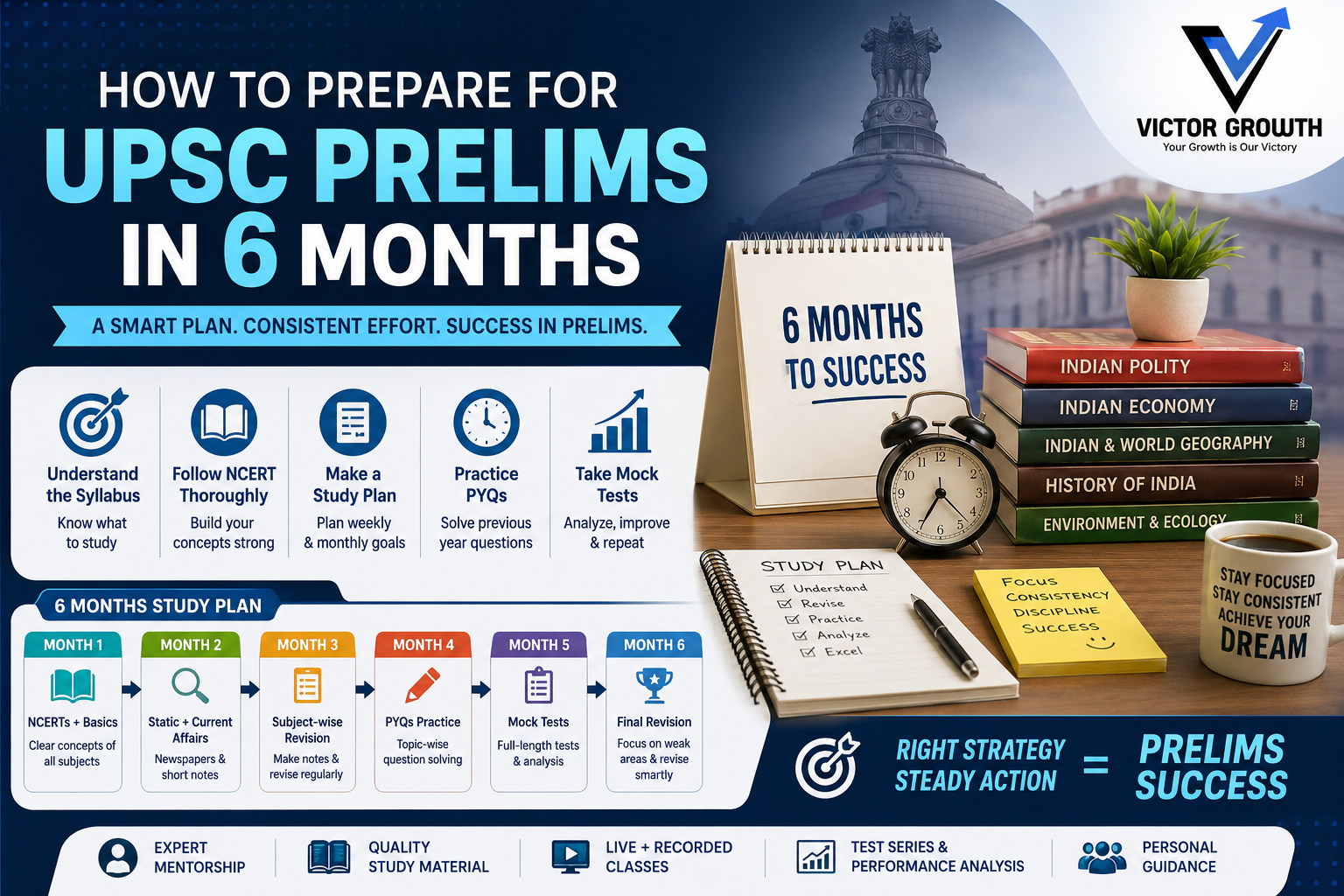
The Six-Month Preparation Strategy
Month 1 – Build the Foundation
Focus entirely on understanding concepts.
Study:
Indian Polity
Book:
- NCERT Class XI
- M. Laxmikanth
Topics:
- Constitution
- Fundamental Rights
- Parliament
- President
- Judiciary
- Federalism
- Local Government
Modern History
Books:
- NCERT
- Spectrum Modern India
Focus on:
- Freedom Movement
- Revolt of 1857
- Governor Generals
- Congress Sessions
Geography
Books:
- NCERT Class XI & XII
- GC Leong
Topics:
- Physical Geography
- Indian Geography
- Climate
- Agriculture
Economy
Books:
- NCERT
- Indian Economy by Ramesh Singh (Selective)
Topics:
- GDP
- Inflation
- Fiscal Policy
- Monetary Policy
- Budget
- Banking
Daily Routine
- 8–10 hours study
- Newspaper (1 hour)
- Current Affairs Notes
- Revision before sleeping
Month 2 – Finish Remaining Syllabus
Study:
Environment
Book:
- Shankar IAS Environment
Topics:
- Biodiversity
- National Parks
- Climate Change
- Pollution
- Environmental Acts
Science & Technology
Focus only on:
- Biotechnology
- Space
- Defence
- Artificial Intelligence
- Semiconductor Technology
Art & Culture
Book:
- Nitin Singhania (Selective)
Focus:
- Dance
- Music
- Architecture
- UNESCO Sites
Government Schemes
Prepare:
- Ministries
- Flagship Schemes
- Reports
- Indices
Month 3 – Start MCQ Practice
Now begins the most important phase.
Daily:
- 100 MCQs
- Topic-wise Tests
- Weekly Revision
Learn:
- Elimination Techniques
- Intelligent Guessing
- Risk Management
Maintain an error notebook.
Every mistake should become a lesson.
Month 4 – Current Affairs and Mock Tests
By now your syllabus should be complete.
Focus on:
- Monthly Current Affairs
- Government Reports
- Budget
- Economic Survey
- International Organizations
Start:
- Full-Length Mock Tests
Minimum:
- 2 Tests per Week
Analyse every test.
Remember:
Writing tests without analysis is a waste of time.
Month 5 – Revision Phase
This month is dedicated to revision.
Revise:
- NCERTs
- Laxmikanth
- Spectrum
- Environment
- Geography
- Economy
- Notes
Solve:
- Previous Year Questions (Last 10–15 Years)
Observe UPSC’s pattern.
Many concepts repeat.
Month 6 – Exam Mode
This month is all about confidence.
Daily:
- One Full-Length Test
- One Revision Session
- Current Affairs Revision
- Formula Revision
Avoid:
- New Books
- New Coaching Material
- Random YouTube Videos
Trust your preparation.
Best Books for UPSC Prelims
| Subject | Recommended Book |
|---|---|
| Polity | M. Laxmikanth |
| History | Spectrum Modern India |
| Ancient & Medieval | Old NCERT |
| Geography | NCERT + GC Leong |
| Economy | Ramesh Singh (Selective) |
| Environment | Shankar IAS |
| Art & Culture | Nitin Singhania |
| Current Affairs | Newspaper + Monthly Magazine |
| CSAT | Previous Year Papers + Practice Workbook |
Daily Study Timetable
| Time | Activity |
|---|---|
| 5:30 – 6:00 AM | Wake Up & Planning |
| 6:00 – 8:00 AM | Core Subject |
| 8:00 – 9:00 AM | Breakfast |
| 9:00 – 12:00 PM | Subject Study |
| 12:00 – 1:00 PM | Revision |
| 2:00 – 5:00 PM | Second Subject |
| 5:00 – 6:00 PM | Newspaper |
| 6:00 – 8:00 PM | MCQs |
| 8:30 – 10:00 PM | Revision & Notes |
Importance of Current Affairs
Current Affairs contribute nearly 25–35% of the Preliminary Examination.
Sources:
- The Hindu
- Indian Express
- PIB
- PRS India
- Yojana
- Kurukshetra
- Government Websites
Focus on:
- International Relations
- Environment
- Economy
- Science
- Government Schemes
Mock Tests: The Game Changer
Every topper emphasizes one thing:
Mock Tests improve marks more than reading additional books.
Benefits include:
- Time management
- Accuracy improvement
- Question selection
- Confidence building
- Revision
Aim for:
- 40–60 Full-Length Tests
- 8,000–10,000 MCQs
Common Mistakes to Avoid
- Reading too many books
- Ignoring NCERTs
- Skipping revision
- Avoiding mock tests
- Neglecting CSAT
- Making excessive notes
- Studying without a timetable
- Comparing yourself with others
- Ignoring current affairs
- Studying randomly without a strategy
Revision Strategy
A proven formula is:
- First Revision – Within 7 Days
- Second Revision – Within 30 Days
- Third Revision – Before Mock Tests
- Final Revision – Last 15 Days
Remember:
Revision is where selection happens.
Why Guidance Matters
Many aspirants fail not because they lack intelligence but because they lack direction.
A mentor helps you:
- Follow the right study plan
- Avoid unnecessary resources
- Analyse mock tests
- Stay motivated
- Improve consistency
- Focus on high-scoring topics
Expert guidance significantly reduces preparation time and increases efficiency.
Why Victor Growth is Considered One of the Best IAS Coaching in Kerala
Choosing the right institute can make a significant difference in your UPSC journey. Victor Growth has established itself as one of the Best IAS Coaching in Kerala by focusing on quality mentorship and result-oriented preparation.
What Makes Victor Growth Different?
- Over 20 years of UPSC mentoring experience
- Structured Foundation and Prelims-oriented programs
- Comprehensive printed study materials
- Daily current affairs discussions
- Regular mock tests with detailed performance analysis
- Personal mentorship and doubt-clearing sessions
- Offline, Online Live, and Recorded classes
- Access through the Victor Growth mobile learning platform
- Experienced faculty for General Studies and Optional subjects
- Focus on answer writing and interview guidance
Whether you are a beginner or a working professional, Victor Growth provides a structured preparation ecosystem designed to maximize your chances of success in the UPSC Civil Services Examination.
Final Thoughts
Preparing for UPSC Prelims in six months is not about studying endlessly—it is about studying strategically. Stick to standard books, revise consistently, practice thousands of MCQs, and evaluate your performance through mock tests.
Success in UPSC is built on consistency, discipline, and smart execution. With the right plan and proper guidance, six months can be enough to secure your place in the Civil Services.
If you are looking for the Best IAS Coaching in Kerala, choose an institute that provides structured mentoring, comprehensive study material, regular testing, and personalized guidance to help you achieve your IAS dream.
Frequently Asked Questions (FAQs)
1. Can I crack UPSC Prelims in 6 months?
Yes. With disciplined preparation, consistent revision, and regular mock test practice, many aspirants have successfully cleared the UPSC Prelims within six months.
2. How many hours should I study daily for UPSC Prelims?
A focused study schedule of 8–10 productive hours per day is generally recommended for six-month preparation.
3. Which books are enough for UPSC Prelims?
Standard resources such as NCERTs, M. Laxmikanth, Spectrum Modern India, GC Leong, Shankar IAS Environment, and selective Economy books, combined with current affairs, are sufficient.
4. How important are current affairs for UPSC Prelims?
Current affairs are extremely important and often account for 25–35% of the questions. Daily newspaper reading and monthly current affairs revision are essential.
5. How many mock tests should I take before UPSC Prelims?
Aim to complete 40–60 full-length mock tests along with topic-wise practice tests and thorough analysis of your mistakes.
6. Should I prepare CSAT separately?
Yes. Although CSAT is qualifying, many candidates fail because they neglect it. Regular weekly practice in comprehension, reasoning, and aptitude is highly recommended.
7. Is coaching necessary to clear UPSC Prelims?
Coaching is not mandatory, but structured guidance, mentorship, quality study material, and regular test series can significantly improve preparation efficiency and help avoid common mistakes.
8. Why is Victor Growth considered among the Best IAS Coaching in Kerala?
Victor Growth offers experienced mentorship, structured classroom programs, comprehensive study materials, regular current affairs sessions, mock tests with detailed analysis, and flexible learning modes (offline, online live, and recorded), making it a trusted choice for UPSC aspirants in Kerala.