
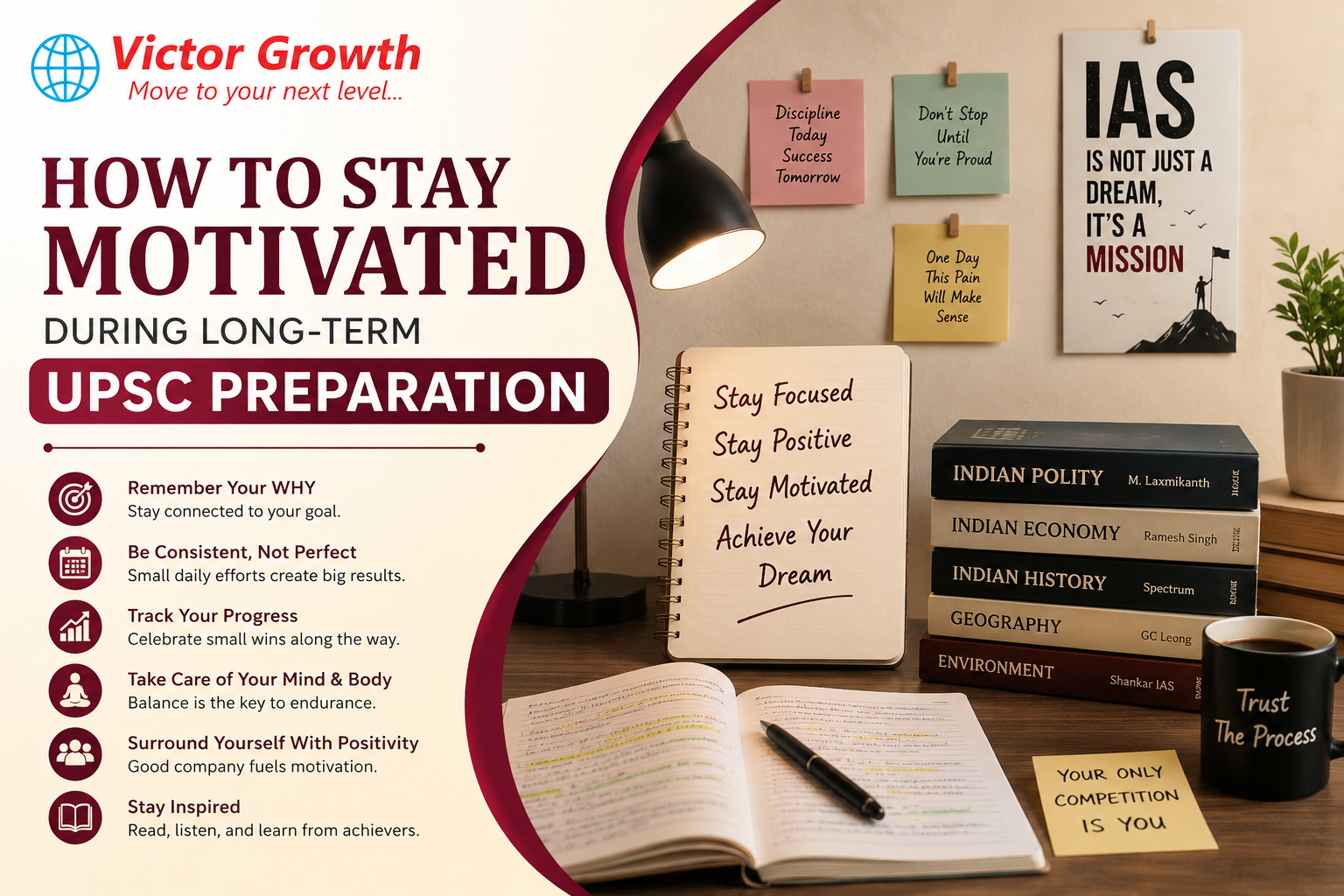
Preparing for the UPSC Civil Services Examination is one of the most demanding and rewarding journeys an aspirant can undertake. Unlike many competitive exams that require a few months of preparation, UPSC often demands one to three years of consistent effort, making it a true test of patience, perseverance, and resilience.
While the syllabus, mock tests, and answer writing are important, one factor often determines whether an aspirant continues or gives up: motivation.
Many students begin their preparation with great enthusiasm. However, as months pass, they encounter setbacks such as low mock test scores, an unfinished syllabus, repeated revisions, social comparisons, or even unsuccessful attempts. These challenges can lead to frustration and self-doubt.
The truth is that motivation alone is not enough. Success in UPSC comes from building habits, maintaining discipline, and staying focused even when motivation fluctuates.
At Victor Growth, regarded as one of the Best IAS Coaching in Kerala, aspirants are encouraged to combine structured preparation with continuous mentorship, helping them remain motivated and consistent throughout their UPSC journey.
Why Motivation Declines During UPSC Preparation
Understanding the reasons behind declining motivation is the first step toward overcoming it.
Common causes include:
- The vast UPSC syllabus
- Long preparation duration
- Low mock test scores
- Repeated revisions
- Fear of failure
- Social isolation
- Comparing oneself with others
- Lack of visible progress
- Family or financial pressure
- Uncertainty about results
Recognizing these challenges helps aspirants adopt practical strategies to stay focused instead of becoming discouraged.
Remember Your “Why”
Every successful UPSC aspirant has a strong reason for pursuing the Civil Services.
Your motivation may stem from:
- Serving society
- Becoming an IAS, IPS, or IFS officer
- Contributing to nation-building
- Personal growth
- Financial stability
- Inspiring your family
- Achieving a lifelong dream
Write your reason on paper and keep it visible in your study space.
Whenever you feel demotivated, revisit this purpose.
A strong purpose provides direction during difficult times.
Focus on Discipline Rather Than Motivation
Motivation is temporary.
Discipline is permanent.
Some days you will feel energetic.
Other days you will not.
Instead of waiting to feel motivated:
- Follow your timetable.
- Complete your daily targets.
- Maintain consistency.
Small actions repeated daily create extraordinary long-term results.
Set Realistic Goals
Avoid setting impossible study targets.
Instead of saying:
“I will finish the entire Polity syllabus today.”
Set practical goals like:
- Complete one chapter of Laxmikanth.
- Solve 50 MCQs.
- Revise Modern History.
- Write two Mains answers.
Completing achievable goals creates a sense of accomplishment and keeps motivation high.
Break the Syllabus into Small Milestones
The UPSC syllabus appears overwhelming when viewed as a whole.
Divide it into manageable parts.
Example:
Month 1
- NCERT History
- Polity Basics
Month 2
- Geography
- Economy
Month 3
- Environment
- Current Affairs Integration
Celebrate each completed milestone before moving to the next.
Progress, not perfection, should be your focus.
Follow a Structured Study Routine
A well-planned routine reduces decision fatigue.
Include time for:
- Core subjects
- Current affairs
- Answer writing
- MCQs
- Revision
- Exercise
- Sleep
A predictable schedule builds momentum and minimizes procrastination.
Track Your Progress
Maintain a study tracker.
Record:
- Hours studied
- Chapters completed
- Mock test scores
- Revision status
- Answer-writing practice
Review your progress every week.
Even small improvements reinforce confidence and keep you motivated.
Celebrate Small Wins
Many aspirants wait until the final UPSC result to celebrate.
Instead, acknowledge smaller achievements such as:
- Completing a difficult subject
- Improving mock test scores
- Writing better answers
- Finishing revision on time
- Maintaining consistency for a month
Recognizing progress keeps the journey enjoyable.
Avoid Comparing Yourself with Others
Every aspirant has a different background, schedule, and learning pace.
Comparisons often create unnecessary stress.
Instead of asking:
“How much has someone else completed?”
Ask:
“Am I improving compared to last month?”
Your only meaningful competition is your previous self.
Learn from Failure
Every setback offers valuable lessons.
Low mock scores do not define your ability.
Instead, analyse:
- Why did I lose marks?
- Which concepts are weak?
- What can I improve before the next test?
Treat failures as feedback rather than final judgments.
Develop a Positive Mindset
Replace negative thoughts such as:
“I will never clear UPSC.”
With constructive alternatives:
“I have identified my weak areas and will improve them.”
Positive thinking should be realistic, grounded in action, and focused on continuous improvement.
Take Regular Breaks
Continuous studying without rest leads to burnout.
Include:
- Short breaks every hour
- Weekly relaxation
- Family time
- Reading for pleasure
- Outdoor activities
Balanced preparation is more sustainable than relentless study.
Maintain Physical Health
A healthy body supports a healthy mind.
Daily habits should include:
- 30–45 minutes of exercise
- Nutritious meals
- Adequate hydration
- 7–8 hours of sleep
Good physical health improves concentration, memory, and emotional resilience.
Practice Mindfulness or Meditation
Simple mindfulness exercises can help reduce stress.
Benefits include:
- Better concentration
- Emotional stability
- Reduced anxiety
- Improved decision-making
Even 10–15 minutes a day can make a noticeable difference.
Stay Connected with Positive People
Surround yourself with individuals who encourage your goals.
Avoid conversations that:
- Discourage preparation
- Create unnecessary fear
- Promote negativity
Supportive mentors, family, and study groups can provide encouragement during difficult phases.
Use Mock Tests as Motivation
Many aspirants fear mock tests.
Instead, view them as opportunities to improve.
Every mock test helps you:
- Learn new concepts
- Improve time management
- Build confidence
- Identify weak areas
Progress in mock tests often reflects steady preparation.
Read Success Stories Carefully
Reading about successful candidates can inspire you.
However, remember:
Every topper had a unique journey.
Use their experiences for learning—not comparison.
Focus on the principles they followed:
- Consistency
- Revision
- Mock tests
- Answer writing
- Discipline
Limit Social Media
Social media often creates unrealistic expectations.
Reduce time spent on:
- Endless scrolling
- Unverified study advice
- Comparison with others
Use digital platforms only for educational purposes.
Build a Growth Mindset
A growth mindset believes that abilities improve through effort.
Instead of saying:
“I am weak in Economy.”
Say:
“I have not mastered Economy yet.”
This shift encourages continuous learning.
Create a Dedicated Study Environment
Your study space should:
- Be organized
- Minimize distractions
- Contain essential study materials
- Encourage concentration
A productive environment reduces procrastination.
The Role of Mentorship in Staying Motivated
Long-term preparation becomes easier with proper guidance.
Experienced mentors help aspirants:
- Set realistic goals
- Stay accountable
- Analyse performance
- Improve weak areas
- Maintain confidence
- Navigate setbacks
Regular mentor interactions often renew motivation during challenging periods.
Why Victor Growth is Considered One of the Best IAS Coaching in Kerala
Victor Growth understands that UPSC preparation is not only about academics but also about sustaining motivation over an extended period.
Key Features
- Over 20 years of UPSC mentoring experience
- Personalized study plans and goal setting
- Comprehensive Foundation, Prelims, and Mains programs
- Daily current affairs discussions
- Regular Prelims and Mains test series
- Dedicated answer-writing practice with expert feedback
- One-to-one mentorship and performance tracking
- Comprehensive printed and digital study materials
- Offline, Online Live, and Recorded learning options
- Continuous academic guidance and motivational support
This holistic ecosystem helps aspirants remain disciplined, confident, and focused throughout every stage of UPSC preparation.
Final Thoughts
Motivation is the spark that begins your UPSC journey, but discipline is the force that carries you to success. There will be days of excitement and days of doubt, moments of achievement and periods of struggle. What matters most is your ability to continue moving forward, one step at a time.
Build strong habits, follow a realistic timetable, celebrate small victories, learn from setbacks, and seek guidance whenever necessary. With patience, perseverance, and consistent effort, your dream of joining the Civil Services can become a reality.
If you are searching for the Best IAS Coaching in Kerala, choose an institute that combines quality teaching with personalized mentorship, structured preparation, continuous evaluation, and motivational support to help you stay committed throughout your UPSC journey.
Frequently Asked Questions (FAQs)
1. Why do UPSC aspirants lose motivation during preparation?
Motivation often declines because of the vast syllabus, long preparation duration, repeated revisions, low mock test scores, social comparisons, uncertainty about results, and the emotional demands of sustained preparation.
2. How can I stay motivated for long-term UPSC preparation?
Focus on your purpose, follow a structured timetable, set realistic goals, celebrate small achievements, revise consistently, take regular breaks, maintain good health, and seek guidance from experienced mentors.
3. Is discipline more important than motivation?
Yes. Motivation naturally rises and falls, while discipline ensures that you continue studying and improving even on days when you do not feel particularly motivated.
4. How do mock tests help maintain motivation?
Mock tests measure progress, identify weak areas, improve confidence through practice, and provide a sense of achievement as your scores improve over time.
5. Should I compare my preparation with others?
No. Every aspirant has different circumstances and learning speeds. Compare your current performance with your previous performance to track meaningful progress.
6. How important is physical and mental health during UPSC preparation?
Healthy sleep, regular exercise, balanced nutrition, and stress management significantly improve concentration, memory, productivity, and emotional resilience, all of which contribute to better preparation.
7. Can mentorship improve my motivation?
Yes. Experienced mentors provide accountability, constructive feedback, realistic study plans, and emotional encouragement, helping aspirants stay focused and overcome preparation challenges.
8. Why is Victor Growth considered among the Best IAS Coaching in Kerala?
Victor Growth offers structured Foundation, Prelims, and Mains programs, personalized mentorship, regular test series, answer-writing guidance, comprehensive study materials, current affairs support, and continuous performance monitoring—creating a motivating and disciplined learning environment for UPSC aspirants.