The Air Force Common Admission Test (AFCAT) is one of the most popular entry routes for graduates who aspire to become officers in the Indian Air Force (IAF). Every year, thousands of aspirants compete for opportunities in the Flying Branch, Ground Duty (Technical), and Ground Duty (Non-Technical) branches.
Understanding the syllabus before beginning preparation is one of the most important steps toward AFCAT success. A clear understanding of the subjects, important topics, question pattern, and marking scheme allows candidates to create an effective study plan instead of preparing randomly.
For aspirants searching for the Best AFCAT Coaching in Kerala, understanding how a coaching institute approaches the syllabus is equally important. A good institute should not merely complete the syllabus but should combine concept building, practice questions, previous-year papers, mock tests, revision, current-affairs preparation, and AFSB guidance.
This detailed guide explains the AFCAT Syllabus 2026 subject by subject and provides a practical preparation strategy for every section.
What is AFCAT?
AFCAT stands for Air Force Common Admission Test. It is conducted by the Indian Air Force for recruitment of officers in Flying and Ground Duty branches.
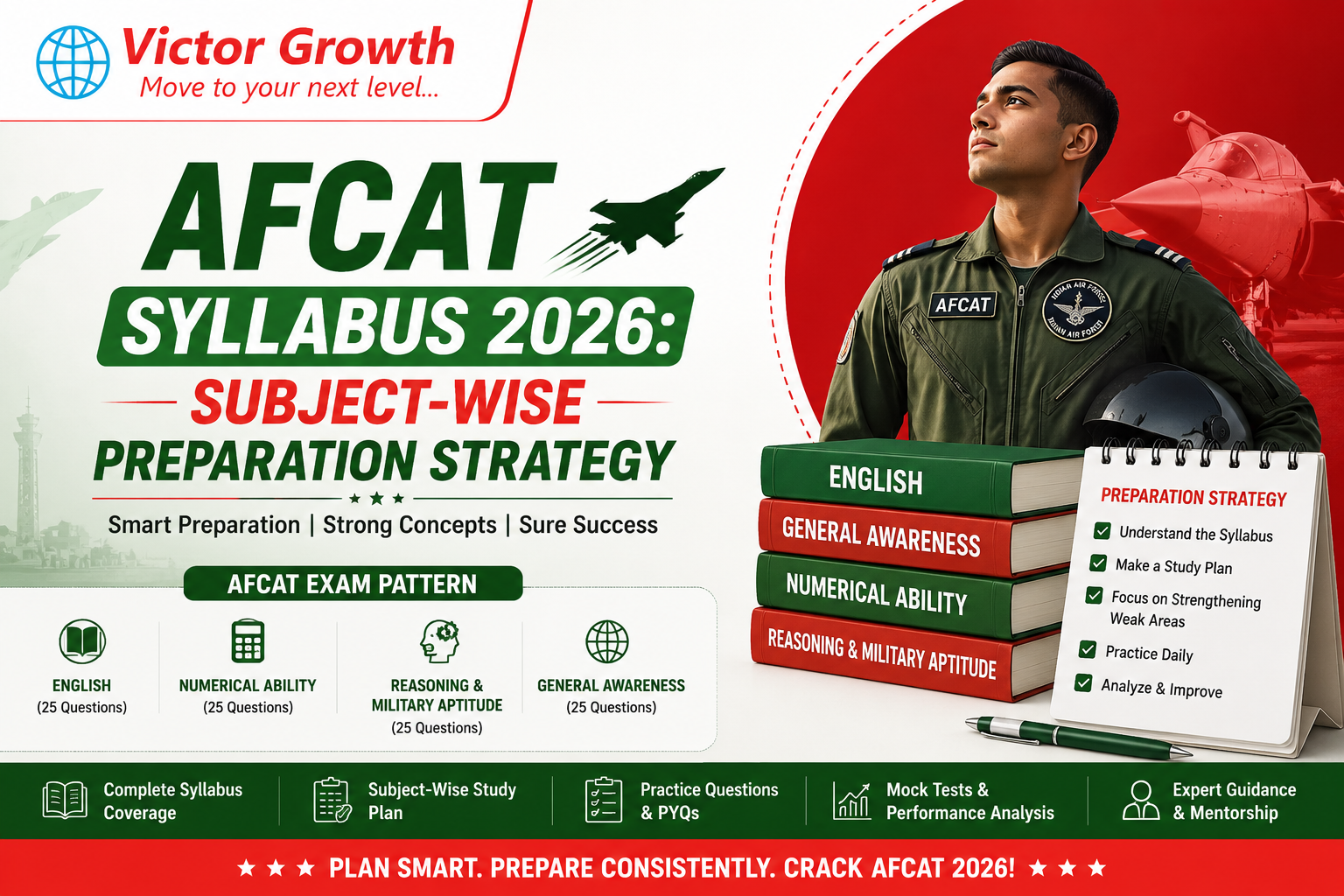
The AFCAT examination is conducted as an online objective-type examination. According to the Indian Air Force’s official syllabus, the AFCAT paper consists of 100 questions for 300 marks, with a duration of 2 hours. Each correct answer carries 3 marks, while 1 mark is deducted for an incorrect answer. Unattempted questions receive no marks.
The major sections are:
- English
- General Awareness
- Numerical Ability
- Reasoning and Military Aptitude Test
AFCAT Syllabus 2026 at a Glance
| Subject | Major Areas | Preparation Priority |
|---|---|---|
| English | Grammar, Vocabulary, Comprehension, Cloze Test, Sentence Rearrangement | High |
| General Awareness | History, Geography, Polity, Economy, Science, Defence, Current Affairs | High |
| Numerical Ability | Percentage, Ratio, Average, Profit & Loss, Time & Work, Number System, etc. | High |
| Reasoning & Military Aptitude | Verbal and Non-Verbal Reasoning | High |
The official Indian Air Force syllabus lists English topics such as comprehension, error detection, sentence completion, synonyms and antonyms, cloze tests, idioms and phrases, analogy, sentence rearrangement, and one-word substitution. General Awareness covers areas including history, geography, sports, organisations, art and culture, personalities, environment and ecology, Indian polity, economy, science and technology, current affairs, and defence. Numerical Ability includes topics such as decimals and fractions, time and work, averages, percentages, profit and loss, ratio and proportion, simple and compound interest, time and distance, area and perimeter, probability, number system, mixtures and allegations, and clocks. Reasoning and Military Aptitude covers verbal and non-verbal reasoning.
AFCAT English Syllabus 2026
English is an important scoring area in AFCAT. Candidates with good vocabulary, grammar, and reading skills can improve their performance considerably through consistent practice.
According to the official AFCAT syllabus, English includes the following areas:
Important English Topics
- Reading Comprehension
- Detecting Errors in Sentences
- Sentence Completion
- Fill in the Blanks
- Synonyms
- Antonyms
- Cloze Test
- Idioms and Phrases
- Analogy
- Sentence Rearrangement
- One-Word Substitution
English Preparation Strategy
1. Build Your Vocabulary
Vocabulary is important for several types of AFCAT English questions.
Maintain a vocabulary notebook containing:
- New words
- Synonyms
- Antonyms
- One-word substitutions
- Idioms
- Commonly confused words
Instead of trying to memorize hundreds of words at once, learn a manageable number every day and revise them regularly.
2. Strengthen Grammar
Focus on commonly tested grammar concepts such as:
- Parts of speech
- Subject-verb agreement
- Tenses
- Articles
- Prepositions
- Conjunctions
- Pronouns
- Active and passive voice
- Direct and indirect speech
- Sentence structure
Grammar rules become easier when you solve questions immediately after learning each concept.
3. Read Every Day
Regular reading improves both vocabulary and comprehension.
Read:
- Quality newspapers
- Editorials
- Defence-related articles
- Current-affairs articles
- English magazines
While reading, note unfamiliar words and revise them later.
4. Practice Comprehension
For reading comprehension:
- Read the passage carefully.
- Understand the central idea.
- Identify important details.
- Avoid assumptions not supported by the passage.
- Answer questions based on the given information.
AFCAT General Awareness Syllabus 2026
General Awareness covers a broad range of subjects and requires long-term preparation.
The official syllabus includes:
- History
- Geography
- Sports
- National and International Organisations
- Art and Culture
- Important Personalities
- Environment and Ecology
- Indian Polity
- Economy
- Basic Science
- Science and Technology
- National and International Current Affairs
- Defence
General Awareness Preparation Strategy
General Awareness cannot be mastered effectively through last-minute preparation. Candidates should start building their knowledge months before the examination.
1. Prepare Static GK
Give particular attention to:
History
- Ancient India
- Medieval India
- Modern India
- Indian Freedom Movement
- Important movements
- Important personalities
Geography
- Indian geography
- Rivers
- Mountains
- Climate
- Soils
- Natural resources
- World geography
Polity
- Constitution
- Fundamental Rights
- Parliament
- President
- Prime Minister
- Supreme Court
- Constitutional bodies
- Important amendments
Economy
- Basic economic concepts
- Banking
- Inflation
- Fiscal policy
- Monetary policy
- Budget
- Major government programmes
Science
- Physics basics
- Chemistry basics
- Biology
- Space and technology
- Scientific developments
2. Give Special Attention to Defence Current Affairs
Defence-related knowledge is particularly relevant for AFCAT aspirants.
Follow developments involving:
- Indian Armed Forces
- Defence exercises
- New military equipment
- Missile systems
- Defence agreements
- Military commands
- Important appointments
- Defence organisations
- Space and defence technology
3. Follow Current Affairs Regularly
Instead of studying several months of current affairs in the final week, follow a daily routine.
A good approach is:
Daily → Weekly revision → Monthly compilation → Final revision
Maintain short notes rather than collecting excessive material.
AFCAT Numerical Ability Syllabus 2026
Numerical Ability is an area where regular practice can produce significant improvement.
The official syllabus includes topics such as:
- Decimal and Fractions
- Time and Work
- Average
- Percentage
- Profit and Loss
- Ratio and Proportion
- Simple Interest
- Compound Interest
- Time and Distance
- Races
- Trains
- Boats and Streams
- Area and Perimeter
- Probability
- Number System
- Number Series
- Mixture and Allegation
- Clocks
Numerical Ability Preparation Strategy
1. Start With Basic Concepts
Do not immediately begin with difficult questions.
Build your foundation in:
- Basic arithmetic
- Fractions
- Percentages
- Ratios
- Averages
- Basic algebra
Once the fundamentals are clear, move to advanced applications.
2. Create a Formula Sheet
Maintain one dedicated formula notebook.
Include formulas for:
- Percentage
- Profit and Loss
- Simple Interest
- Compound Interest
- Speed, Time and Distance
- Time and Work
- Area
- Probability
Revise these formulas regularly.
3. Improve Calculation Speed
AFCAT requires candidates to solve questions efficiently within a limited examination period.
Practice:
- Mental calculations
- Multiplication shortcuts
- Fraction conversions
- Percentage conversions
- Approximation techniques
Accuracy should always come before speed.
4. Solve Questions With a Timer
Once you understand a topic, begin timed practice.
For example:
20 questions → fixed time → check accuracy → analyse mistakes
Gradually reduce the time taken while maintaining accuracy.
AFCAT Reasoning and Military Aptitude Syllabus 2026
The Reasoning and Military Aptitude section tests a candidate’s logical and analytical thinking abilities.
The official syllabus identifies Verbal and Non-Verbal Reasoning as the core areas.
Important areas to practise include:
- Analogy
- Classification
- Series
- Coding-Decoding
- Blood Relations
- Direction Sense
- Logical Reasoning
- Figure Classification
- Pattern Recognition
- Non-Verbal Reasoning
- Spatial Reasoning
Reasoning Preparation Strategy
1. Learn the Basic Pattern
Most reasoning questions follow identifiable patterns.
Instead of memorising answers, understand how the pattern works.
2. Practice Daily
Reasoning is a skill that improves with repeated exposure.
A useful daily target is:
20–30 questions initially → gradually increase timed practice.
3. Analyse Your Mistakes
When you get a reasoning question wrong, don’t simply check the answer.
Ask:
- Why did I choose the wrong option?
- Did I misunderstand the pattern?
- Did I make a calculation mistake?
- Did I spend too much time?
- Was there a faster approach?
This analysis is more valuable than simply solving more questions.
Subject-Wise Preparation Priority
A balanced approach is essential, but candidates should also identify their weak areas.
If English is weak:
Spend additional time on grammar and vocabulary.
If Mathematics is weak:
Start with fundamentals and gradually increase difficulty.
If General Awareness is weak:
Follow a daily current-affairs routine and revise monthly.
If Reasoning is weak:
Practise topic-wise questions every day.
The goal is not to spend equal time on every subject but to allocate time according to your strengths and weaknesses.
4-Month AFCAT Preparation Strategy
For candidates with approximately four months available, the following approach can be useful.
Month 1: Foundation
Focus on:
- Understanding the complete syllabus
- Learning basic concepts
- Starting vocabulary preparation
- Beginning current affairs
- Covering fundamental mathematics
- Learning basic reasoning patterns
Avoid excessive mock tests during the initial stage.
Month 2: Syllabus Completion
Focus on:
- Completing remaining topics
- Increasing question practice
- Solving topic-wise tests
- Revising current affairs
- Starting previous-year papers
Month 3: Intensive Practice
Focus on:
- Full-length mock tests
- Previous-year papers
- Timed practice
- Weak-area improvement
- Current-affairs revision
Start analysing every mock test carefully.
Month 4: Revision and Exam Strategy
Focus on:
- Full syllabus revision
- Formula revision
- Vocabulary revision
- Current-affairs revision
- Mock tests
- Error analysis
- Time management
Avoid collecting new study materials during the final phase.
60-Day AFCAT Preparation Plan
If you have only two months, preparation must be more focused.
Days 1–20
- Cover fundamentals.
- Complete important topics.
- Start daily current affairs.
- Begin vocabulary revision.
Days 21–40
- Complete remaining syllabus.
- Solve previous-year questions.
- Start regular sectional tests.
Days 41–50
- Take full-length mock tests.
- Identify weak areas.
- Improve speed and accuracy.
Days 51–60
- Revise everything.
- Take strategically selected mock tests.
- Revise current affairs and formulas.
- Avoid learning too many new concepts.
Daily AFCAT Study Plan
A practical daily routine could look like this:
| Activity | Suggested Time |
| Current Affairs | 30 minutes |
| English | 60 minutes |
| Numerical Ability | 60 minutes |
| Reasoning | 60 minutes |
| General Awareness | 60 minutes |
| Practice Questions | 45 minutes |
| Revision | 30 minutes |
The exact schedule can be adjusted according to the candidate’s academic background and available preparation time.
AFCAT Mock Test Strategy
Mock tests should not be treated simply as examinations.
Use the following three-step approach:
Step 1: Attempt the Test
Complete the test under realistic time conditions.
Step 2: Analyse the Result
Check:
- Correct answers
- Incorrect answers
- Unattempted questions
- Time spent
- Weak subjects
Step 3: Correct the Weakness
Revise the relevant concept and solve similar questions.
This creates a continuous improvement cycle:
Test → Analyse → Improve → Retest
Importance of Previous Year Question Papers
Previous-year papers are extremely useful because they help candidates understand the type of questions they may encounter.
Use them to:
- Understand the examination style.
- Identify recurring concepts.
- Practise time management.
- Improve accuracy.
- Assess preparation level.
Do not merely memorise previous answers. Focus on understanding the underlying concepts.
How the Best AFCAT Coaching in Kerala Can Help
Choosing the Best AFCAT Coaching in Kerala can make preparation more structured and efficient.
A good coaching programme should provide:
Comprehensive Syllabus Coverage
Experienced faculty should ensure that every important section is covered systematically.
Expert Faculty
Subject specialists can simplify difficult concepts and teach examination-oriented techniques.
Updated Study Materials
Candidates should receive relevant notes, question banks, current-affairs material, and revision resources.
Regular Mock Tests
Frequent tests help students measure progress and improve exam temperament.
Performance Analysis
A strong coaching programme should identify individual strengths and weaknesses.
Personalised Mentoring
Students benefit from guidance regarding:
- Study plans
- Weak subjects
- Revision
- Time management
- Mock-test performance
AFSB Preparation
Since AFCAT is only one part of the selection process, aspirants should also receive guidance for the Air Force Selection Board stage.
Why Choose AFCAT Coaching in Kerala?
Kerala has become a preferred destination for many defence aspirants because students can access structured coaching while staying within a familiar academic environment.
The Best AFCAT Coaching in Kerala can offer:
- Experienced faculty
- Dedicated AFCAT batches
- Online and offline classes
- Updated study materials
- Regular mock tests
- Current-affairs sessions
- Doubt-clearing support
- Personal mentoring
- AFSB preparation
However, candidates should compare institutes carefully rather than choosing solely based on advertisements or fees.
How to Choose the Best AFCAT Coaching in Kerala
Before enrolling, check the following:
1. Faculty Experience
Look for experienced AFCAT and defence-exam educators.
2. Course Structure
Ensure the programme covers the entire syllabus rather than only selected topics.
3. Mock Tests
Ask how frequently tests are conducted and whether detailed analysis is provided.
4. Study Materials
Check whether the materials are updated and examination-oriented.
5. AFSB Guidance
A complete defence preparation programme should not stop at the written exam.
6. Individual Attention
Check batch size and doubt-clearing facilities.
7. Online/Offline Options
Choose the learning format that suits your schedule.
8. Student Reviews and Results
Consider genuine student experiences and consistent performance rather than relying only on promotional claims.
Common Mistakes to Avoid While Preparing for AFCAT
Mistake 1: Studying Without Understanding the Syllabus
Always create a checklist of topics before starting.
Mistake 2: Ignoring Weak Subjects
Avoid spending all your time on subjects you already enjoy.
Mistake 3: Collecting Too Many Books
Choose a limited number of reliable resources and revise them thoroughly.
Mistake 4: Skipping Mock Tests
Practice under timed conditions before the actual exam.
Mistake 5: Ignoring Current Affairs
Current affairs require consistent preparation.
Mistake 6: Not Revising
Learning something once does not guarantee retention.
Mistake 7: Random Guessing
Because AFCAT has negative marking, careless attempts can reduce your score. The official scheme awards 3 marks for a correct response and deducts 1 mark for an incorrect response.
AFCAT Exam-Day Strategy
On examination day:
- Read instructions carefully.
- Stay calm.
- Start with questions you can answer confidently.
- Avoid spending excessive time on one question.
- Keep track of time.
- Be cautious with guesses because of negative marking.
- Use the final minutes strategically.
Your preparation should make the examination feel like another mock test.
AFCAT Preparation Checklist
Before the examination, make sure you have:
Completed the complete syllabus
Revised English grammar
Revised important vocabulary
Covered static General Awareness
Revised current affairs
Completed numerical ability topics
Practised reasoning extensively
Solved previous-year papers
Attempted full-length mock tests
Analysed mock-test mistakes
Revised formulas
Prepared short revision notes
Worked on time management
Final Tips for AFCAT 2026 Preparation
- Understand the syllabus before starting.
- Build strong fundamentals first.
- Practise every subject regularly.
- Give special attention to current affairs and defence news.
- Solve previous-year questions.
- Take regular mock tests.
- Analyse every mistake.
- Revise continuously.
- Avoid random guessing.
- Prepare for AFSB alongside the written examination.
- Maintain a consistent study routine.
- Choose a coaching institute based on quality, not just advertising.
Conclusion
The AFCAT Syllabus 2026 covers English, General Awareness, Numerical Ability, and Reasoning & Military Aptitude. Although the syllabus is manageable, the competitive nature of the examination makes systematic preparation essential.
A successful preparation strategy should combine concept building, daily practice, current-affairs preparation, previous-year papers, mock tests, revision, and performance analysis.
For aspirants who need structured guidance, enrolling in the Best AFCAT Coaching in Kerala can provide access to experienced faculty, updated study materials, regular assessments, personalised mentoring, and AFSB preparation.
The key is not simply studying for more hours—it is studying with a clear strategy, measuring your progress, correcting your weaknesses, and remaining consistent until the examination.
With the right preparation plan and disciplined effort, Kerala aspirants can confidently work toward their goal of joining the Indian Air Force as officers.
Frequently Asked Questions (FAQs)
1. What is the AFCAT Syllabus 2026?
The AFCAT syllabus consists of four major areas: English, General Awareness, Numerical Ability, and Reasoning & Military Aptitude. The official Indian Air Force syllabus provides the detailed topics under each section.
2. What is the AFCAT exam pattern?
The AFCAT online examination has 100 questions carrying a maximum of 300 marks, with a duration of 2 hours. Each correct answer receives 3 marks and each incorrect answer attracts a 1-mark deduction.
3. Is the AFCAT syllabus difficult?
The syllabus is manageable with consistent preparation. The main challenge is completing the syllabus while developing the speed and accuracy required for the examination.
4. Which subject should I study first for AFCAT?
Start with the subject in which your fundamentals are weakest. At the same time, maintain daily practice in English, General Awareness, Mathematics, and Reasoning.
5. How should I prepare for AFCAT General Awareness?
Combine static GK with daily current affairs. Give particular attention to Indian history, geography, polity, economy, science, defence, national and international events, and other areas listed in the official syllabus.
6. How can I improve my AFCAT Mathematics score?
Build your fundamentals first, learn important formulas, practise calculations, solve topic-wise questions, and gradually move to timed practice.
7. How important are mock tests for AFCAT?
Mock tests are extremely important because they help improve speed, accuracy, time management, and exam confidence. More importantly, candidates should analyse their mistakes after every test.
8. How many hours should I study for AFCAT?
There is no fixed number of hours suitable for everyone. A focused 4–6 hours of daily preparation, combined with regular revision and mock tests, can provide a strong preparation routine for many candidates.
9. Should I join AFCAT coaching in Kerala?
If you need structured preparation, expert guidance, regular tests, study materials, and personalised mentoring, joining the Best AFCAT Coaching in Kerala can make your preparation more systematic.
10. How do I choose the Best AFCAT Coaching in Kerala?
Compare faculty experience, syllabus coverage, study materials, mock-test quality, individual mentoring, current-affairs support, AFSB preparation, batch size, learning format, and genuine student results before enrolling.
11. Does AFCAT coaching include AFSB preparation?
Many comprehensive AFCAT coaching programmes include AFSB preparation. Aspirants should confirm whether OIR, psychological tests, group tasks, interview preparation, and other AFSB-related training are included in the course.
12. Can I prepare for AFCAT through self-study?
Yes. Self-study can work when candidates have discipline, reliable study resources, a structured timetable, and consistent mock-test practice. Coaching can provide additional structure and expert guidance.