Preparing for the Air Force Common Admission Test (AFCAT) requires the right combination of conceptual understanding, regular practice, previous-year questions, mock tests and revision. With hundreds of AFCAT preparation books and online resources available, choosing the right study material can be challenging, especially for beginners.
For aspirants searching for the best AFCAT coaching in Kerala, selecting the right books is an equally important part of preparation. A good book should explain concepts clearly, provide sufficient practice questions, include exam-oriented exercises and help candidates understand the level and pattern of questions.
This comprehensive guide discusses the best books for AFCAT preparation, subject-wise book selection strategies, how to use them effectively, common mistakes to avoid and how coaching guidance can make book-based preparation more effective.
Why Choosing the Right AFCAT Books Matters
Books are one of the most important resources in competitive-exam preparation. However, using too many books can create confusion.
Aspirants often make the mistake of purchasing multiple books for the same subject and trying to complete all of them. This can result in:
- Incomplete syllabus coverage
- Repeated study of the same topics
- Lack of revision
- Confusion between different approaches
- Less time for mock tests
- Poor time management
Instead of collecting numerous books, choose one reliable primary book for each subject, supported by previous-year papers, current-affairs resources and mock tests.
The objective should be:
Limited Resources + Multiple Revisions + Extensive Practice
Best Books for AFCAT Preparation: Subject-Wise Guide
AFCAT preparation can broadly be divided into:
- English
- General Awareness
- Numerical Ability
- Reasoning and Military Aptitude
Each section requires a slightly different preparation strategy.
1. Best Books for AFCAT English Preparation
English is an important section for AFCAT aspirants. Candidates should focus on vocabulary, grammar, comprehension and regular question practice.
Recommended Books
Objective General English – S. P. Bakshi
This is a popular book for competitive-exam English preparation.
It can be useful for:
- Grammar fundamentals
- Vocabulary
- Sentence correction
- Error detection
- Practice exercises
- Objective-type questions
How to Use It
Do not try to complete the entire book mechanically.
Instead:
- Identify the grammar topics required for AFCAT.
- Learn the basic rules.
- Solve practice questions.
- Record repeated mistakes.
- Revise difficult concepts.
- Practise questions under time limits.
Word Power Made Easy – Norman Lewis
Vocabulary can make a significant difference in English preparation.
Word Power Made Easy can help aspirants build vocabulary through word roots, meanings and contextual learning.
Use it gradually rather than attempting dozens of pages in one sitting.
Suggested Routine
Learn a small set of words regularly and revise previously learned vocabulary.
Learn → Use → Revise → Test
This is more effective than simply memorising long vocabulary lists.
2. Best Books for AFCAT General Awareness
General Awareness is one of the broadest areas of AFCAT preparation.
Candidates need to combine static GK with current affairs.
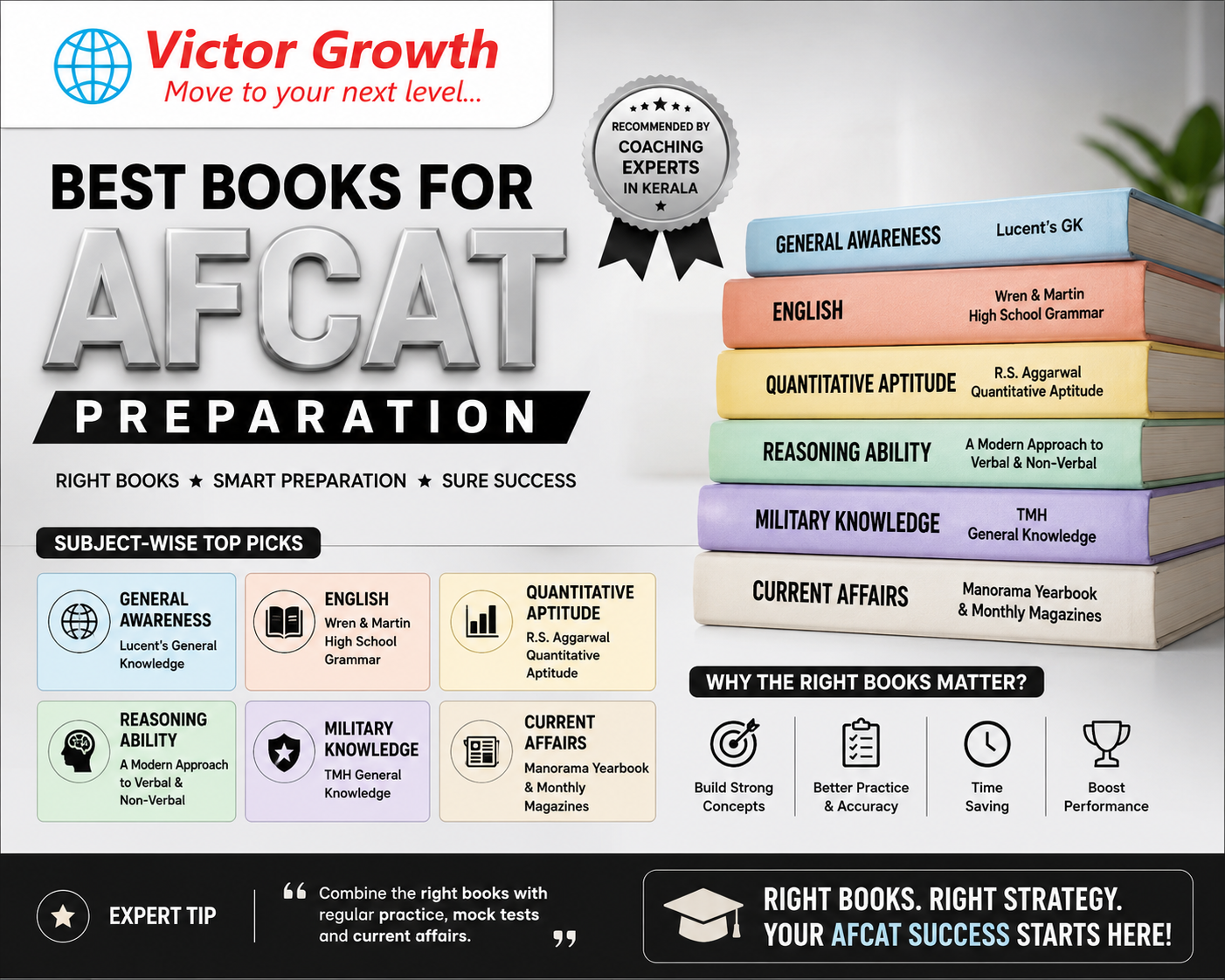
Lucent’s General Knowledge
Lucent’s General Knowledge is commonly used by competitive-exam aspirants for building basic static-GK knowledge.
It can be useful for:
- History
- Geography
- Indian polity
- General science
- Economics
- General knowledge
However, static GK preparation should be supplemented with current affairs.
Manorama Yearbook
For Kerala-based aspirants, Manorama Yearbook can be a familiar supplementary resource for general awareness.
It provides information across several areas and can be used as a reference resource.
However, aspirants should avoid trying to memorise the entire yearbook.
Use it selectively for:
- Important national developments
- International events
- Science and technology
- Sports
- Awards
- Government-related developments
- Important personalities
3. Best Books for AFCAT Mathematics Preparation
Numerical Ability can become a challenging section for candidates who are weak in mathematics.
The best approach is to strengthen basic concepts first and then gradually increase question-solving speed.
Quantitative Aptitude for Competitive Examinations – R.S. Aggarwal
This is a widely used quantitative aptitude resource.
It covers several important areas such as:
- Number systems
- Percentage
- Profit and loss
- Ratio and proportion
- Average
- Time and work
- Time, speed and distance
- Simple and compound interest
- Probability
- Data interpretation
How to Use It for AFCAT
Do not attempt every question from every chapter.
Instead:
Concept → Basic Questions → AFCAT-Level Questions → Timed Practice
Focus on understanding methods and improving calculation speed.
4. Best Books for AFCAT Reasoning
Reasoning requires practice rather than excessive theoretical study.
A Modern Approach to Verbal & Non-Verbal Reasoning – R.S. Aggarwal
This is a widely recognised reasoning resource for competitive-exam preparation.
It covers areas such as:
- Analogy
- Classification
- Series
- Coding-decoding
- Blood relations
- Direction tests
- Logical reasoning
- Non-verbal reasoning
- Figure-based questions
How to Use the Book
Begin with basic questions.
Once you understand the method, practise increasingly difficult questions under a time limit.
The goal should be to improve:
Accuracy + Speed + Question Selection
5. AFCAT Previous-Year Question Papers
Previous-year question papers are among the most valuable resources for AFCAT preparation.
Instead of relying only on textbooks, aspirants should regularly solve questions based on the actual examination pattern.
Previous-year questions can help you understand:
- Question styles
- Frequently tested concepts
- Difficulty level
- Time requirements
- Common question types
- Your weak areas
Best Way to Use Previous-Year Papers
Do not immediately check the answer after seeing a difficult question.
Follow this process:
Attempt → Mark Answer → Check Solution → Analyse Mistake → Revise Concept
Maintain a separate notebook for questions you repeatedly get wrong.
6. AFCAT Mock-Test Books and Practice Sets
Books containing AFCAT practice sets can help candidates develop exam temperament.
Look for practice resources that provide:
- Full-length tests
- Sectional tests
- Detailed solutions
- Exam-style questions
- Time-based practice
However, printed mock-test books should ideally be supplemented with online mock tests because computer-based practice can help candidates become more comfortable with the actual test environment.
Best Books for AFCAT Preparation: Quick Reference Table
| Subject | Recommended Resource | Main Purpose |
|---|---|---|
| English | Objective General English – S.P. Bakshi | Grammar & practice |
| Vocabulary | Word Power Made Easy – Norman Lewis | Vocabulary |
| General Awareness | Lucent’s General Knowledge | Static GK |
| General Awareness | Manorama Yearbook | Supplementary awareness |
| Mathematics | Quantitative Aptitude – R.S. Aggarwal | Numerical practice |
| Reasoning | A Modern Approach to Verbal & Non-Verbal Reasoning – R.S. Aggarwal | Reasoning practice |
| AFCAT Practice | Previous-Year Papers | Exam-pattern familiarity |
| Mock Tests | AFCAT practice sets/mocks | Speed & accuracy |
Should AFCAT Aspirants Buy All These Books?
No.
This is one of the most important points for beginners.
You do not need a large collection of books to prepare successfully.
A practical combination could be:
English
One grammar/vocabulary resource + PYQs
Mathematics
One quantitative aptitude book + PYQs
Reasoning
One reasoning book + PYQs
General Awareness
One static-GK book + current affairs
Overall Preparation
Mock tests + previous-year questions
This is usually more manageable than attempting to complete five or six books per subject.
How Coaching Experts Can Help You Select the Right Books
Searching for the best AFCAT coaching in Kerala should not be based only on the number of books provided.
A good coaching programme should help students understand:
- Which books are actually necessary
- Which chapters are important
- Which topics need more practice
- Which resources are supplementary
- How to use previous-year questions
- How to revise efficiently
- How to prepare current affairs
The value of coaching lies not simply in providing books but in helping aspirants use the right resources correctly.
How to Use AFCAT Books Effectively
Buying a good book is only the first step.
The real advantage comes from using it strategically.
Step 1: Understand the AFCAT Syllabus
Before opening a preparation book, identify the topics relevant to the examination.
This prevents you from spending unnecessary time on irrelevant sections.
Step 2: Start With Fundamentals
If your basics are weak, begin with foundational concepts.
For example, in Mathematics:
Percentage → Ratio → Average → Profit & Loss → Advanced Applications
Similarly, in English:
Grammar Rules → Vocabulary → Sentence-Based Questions → Comprehension
Step 3: Practise Regularly
Reading a book without solving questions will not be enough.
After learning a topic, immediately solve practice questions.
Step 4: Maintain a Mistake Notebook
Write down:
- Incorrect answers
- Difficult formulas
- Grammar rules you forget
- Vocabulary you repeatedly miss
- GK facts you need to revise
- Reasoning methods you find difficult
Revise this notebook every week.
How Many Hours Should You Spend on Books?
Do not measure preparation only by the number of pages completed.
A better approach is to divide your time between learning and practice.
For example:
2 Hours
- 45 minutes – Concept learning
- 60 minutes – Question practice
- 15 minutes – Revision
4 Hours
- 1 hour – English
- 1 hour – Mathematics
- 1 hour – Reasoning
- 1 hour – General Awareness/current affairs
The exact schedule should depend on your preparation level and daily availability.
Books vs Online Resources for AFCAT Preparation
Both books and online resources have advantages.
| Books | Online Resources |
|---|---|
| Detailed explanations | Easy access |
| Useful for revision | Updated current affairs |
| No screen required | Online mock tests |
| Easy to annotate | Video explanations |
| Good for concept building | Interactive practice |
The most effective strategy is often to combine both.
Books for fundamentals + online resources for current affairs and tests.
Importance of Current Affairs for AFCAT
One limitation of traditional books is that current affairs become outdated.
A book published several months ago may not contain the latest developments.
Therefore, candidates should supplement static-GK books with regularly updated current-affairs preparation.
Pay attention to:
- Defence developments
- National events
- International relations
- Government initiatives
- Science and technology
- Sports
- Awards
- Important appointments
- Major reports
- Important days
- Military exercises
Special Focus for Defence Aspirants
AFCAT aspirants should develop an interest in defence-related developments.
Regularly follow important topics such as:
- Indian Air Force developments
- Indian Army and Navy developments
- Defence exercises
- Defence technology
- Aircraft and missile systems
- Military appointments
- Defence agreements
- Space and aviation developments
- Major national security developments
Do not study defence information randomly. Focus on important, exam-relevant developments.
Common Mistakes When Choosing AFCAT Books
1. Buying Too Many Books
More books do not automatically mean better preparation.
2. Using Outdated Current-Affairs Books
Current affairs require regularly updated sources.
3. Ignoring Previous-Year Questions
Textbook questions alone may not provide sufficient exam familiarity.
4. Reading Without Practising
Aspirants need to solve questions regularly.
5. Changing Books Frequently
Constantly switching resources can interrupt preparation.
6. Trying to Complete Every Page
Focus on the AFCAT syllabus rather than completing a book from cover to cover.
7. Ignoring Revision
Repeated revision is essential for retaining information.
How the Best AFCAT Coaching in Kerala Can Complement Book Preparation
The best AFCAT coaching in Kerala should ideally provide more than classroom teaching.
A well-structured programme can complement your book preparation through:
Expert Faculty
Teachers can simplify difficult concepts and explain shortcuts where appropriate.
Structured Study Material
Good notes can help students avoid unnecessary material.
Regular Tests
Mock tests help assess whether book-based preparation is translating into actual performance.
Doubt-Clearing Sessions
Students can clarify difficult concepts rather than spending excessive time struggling independently.
Performance Analysis
Regular analysis helps identify weak areas and modify the study plan.
Current-Affairs Support
Updated current-affairs resources can supplement static-GK books.
Recommended AFCAT Book Strategy for Beginners
If you are just starting AFCAT preparation, avoid overwhelming yourself.
A simple approach is:
Phase 1 – Foundation
Choose your primary books and understand basic concepts.
Phase 2 – Practice
Solve topic-wise questions.
Phase 3 – Previous-Year Questions
Start solving AFCAT-oriented questions regularly.
Phase 4 – Mock Tests
Take sectional and full-length tests.
Phase 5 – Revision
Revise:
- Formulas
- Vocabulary
- GK
- Current affairs
- Mistake notebook
- Frequently tested concepts
Phase 6 – Final Preparation
Reduce new material and focus on:
Revision + PYQs + Mock Tests + Accuracy + Time Management
How to Choose the Best AFCAT Books Based on Your Level
For Beginners
Choose books with:
- Clear explanations
- Basic concepts
- Solved examples
- Topic-wise exercises
For Intermediate Aspirants
Focus more on:
- AFCAT-level practice
- Previous-year questions
- Sectional tests
- Speed improvement
For Advanced Aspirants
Focus on:
- Full-length mock tests
- Time management
- Difficult questions
- Accuracy
- Weak-topic revision
Your book selection should change according to your preparation stage.
Final Thoughts
Choosing the best books for AFCAT preparation is an important step, but books alone cannot guarantee success. What matters is how effectively you use them.
A strong AFCAT preparation strategy should combine:
Right Books + Concept Building + Previous-Year Questions + Current Affairs + Mock Tests + Revision + Consistency
For candidates looking for the best AFCAT coaching in Kerala, compare coaching institutes based on faculty quality, study materials, test series, doubt-clearing support, current-affairs guidance, performance analysis and overall student support.
Avoid collecting too many resources. Select reliable books, complete the relevant portions, revise them multiple times and spend sufficient time solving questions.
The objective is not to read the maximum number of books.
The objective is to master the concepts, practise effectively and perform confidently in the AFCAT examination.
Frequently Asked Questions (FAQs)
1. Which is the best book for AFCAT preparation?
There is no single book that covers every aspect of AFCAT preparation perfectly. Aspirants can use subject-specific resources such as S.P. Bakshi for English, R.S. Aggarwal resources for Mathematics and Reasoning, Lucent’s General Knowledge for static GK, along with previous-year questions and updated current-affairs resources.
2. Is one book enough for AFCAT preparation?
One book per major subject can be sufficient for the fundamentals, provided you supplement your preparation with previous-year questions, mock tests and current affairs.
3. Which book is best for AFCAT English?
Objective General English by S.P. Bakshi is a useful resource for grammar and objective English practice. Word Power Made Easy by Norman Lewis can be used separately for vocabulary development.
4. Which book is best for AFCAT Mathematics?
Quantitative Aptitude for Competitive Examinations by R.S. Aggarwal is a commonly used resource for building quantitative aptitude fundamentals and practising numerical questions.
5. Which book is best for AFCAT Reasoning?
A Modern Approach to Verbal & Non-Verbal Reasoning by R.S. Aggarwal is a widely used reasoning resource covering numerous verbal and non-verbal reasoning topics.
6. Which book is best for AFCAT General Awareness?
Lucent’s General Knowledge can be used for static GK. Candidates should also follow updated current affairs because books alone cannot provide the latest information.
7. Are AFCAT previous-year papers important?
Yes. Previous-year papers are extremely useful for understanding question patterns, difficulty levels, frequently tested concepts and time requirements.
8. Should I join the best AFCAT coaching in Kerala if I already have good books?
Books provide study material, but coaching can provide structure, expert guidance, regular tests, doubt-clearing and performance analysis. Whether coaching is necessary depends on your individual preparation style and requirements.
9. How many books should I use for AFCAT preparation?
Avoid using too many books. A practical strategy is to choose one reliable primary resource for each subject and supplement it with PYQs, current affairs and mock tests.
10. How should I prepare for AFCAT current affairs?
Follow current affairs regularly and revise important developments related to defence, national and international events, science and technology, government initiatives, sports, awards and important appointments.
11. Can I prepare for AFCAT using books without coaching?
Yes. Self-study can work if you have a disciplined timetable, reliable books, regular practice, previous-year questions, mock tests and consistent revision.
12. What should I look for in the best AFCAT coaching in Kerala?
Look for experienced faculty, structured syllabus coverage, quality study material, regular mock tests, previous-year question practice, current-affairs support, doubt-clearing facilities, performance analysis and a consistent learning environment.