
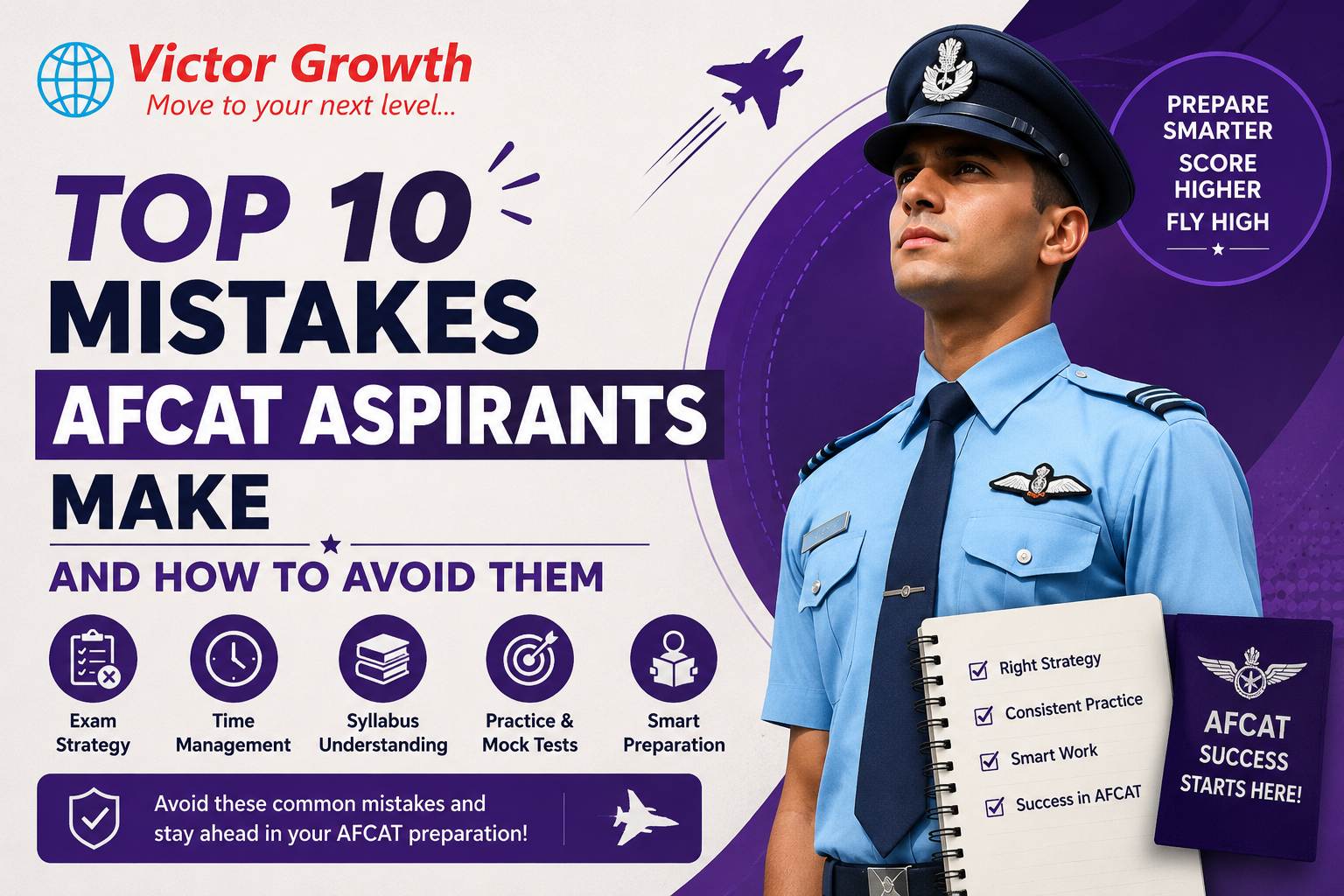
Preparing for the Air Force Common Admission Test (AFCAT) requires more than simply studying the syllabus. Many aspirants work hard but still struggle to achieve their desired score because of avoidable mistakes in planning, preparation, time management, revision, and mock-test practice.
If you are searching for the best AFCAT coaching in Kerala, it is important to understand not only what to study but also how to prepare effectively. A structured preparation strategy, regular practice, expert guidance, and consistent evaluation can help AFCAT aspirants avoid common mistakes and improve their chances of success.
This article discusses the top 10 mistakes AFCAT aspirants make, along with practical ways to avoid them.
Why Do AFCAT Aspirants Make Mistakes During Preparation?
AFCAT preparation involves multiple areas, including English, General Awareness, Numerical Ability, Reasoning and Military Aptitude. Candidates often make mistakes because they:
- Start preparation without understanding the exam pattern
- Study without a proper timetable
- Focus only on their favourite subjects
- Ignore weak areas
- Avoid mock tests
- Depend completely on memorisation
- Do not analyse previous-year questions
- Fail to revise regularly
- Spend too much time on difficult questions
- Become inconsistent with their preparation
Understanding these mistakes early can help aspirants build a more effective preparation strategy.
Top 10 Mistakes AFCAT Aspirants Make
1. Starting Preparation Without Understanding the AFCAT Exam Pattern
One of the most common mistakes is beginning preparation without first understanding the AFCAT exam structure.
Candidates may start collecting books, watching videos and solving questions without knowing:
- What subjects are included
- How many questions are asked
- How much time is available
- The marking scheme
- The importance of speed and accuracy
- Which topics require more practice
How to Avoid This Mistake
Start your preparation by understanding the complete AFCAT syllabus and exam pattern. Divide the syllabus into manageable sections and identify the topics you are already comfortable with and those requiring additional attention.
A clear understanding of the exam allows you to prepare strategically instead of studying randomly.
2. Not Following a Proper Study Plan
Studying whenever you have free time may not produce consistent results. Many aspirants begin with enthusiasm but gradually lose consistency.
AFCAT preparation requires regular practice because the syllabus covers different subjects and skills.
How to Avoid This Mistake
Create a realistic daily and weekly study plan.
For example:
| Activity | Suggested Focus |
|---|---|
| English | Vocabulary, grammar and comprehension |
| General Awareness | Current affairs and static GK |
| Numerical Ability | Concepts and problem-solving |
| Reasoning | Logical and analytical questions |
| Mock Tests | Regular timed practice |
| Revision | Previously studied topics |
Your timetable should be practical enough to follow every day.
Consistency is more important than studying for extremely long hours occasionally.
3. Ignoring Weak Subjects
Another major mistake is spending most of the preparation time on subjects that feel easy.
For example, an aspirant who is strong in English may spend hours practising English while avoiding Numerical Ability because they find mathematics difficult.
This creates an imbalance in preparation.
How to Avoid This Mistake
Identify your strengths and weaknesses during the initial stage of preparation.
Use practice tests to determine:
- Which subjects have the lowest accuracy
- Which topics consume more time
- Which concepts you repeatedly get wrong
- Which areas need additional revision
Then allocate additional preparation time to weaker areas.
Remember:
Your weakest subject can become your biggest score improvement opportunity.
4. Relying Only on Memorisation
AFCAT preparation, particularly General Awareness and English vocabulary, involves remembering a considerable amount of information. However, relying entirely on memorisation is not an effective strategy.
For Numerical Ability and Reasoning especially, understanding concepts is essential.
How to Avoid This Mistake
Instead of simply memorising formulas or answers:
- Understand the concept.
- Learn the relevant formula or method.
- Solve basic questions.
- Progress to moderate-level questions.
- Practise previous-year questions.
- Apply the concept in timed tests.
Conceptual understanding makes it easier to solve unfamiliar questions.
5. Neglecting Current Affairs and General Awareness
General Awareness can be challenging because it covers a wide range of areas.
Some candidates postpone General Awareness preparation until the final few weeks. This can create unnecessary pressure.
Important areas may include:
- National and international events
- Defence-related developments
- Indian polity
- History
- Geography
- Economics
- Science
- Sports
- Awards and honours
- Important government initiatives
- Important organisations
- Military exercises
- Aviation and defence-related developments
How to Avoid This Mistake
Develop a daily current-affairs habit.
Instead of trying to study everything at once, spend a fixed amount of time every day reviewing important events and periodically revise previously studied information.
For defence aspirants, following major developments related to the Indian Armed Forces can also be useful.
6. Not Practising Enough Previous-Year Questions
Previous-year questions are among the most useful resources for understanding the nature of competitive examinations.
Some aspirants focus heavily on theoretical study but do not solve enough questions.
This creates a gap between knowing a concept and using that concept under exam conditions.
How to Avoid This Mistake
Make previous-year-question practice an important part of your preparation.
While solving questions, analyse:
- Frequently tested concepts
- Question difficulty
- Common question patterns
- Your accuracy
- Time taken
- Repeated mistakes
Don’t simply check whether your answer is correct. Understand why you got a question wrong.
7. Avoiding Mock Tests Until the End
Many candidates wait until the final stage of preparation before attempting full-length mock tests.
This is a mistake.
Mock tests are not only for checking your preparation. They are also a training tool for improving:
- Speed
- Accuracy
- Time management
- Question selection
- Exam temperament
- Confidence
How to Avoid This Mistake
Start with topic-wise tests and gradually move towards sectional and full-length mock tests.
A useful progression can be:
Topic Tests → Sectional Tests → Mixed Tests → Full-Length AFCAT Mocks
After every mock test, analyse your performance carefully.
8. Failing to Analyse Mock-Test Mistakes
Taking mock tests without analysing them is another common mistake.
Suppose you score 70% in a mock test. Simply moving on to the next test without understanding your mistakes means you may repeat the same errors.
How to Avoid This Mistake
Maintain a mistake notebook.
Record:
- Questions answered incorrectly
- Questions left unanswered
- Concepts you forgot
- Calculation errors
- Questions that consumed excessive time
- Guessing errors
- Topics requiring revision
Then revisit these areas regularly.
The goal of a mock test is not just to get a score. It is to identify opportunities for improvement.
9. Poor Time Management During the Exam
AFCAT is a competitive examination where time management can significantly influence performance.
Some aspirants spend too much time trying to solve one difficult question.
This can reduce the time available for easier questions.
How to Avoid This Mistake
Develop the habit of identifying questions according to difficulty.
A practical approach is:
First Priority
Attempt questions you can solve confidently and quickly.
Second Priority
Attempt questions requiring moderate calculation or reasoning.
Third Priority
Return to difficult or time-consuming questions if time permits.
Practise this strategy during mock tests so that it becomes natural on exam day.
10. Preparing Inconsistently and Losing Motivation
Perhaps the biggest mistake is inconsistency.
An aspirant may study for 8–10 hours one day and then do almost nothing for the next two or three days.
Competitive-exam preparation requires sustained effort.
There may also be periods when scores in mock tests remain low. This can affect confidence.
How to Avoid This Mistake
Focus on daily progress rather than comparing yourself with others.
Set small targets such as:
- Complete one topic
- Solve 30 questions
- Revise vocabulary
- Study current affairs
- Take one sectional test
- Analyse yesterday’s mistakes
Small improvements accumulated over several weeks can produce significant results.
How the Best AFCAT Coaching in Kerala Can Help Aspirants Avoid These Mistakes
Choosing the best AFCAT coaching in Kerala can provide structure and guidance, particularly for candidates who struggle with self-directed preparation.
A good AFCAT coaching programme should ideally provide:
1. Structured Syllabus Coverage
The entire syllabus should be divided into manageable sections so that aspirants can complete preparation systematically.
2. Experienced Faculty
Qualified and experienced teachers can simplify difficult concepts and provide examination-oriented strategies.
3. Regular Tests
Regular tests help candidates understand their current level of preparation and identify areas that require improvement.
4. Previous-Year Question Practice
A good coaching programme should provide adequate exposure to previous-year questions and exam-style practice.
5. Study Materials
Well-organised study materials can reduce the need to depend on multiple unrelated resources.
6. Doubt-Clearing Support
Aspirants should have access to faculty or mentors when they face difficulty understanding a particular concept.
7. Performance Analysis
Test scores are more useful when accompanied by meaningful analysis and feedback.
8. Current-Affairs Guidance
Regular current-affairs updates can help aspirants prepare more efficiently for General Awareness.
9. Personalised Guidance
Every candidate has different strengths and weaknesses. Individual guidance can help students focus on areas that need the most attention.
10. Consistent Preparation Environment
A structured classroom or online learning environment can help candidates remain accountable and consistent.
AFCAT Preparation Strategy to Avoid Common Mistakes
Aspirants can follow a simple preparation cycle:
Understand → Learn → Practise → Test → Analyse → Revise → Repeat
Step 1: Understand
Know the AFCAT syllabus, exam structure and question pattern.
Step 2: Learn
Build strong fundamentals in every subject.
Step 3: Practise
Solve topic-wise and previous-year questions.
Step 4: Test
Attempt sectional and full-length mock tests.
Step 5: Analyse
Identify mistakes, weak topics and time-management problems.
Step 6: Revise
Regularly revise formulas, vocabulary, current affairs and important concepts.
Step 7: Repeat
Continue the cycle until your performance becomes consistent.
AFCAT Preparation Checklist
Before appearing for the examination, ask yourself:
- Have I completed the AFCAT syllabus?
- Have I identified my weak subjects?
- Am I regularly solving previous-year questions?
- Am I taking mock tests?
- Do I analyse my mistakes after every test?
- Have I improved my speed?
- Is my accuracy improving?
- Am I revising regularly?
- Am I following current affairs consistently?
- Can I manage my time effectively during a mock test?
- Am I following a realistic study schedule?
- Have I avoided depending on too many study resources?
If the answer to most of these questions is yes, you are moving in the right direction.
Why Avoiding Mistakes Is as Important as Studying More
Many AFCAT aspirants believe that studying for more hours automatically guarantees better results.
However, effective preparation is not simply about the number of hours spent studying.
For example:
10 hours of unplanned study + poor revision + no mock analysis
may be less effective than:
5–6 hours of focused study + regular practice + revision + test analysis.
The quality and consistency of preparation matter significantly.
Therefore, aspirants should focus on smart preparation rather than simply studying longer.
Final Thoughts
Clearing AFCAT requires a combination of knowledge, practice, speed, accuracy, consistency and exam strategy. Avoiding common mistakes can make the preparation process much more effective.
Whether you choose self-study, online classes or the best AFCAT coaching in Kerala, make sure your preparation includes structured learning, regular practice, mock tests, revision and performance analysis.
Most importantly, do not become discouraged by mistakes during preparation. Every incorrect answer can be used as an opportunity to identify a weakness and improve it before the actual examination.
Prepare consistently, practise intelligently, analyse your performance and keep improving.
Frequently Asked Questions (FAQs)
1. What are the most common mistakes AFCAT aspirants make?
The most common mistakes include not understanding the exam pattern, following an inconsistent study plan, ignoring weak subjects, avoiding mock tests, neglecting current affairs, not practising previous-year questions and failing to analyse mistakes.
2. Is coaching necessary for AFCAT preparation?
Coaching is not mandatory, and candidates can prepare through self-study. However, a structured coaching programme can provide expert guidance, study materials, regular tests, doubt-clearing support and a systematic preparation strategy.
3. How can I choose the best AFCAT coaching in Kerala?
Look for experienced faculty, structured syllabus coverage, regular mock tests, quality study materials, previous-year question practice, doubt-clearing facilities, performance analysis and consistent student support.
4. How important are mock tests for AFCAT preparation?
Mock tests are extremely useful for improving speed, accuracy, time management and exam confidence. They also help candidates identify weak areas before the actual examination.
5. Should I solve AFCAT previous-year questions?
Yes. Previous-year questions help aspirants understand the types of questions asked and identify important concepts and recurring patterns.
6. How can I improve my AFCAT time management?
Practise timed tests regularly. Learn to identify easy, moderate and difficult questions and avoid spending excessive time on a single question.
7. How should I prepare for AFCAT General Awareness?
Follow current affairs regularly and combine them with static General Awareness topics such as history, geography, polity, economics, science, defence and important national and international events.
8. What should I do if I am weak in Mathematics?
Start with fundamental concepts and gradually move to more advanced questions. Practise regularly and focus on accuracy before trying to increase speed.
9. Is self-study enough to crack AFCAT?
Self-study can be sufficient if you have a disciplined study plan, reliable resources, regular practice and strong self-evaluation. Candidates who need structured guidance may benefit from a reputed coaching programme.
10. How can the best AFCAT coaching in Kerala improve my preparation?
The best AFCAT coaching in Kerala can help aspirants follow a structured preparation plan, understand difficult concepts, practise exam-oriented questions, take regular mock tests and receive feedback on their performance.