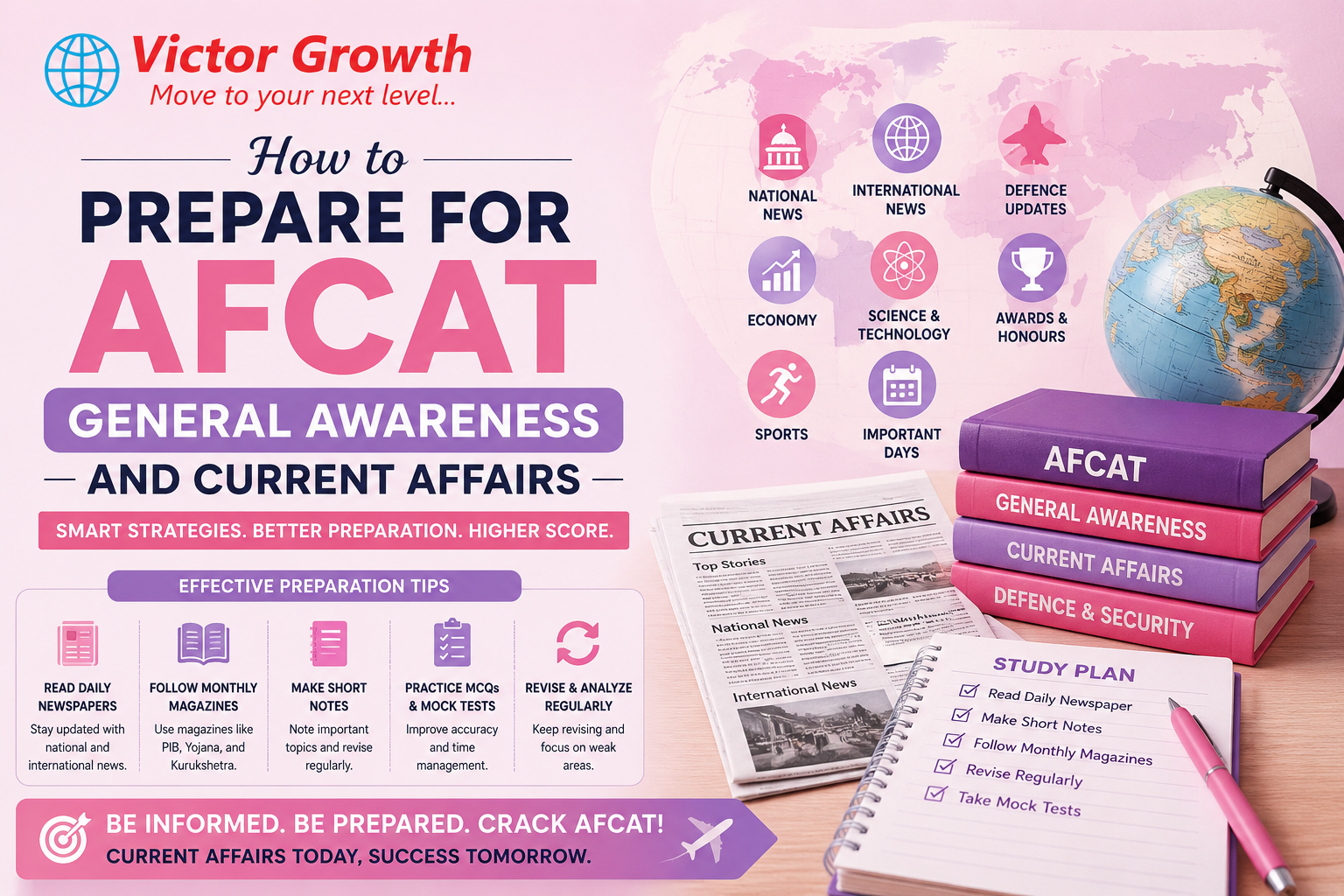
General Awareness and Current Affairs are important components of AFCAT preparation. Unlike subjects where candidates can rely mainly on formulas or fixed concepts, General Awareness requires continuous learning, regular revision, smart note-making and awareness of important national and international developments.
For aspirants searching for the best AFCAT coaching in Kerala, a structured approach to General Awareness can make preparation more manageable. Candidates do not need to memorise every piece of news they encounter. Instead, they should identify exam-relevant information, revise it repeatedly and practise questions regularly.
This comprehensive guide explains how to prepare for AFCAT General Awareness and Current Affairs, the important topics to cover, effective study methods, daily and weekly routines, common mistakes and how coaching can support AFCAT preparation.
Why Are General Awareness and Current Affairs Important for AFCAT?
General Awareness covers a wide range of subjects. Questions may test a candidate’s understanding of:
- Indian history
- Geography
- Indian polity
- Economy
- General science
- Defence
- Sports
- Awards and honours
- Important organisations
- Current national events
- International developments
- Science and technology
- Important government initiatives
Current Affairs is particularly challenging because the information keeps changing.
A candidate may study a topic today and need to revise it several times before the examination.
Therefore, AFCAT General Awareness preparation should follow:
Learn → Revise → Practise → Analyse → Repeat
AFCAT General Awareness: What Should You Study?
A good preparation strategy starts by dividing General Awareness into manageable categories.
1. History
Important areas include:
Ancient India
- Indus Valley Civilisation
- Vedic period
- Buddhism and Jainism
- Mauryan Empire
- Gupta period
- Important ancient kingdoms
Medieval India
- Delhi Sultanate
- Mughal Empire
- Bhakti and Sufi movements
- Important medieval rulers
- Administrative systems
Modern India
- Arrival of Europeans
- British expansion
- Revolt of 1857
- Indian National Congress
- Indian freedom movement
- Important movements
- Important leaders
- Indian Independence
Focus particularly on important events, personalities, movements and chronology.
2. Geography
AFCAT aspirants should build a strong understanding of Indian and world geography.
Important topics include:
- Physical geography
- Indian rivers
- Mountains
- Plateaus
- Climate
- Monsoons
- Soil types
- Natural vegetation
- Agriculture
- Mineral resources
- Industries
- Important geographical locations
- World geography
- Oceans and seas
- Important straits and canals
Preparation Tip
Use maps wherever possible.
Visual learning can make geographical information easier to remember.
3. Indian Polity
Polity is an important area for competitive examinations.
Focus on:
- Constitution of India
- Fundamental Rights
- Fundamental Duties
- Directive Principles
- President
- Vice-President
- Prime Minister
- Parliament
- Supreme Court
- High Courts
- Election Commission
- Constitutional bodies
- Important amendments
- Local self-government
- Centre-State relations
Do not simply memorise isolated facts.
Try to understand how different constitutional institutions function.
4. Indian Economy
You do not necessarily need advanced economic knowledge.
Focus on fundamental concepts and important developments.
Topics may include:
- GDP
- Inflation
- Fiscal policy
- Monetary policy
- Banking
- RBI
- Budget
- Taxation
- Employment
- Poverty
- Economic reforms
- Financial institutions
- Major government economic initiatives
Current economic developments should be studied alongside basic concepts.
5. General Science
Science questions can cover basic concepts from:
Physics
- Motion
- Force
- Work and energy
- Heat
- Light
- Sound
- Electricity
- Magnetism
Chemistry
- Elements
- Compounds
- Acids and bases
- Metals and non-metals
- Chemical reactions
- Everyday chemistry
Biology
- Human body
- Nutrition
- Diseases
- Vitamins
- Genetics
- Plants
- Animals
- Basic ecology
Focus on school-level fundamentals and exam-oriented facts.
6. Defence Awareness
For AFCAT aspirants, defence-related awareness deserves special attention.
Regularly follow important developments related to:
- Indian Air Force
- Indian Army
- Indian Navy
- Defence exercises
- Aircraft
- Missiles
- Defence technology
- Military equipment
- Defence agreements
- Important defence organisations
- Military appointments
- Joint exercises
- Space and aviation developments
Why Defence Awareness Matters
Aspirants preparing for a career in the Indian Air Force should naturally develop an interest in India’s defence ecosystem.
This can also make General Awareness preparation more meaningful and easier to retain.
7. Science and Technology
Modern science and technology can contribute important current-affairs topics.
Focus on:
- Space missions
- Satellites
- Artificial intelligence
- Biotechnology
- Digital technology
- Cybersecurity
- Medical developments
- Major scientific discoveries
- Semiconductor technology
- Renewable energy
- Emerging technologies
Don’t try to understand every technical detail.
Focus on the what, why and significance of major developments.
8. Sports
Sports-related current affairs can include:
- Major tournaments
- Winners
- Runners-up
- Important players
- Records
- Venues
- National and international competitions
- Major sporting awards
Maintain short notes rather than trying to memorise large amounts of information at once.
9. Awards and Honours
Keep track of important:
- National awards
- International awards
- Civilian honours
- Military honours
- Sports awards
- Literary awards
- Science and technology awards
Focus on the award + recipient + field/achievement.
10. Important Appointments
Important appointments can change frequently.
Follow major appointments involving:
- Constitutional positions
- Government institutions
- Defence organisations
- International organisations
- Financial institutions
- Major national institutions
Regular revision is essential because appointment-related facts are easy to forget.
11. Government Schemes and Initiatives
Focus on major government programmes and initiatives.
For each important scheme, understand:
- Name
- Launch year
- Ministry/organisation
- Main objective
- Target beneficiaries
- Major features
Avoid memorising every minor government programme.
Prioritise significant schemes and developments.
How to Prepare AFCAT Current Affairs Effectively
Current Affairs preparation can become overwhelming if you do not have a system.
Follow a simple approach.
Step 1: Read Daily
Spend approximately 30–45 minutes reviewing important current affairs.
Focus on quality rather than quantity.
Step 2: Make Short Notes
Do not copy complete newspaper articles.
Write only important information.
For example:
Topic: Defence Exercise
Countries: India + Country X
Purpose: Joint military training
Location: Relevant location
Key feature: Important detail
Short notes make revision much faster.
Step 3: Categorise Current Affairs
Create separate categories:
- Defence
- National
- International
- Economy
- Science & Technology
- Sports
- Awards
- Appointments
- Government Schemes
- Important Days
Categorisation makes revision easier.
Step 4: Revise Weekly
Daily learning without revision can result in rapid forgetting.
Set aside one day each week to revise the week’s current affairs.
Step 5: Revise Monthly
At the end of every month, revise the most important current-affairs developments.
Create a monthly revision sheet containing only high-priority information.
Step 6: Practise MCQs
After studying current affairs, solve questions.
This helps you determine whether you actually remember the information.
Use the cycle:
Read → Note → Revise → Test
How Many Months of Current Affairs Should AFCAT Aspirants Study?
There is no universal fixed period because the relevance of current affairs can vary by examination cycle.
A practical strategy is to:
- Follow current affairs consistently from the beginning of preparation.
- Give additional attention to the months immediately preceding the examination.
- Revise important events multiple times.
- Follow the latest official AFCAT notification and reliable exam-oriented guidance for the relevant cycle.
Do not wait until the final month to start current affairs preparation.
Daily AFCAT General Awareness Study Plan
A simple daily routine could look like this:
| Time | Activity |
|---|---|
| 30 min | Current affairs |
| 30 min | Static GK |
| 30 min | Defence awareness |
| 30 min | MCQ practice |
| 15 min | Revision |
You can adjust the duration according to your overall AFCAT study schedule.
The important thing is daily consistency.
Weekly AFCAT General Awareness Plan
Monday
Indian History + Current Affairs
Tuesday
Geography + Current Affairs
Wednesday
Polity + Current Affairs
Thursday
Economy + Current Affairs
Friday
Science + Technology + Current Affairs
Saturday
Defence + Current Affairs
Sunday
Weekly revision + MCQ test
This rotation ensures that every major area receives attention.
How to Remember General Awareness Better
One of the biggest challenges in General Awareness is forgetting information.
Use multiple techniques.
1. Spaced Revision
Revise information at increasing intervals.
For example:
Day 1 → Day 3 → Day 7 → Day 15 → Day 30
This can improve long-term retention.
2. Active Recall
Instead of repeatedly reading the same notes, close the book and ask yourself:
- What happened?
- Who was involved?
- When did it happen?
- Why is it important?
- Which organisation was involved?
This forces your brain to retrieve the information.
3. Flashcards
Flashcards can be useful for:
- Awards
- Appointments
- Defence exercises
- Important dates
- Capitals
- Organisations
- Abbreviations
4. Mind Maps
Mind maps can help connect related information.
For example:
Indian Defence
→ Air Force
→ Army
→ Navy
→ Defence Exercises
→ Aircraft
→ Missiles
→ Defence Organisations
→ Major Agreements
Best Resources for AFCAT General Awareness
Aspirants should avoid depending on one source for everything.
A balanced resource strategy can include:
Static GK
Use a standard competitive-exam GK book.
Current Affairs
Use reliable, regularly updated current-affairs sources.
Defence Current Affairs
Follow credible defence-related news and official announcements.
Previous-Year Questions
Use AFCAT previous-year questions to identify the type of information that is useful for the examination.
Mock Tests
Use mock tests to assess retention and identify gaps.
How Previous-Year Questions Help General Awareness Preparation
Previous-year questions can help you understand the style and level of questions expected in competitive examinations.
When solving them, don’t just memorise the answer.
Ask:
Why was this fact important?
If you encounter a question about a particular organisation, for example, learn its:
- Headquarters
- Purpose
- Establishment
- Member countries, where relevant
- Major functions
This creates broader understanding around individual questions.
How Mock Tests Improve AFCAT General Awareness Scores
Mock tests are particularly useful because General Awareness covers a wide range of topics.
After every test, identify:
Knowledge Gaps
Topics you have never studied.
Memory Gaps
Topics you studied but forgot.
Confusion Errors
Questions where you confused two similar facts.
Guessing Errors
Questions where you selected an answer without sufficient confidence.
Then revise accordingly.
Common Mistakes in AFCAT General Awareness Preparation
1. Trying to Study Everything
You cannot memorise every piece of information in the news.
Prioritise.
2. Ignoring Static GK
Current affairs are important, but static General Awareness should not be neglected.
3. Studying Current Affairs Only Before the Exam
Last-minute preparation can become overwhelming.
Build the habit early.
4. Making Extremely Long Notes
Long notes become difficult to revise.
Keep notes concise.
5. Reading Without Testing Yourself
Use MCQs and mock tests regularly.
6. Not Revising
Repeated revision is essential for General Awareness.
7. Depending on Social Media Alone
Social media can contain incomplete or inaccurate information.
Use reliable and credible sources for preparation.
AFCAT General Awareness Strategy for Beginners
If you are starting from zero, don’t try to cover the entire syllabus in a few days.
Month 1
Build fundamentals:
- History
- Geography
- Polity
- Science
- Basic economy
Start daily current affairs.
Month 2
Add:
- Defence awareness
- More current affairs
- Government schemes
- Sports
- Awards
- Appointments
Start regular MCQ practice.
Month 3
Focus more on:
- Revision
- Previous-year questions
- Mock tests
- Current-affairs consolidation
- Weak topics
The exact timeline should be adjusted based on your AFCAT examination date.
AFCAT Current Affairs Strategy for Working Professionals and College Students
If you have limited preparation time, do not try to read everything.
Use a 30-minute daily strategy:
10 Minutes
Read important current affairs.
10 Minutes
Make short notes.
10 Minutes
Revise yesterday’s information.
Then use weekends for deeper revision and MCQ practice.
Consistency is more important than studying current affairs for several hours once a week.
How the Best AFCAT Coaching in Kerala Can Help
For aspirants looking for the best AFCAT coaching in Kerala, General Awareness support should be an important factor when comparing coaching programmes.
A good AFCAT coaching programme should ideally provide:
1. Exam-Oriented Current Affairs
Instead of overwhelming students with unnecessary news, current affairs should be filtered for competitive-exam relevance.
2. Regular GK Classes
Structured classes can help students cover static General Awareness systematically.
3. Defence Awareness
Special attention to defence-related developments can benefit AFCAT aspirants.
4. Daily/Weekly Current-Affairs Updates
Regular updates prevent candidates from postponing current-affairs preparation.
5. MCQ Practice
Questions help students convert information into exam-ready knowledge.
6. Mock Tests
Regular tests identify knowledge and retention gaps.
7. Revision Sessions
Revision is particularly important for General Awareness because of the volume of information.
How to Choose the Best AFCAT Coaching in Kerala for General Awareness
Don’t choose a coaching centre simply because it claims to provide “the best GK classes.”
Check whether it offers:
- Experienced faculty
- Structured General Awareness coverage
- Current-affairs updates
- Defence-focused preparation
- Previous-year questions
- Regular MCQs
- Mock tests
- Detailed explanations
- Revision sessions
- Performance analysis
- Updated study materials
A coaching programme should make General Awareness manageable and exam-oriented, rather than simply giving students more information.
30-Day AFCAT General Awareness Revision Plan
If your examination is approaching, use a focused revision cycle.
Days 1–5
History + Geography
Days 6–10
Polity + Economy
Days 11–15
Science + Technology
Days 16–20
Defence + Aviation + Space
Days 21–23
Sports + Awards + Appointments
Days 24–26
Government schemes + Important organisations
Days 27–28
Current affairs revision
Day 29
Mixed MCQ practice
Day 30
Full General Awareness revision test
This is only a model structure and can be modified according to your strengths and the latest examination cycle.
AFCAT General Awareness Revision Checklist
Before the examination, make sure you have revised:
- Indian History
- Indian Geography
- Indian Polity
- Basic Economics
- General Science
- Defence awareness
- Aviation-related developments
- Space developments
- Government schemes
- Important appointments
- Awards
- Sports
- Important organisations
- National and international current affairs
- Important current-affairs MCQs
- Previous-year questions
- Mock-test mistakes
Final Thoughts
Preparing for AFCAT General Awareness and Current Affairs is not about trying to memorise every piece of information available online. It is about identifying important information, understanding it, revising it repeatedly and testing your retention.
A successful strategy can be summarised as:
Read → Shortlist → Note → Revise → Practise → Test → Analyse
For aspirants searching for the best AFCAT coaching in Kerala, choose a programme that provides structured General Awareness preparation, updated current affairs, defence awareness, regular MCQs, mock tests and revision support.
Most importantly, make General Awareness a daily habit rather than a last-minute subject.
Even 30–60 minutes of focused preparation every day can build a strong knowledge base when combined with regular revision and practice.
Start early, study selectively, revise regularly and stay updated. That is the smarter way to prepare for AFCAT General Awareness and Current Affairs.
Frequently Asked Questions (FAQs)
1. How should I start preparing for AFCAT General Awareness?
Start by dividing General Awareness into static GK and current affairs. Cover history, geography, polity, economy, science and defence while following important current events every day.
2. How much time should I spend on AFCAT Current Affairs daily?
Around 30–45 minutes of focused daily preparation can be a practical starting point. Regular revision is more important than spending several hours occasionally.
3. How many months of current affairs should I study for AFCAT?
Follow current affairs consistently throughout your preparation and give additional attention to recent months before the examination. Always follow the latest AFCAT notification and reliable exam-oriented guidance for your specific exam cycle.
4. Is static GK important for AFCAT?
Yes. Current affairs should be combined with static General Awareness covering areas such as history, geography, polity, economy, science and defence.
5. Is defence current affairs important for AFCAT?
Yes. Since AFCAT is a defence-oriented examination, aspirants should develop awareness of important developments involving India’s armed forces, defence technology, exercises, aviation and related developments.
6. How can I remember AFCAT current affairs for a long time?
Use short notes, active recall, flashcards, mind maps and spaced revision. Regular MCQ practice can also help strengthen retention.
7. Should I read newspapers for AFCAT?
Newspapers can be useful, but you do not need to read every article. Focus on important national, international, defence, economic, science and technology developments and use reliable exam-oriented resources to save time.
8. Are current-affairs PDFs enough for AFCAT?
Current-affairs PDFs can be useful revision resources, but do not depend entirely on them. Combine current affairs with static GK, previous-year questions, MCQs and mock tests.
9. How can mock tests improve my AFCAT General Awareness preparation?
Mock tests identify knowledge gaps, memory gaps and confusing topics. Analysing incorrect answers helps you determine exactly what needs to be revised.
10. Should I join the best AFCAT coaching in Kerala for General Awareness?
Coaching is not compulsory, but a good programme can provide structured GK classes, filtered current affairs, defence awareness, regular tests, revision and expert guidance.
11. How do I choose the best AFCAT coaching in Kerala?
Compare faculty experience, syllabus coverage, current-affairs support, defence-focused preparation, study materials, mock tests, previous-year questions, doubt-clearing facilities and performance analysis.
12. What is the biggest mistake in AFCAT General Awareness preparation?
Trying to study everything without a structured revision system is one of the biggest mistakes. Focus on important topics, concise notes, repeated revision and regular MCQ practice rather than collecting excessive information.