Clearing the AFCAT written examination is an important milestone, but for candidates aiming to become officers in the Indian Air Force, the journey does not end with the written test. Candidates who qualify for the relevant AFCAT selection process may have to face the Air Force Selection Board (AFSB) stage, where they are assessed through multiple tests designed to evaluate their suitability for a career as an officer.
This is where structured preparation can make a major difference.
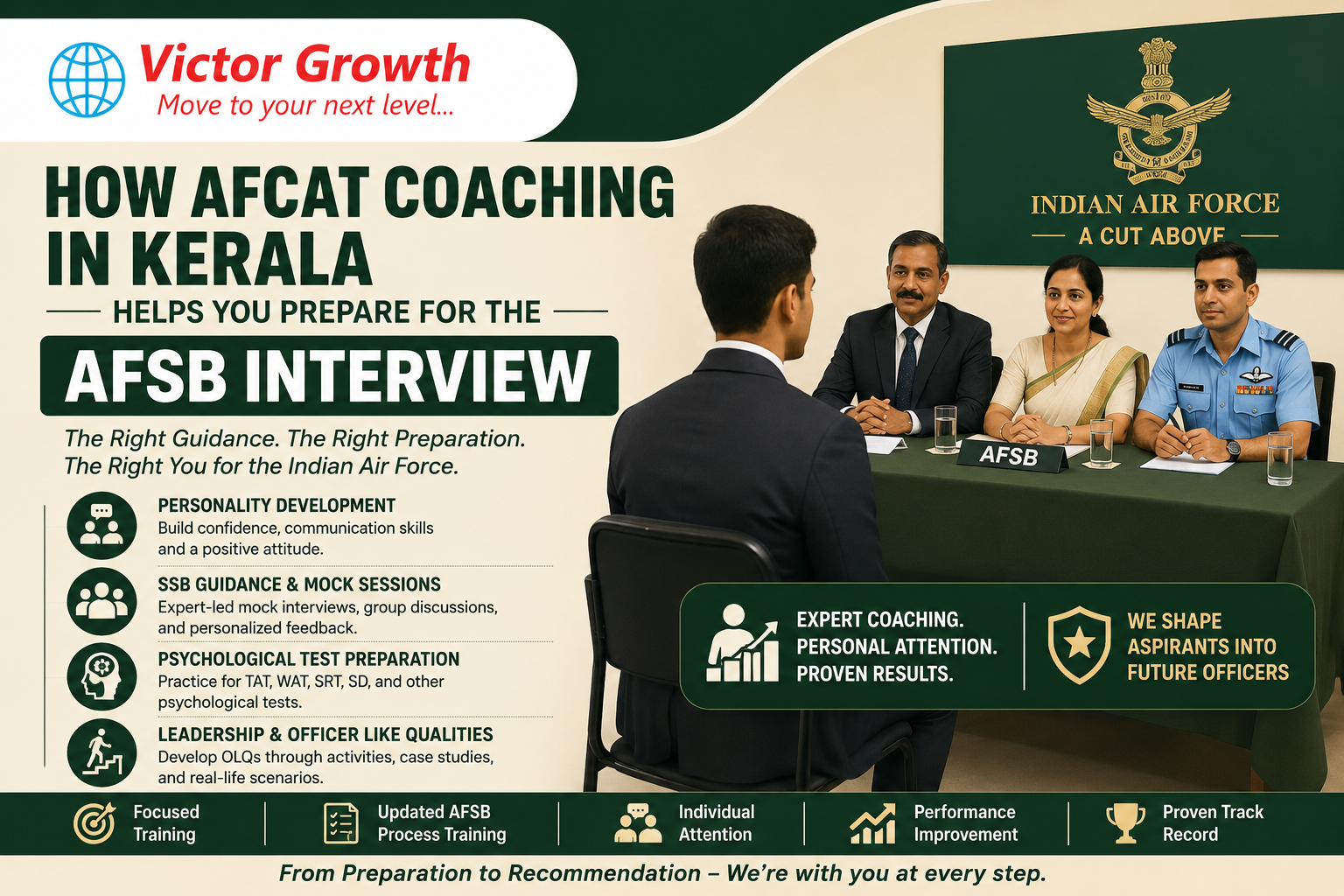
For aspirants searching for the best AFCAT coaching in Kerala, it is important to understand that effective AFCAT preparation should not focus only on written-examination subjects. A well-rounded programme should also help candidates understand the AFSB process, develop communication skills, improve confidence, practise psychological-test formats and prepare for group activities and the interview.
This comprehensive guide explains how AFCAT coaching in Kerala can help aspirants prepare for the AFSB interview, what skills candidates should develop, common preparation mistakes, how to choose the right coaching institute and how to approach the AFSB stage with confidence.
What Is the AFSB Interview?
The Air Force Selection Board (AFSB) process is designed to assess whether candidates possess the qualities and potential required for an officer role in the Indian Air Force.
The assessment is broader than academic knowledge.
Candidates may be evaluated on areas such as:
- Officer-like qualities
- Communication ability
- Leadership potential
- Teamwork
- Decision-making
- Psychological suitability
- Confidence
- Adaptability
- Social awareness
- Responsibility
- Initiative
- Reasoning ability
The exact selection procedure and instructions can vary according to the entry and current official guidelines, so candidates should always refer to the latest official instructions relevant to their AFCAT cycle.
Why AFSB Preparation Is Different From AFCAT Written Preparation
The AFCAT written examination primarily tests knowledge and aptitude through objective questions.
AFSB assessment is different.
It focuses much more on personality, behaviour, psychological responses, communication, leadership potential and performance in individual and group situations.
Therefore:
AFCAT Written Exam
Focuses on:
- English
- General Awareness
- Numerical Ability
- Reasoning
- Military Aptitude
AFSB
Focuses more broadly on:
- Personality
- Psychological responses
- Communication
- Leadership
- Teamwork
- Group behaviour
- Decision-making
- Officer potential
A candidate can perform well academically but still need to work on communication, confidence or group interaction.
That is why AFSB-specific preparation is valuable.
How AFCAT Coaching in Kerala Helps With AFSB Preparation
A good AFCAT coaching institute in Kerala can help bridge the gap between written-exam preparation and AFSB preparation.
Here are some of the major ways coaching can help.
1. Understanding the AFSB Selection Process
One of the first challenges for candidates is understanding what happens at the selection board.
A structured coaching programme can explain:
- Stages of assessment
- Types of tests
- General expectations
- Interview structure
- Psychological testing
- Group activities
- Conference stage
- Documentation requirements
Understanding the process reduces uncertainty.
When candidates know what to expect, they can focus more effectively on performing naturally.
2. Psychological Test Preparation
Psychological assessment is an important part of the selection process.
Candidates may encounter different forms of psychological assessment designed to understand aspects of their personality and thinking.
Depending on the current selection procedure, preparation may involve practice for areas such as:
- Thematic Apperception Test-style exercises
- Word Association exercises
- Situation Reaction exercises
- Self-description exercises
The objective should not be to memorise artificial answers.
Instead, coaching should help candidates understand:
- How to interpret situations
- How to organise their thoughts
- How to respond naturally
- How to express realistic solutions
- How to maintain consistency
3. Story Writing and Picture-Based Practice
Picture-based exercises can require candidates to interpret an image and develop a meaningful story.
Good preparation can teach candidates to consider:
- Characters
- Situation
- Problem
- Action
- Result
- Positive development
However, candidates should avoid creating unrealistic or overly dramatic stories.
The focus should be on logical thinking, initiative and practical problem-solving.
4. Word Association Practice
Word Association-type exercises test how candidates respond to words under time pressure.
A coaching programme can provide regular practice to help candidates:
- Think quickly
- Form meaningful sentences
- Express constructive thoughts
- Avoid unnecessarily negative responses
- Manage limited response time
The objective should not be to memorise “perfect” sentences.
Candidates should develop their own natural thinking style.
5. Situation Reaction Test Preparation
Situation Reaction exercises require candidates to respond to everyday or challenging situations.
These may assess qualities such as:
- Responsibility
- Practical thinking
- Initiative
- Courage
- Decision-making
- Social awareness
- Problem-solving
Coaching can provide practice situations and help candidates understand how to formulate practical responses.
6. Self-Description Preparation
The self-description exercise requires candidates to reflect on themselves.
Candidates may need to think about:
- Their strengths
- Areas they need to improve
- How family members perceive them
- How teachers or friends perceive them
- Their goals
- Their attitude towards responsibilities
Coaching can help candidates organise their thoughts.
However, candidates should remain honest.
Trying to manufacture an artificial personality can create inconsistencies during later stages of the assessment.
7. AFSB Personal Interview Preparation
The personal interview is one of the areas where coaching can provide significant value.
A candidate may be asked questions about:
- Educational background
- Family
- Hobbies
- Interests
- Achievements
- Strengths
- Weaknesses
- Career goals
- Current affairs
- Defence awareness
- Indian Air Force
- AFCAT
- Personal experiences
The interviewer may also ask follow-up questions based on the candidate’s answers.
Therefore, candidates should understand their own background thoroughly.
8. Mock Interviews
Mock interviews are among the most useful forms of AFSB preparation.
A good coaching institute can conduct simulated interviews where candidates practise:
- Introducing themselves
- Answering personal questions
- Discussing academic background
- Explaining career choices
- Talking about hobbies
- Answering questions about the Air Force
- Responding to unexpected follow-up questions
After the mock interview, faculty can provide feedback on:
- Communication
- Confidence
- Clarity
- Body language
- Answer structure
- Knowledge gaps
Repeated practice can help candidates become more comfortable in interview situations.
9. Improving Communication Skills
Communication is an important part of officer-oriented assessment.
Candidates don’t necessarily need highly sophisticated English.
They need to communicate:
- Clearly
- Confidently
- Naturally
- Logically
- Respectfully
AFCAT coaching can help candidates practise:
- Self-introduction
- Group discussions
- Personal interviews
- Short speeches
- Situation-based discussions
- Current-affairs conversations
The objective is effective communication, not complicated vocabulary.
10. Group Discussion Preparation
Group discussions can help assess how candidates interact with others.
A coaching programme can provide practice in:
- Expressing opinions
- Listening to others
- Building on another person’s point
- Disagreeing respectfully
- Speaking with confidence
- Encouraging quieter participants
- Staying relevant
Candidates should avoid dominating the discussion.
Leadership is not simply about speaking the most.
11. Group Planning Exercise Practice
Group planning activities can require candidates to analyse a situation, identify priorities and develop a practical plan.
Coaching can help candidates practise:
- Identifying problems
- Prioritising tasks
- Using available resources
- Managing time
- Working with a team
- Presenting a logical solution
The emphasis should be on practical teamwork and decision-making.
12. Outdoor Group Activity Preparation
Some AFSB activities involve group tasks and physical or outdoor components.
Preparation can help candidates understand the importance of:
- Teamwork
- Coordination
- Initiative
- Communication
- Physical stamina
- Leadership
- Cooperation
Candidates should remember that group activities are not simply competitions.
Your behaviour towards teammates matters.
13. Leadership Development
Officer selection naturally places importance on leadership potential.
A good coaching environment can create opportunities for candidates to practise:
- Taking responsibility
- Organising activities
- Making decisions
- Leading a discussion
- Solving group problems
- Supporting teammates
Leadership should not be confused with giving orders.
Effective leadership includes:
Communication + Responsibility + Initiative + Teamwork
14. Current Affairs and Defence Awareness
AFSB interviews may involve questions related to the candidate’s awareness of the world around them.
AFCAT coaching can help candidates stay updated on:
- Indian defence developments
- Indian Air Force
- Defence exercises
- Aviation
- National security
- International relations
- Science and technology
- Major national developments
- Important current affairs
Candidates should focus on understanding important issues rather than memorising endless headlines.
15. Indian Air Force Awareness
An AFSB aspirant should have genuine knowledge about the organisation they want to join.
Prepare topics such as:
- Role of the Indian Air Force
- Major commands
- Aircraft
- Transport aircraft
- Helicopters
- Fighter aircraft
- Air defence systems
- Training institutions
- Important operations
- Major exercises
- Ranks
- Career opportunities
- Officer responsibilities
Most importantly, understand why you want to join the Indian Air Force.
16. Helping Candidates Understand Their PIQ Details
Personal information provided during the selection process can become important during the interview.
Candidates should be prepared to discuss information related to:
- Education
- Family
- Hobbies
- Achievements
- Responsibilities
- Sports
- Extracurricular activities
- Leadership experiences
- Career goals
A coaching programme can help candidates identify possible interview questions from their own background.
17. Personalised Feedback
One major advantage of coaching is external feedback.
You may not notice:
- Speaking too quickly
- Avoiding eye contact
- Giving excessively long answers
- Repeating the same point
- Appearing uncertain
- Interrupting others
- Speaking too softly
Faculty can identify these habits and help you improve them.
18. Building Confidence
Many candidates understand the answers but struggle to communicate them confidently.
Regular practice can gradually improve:
- Public speaking
- Interview confidence
- Group participation
- Decision-making
- Communication
Confidence should come from preparation and self-awareness, not from pretending to be overly assertive.
19. Learning How to Handle Unexpected Questions
AFSB interviews are not simply a list of questions that can be memorised.
Interviewers may ask follow-up questions based on your answers.
For example:
Question: Why do you want to join the Air Force?
If you answer:
“I have always wanted to serve the country.”
You may be asked:
“Why the Air Force specifically?”
Then:
“What do you know about the life of an Air Force officer?”
Coaching can help candidates practise answering logically without becoming dependent on memorised scripts.
20. Developing Natural Responses
One of the most important principles of AFSB preparation is authenticity.
Candidates should avoid:
- Memorised answers
- Fake achievements
- Artificial personality traits
- Overly rehearsed stories
- Exaggerated confidence
Coaching should help you present your genuine personality effectively, not create a fictional personality.
AFCAT Coaching in Kerala: Written Exam + AFSB Preparation
A comprehensive AFCAT preparation programme should ideally support both stages.
Stage 1: Written Examination
Focus on:
- English
- General Awareness
- Numerical Ability
- Reasoning
- Military Aptitude
- Mock tests
- Previous-year questions
Stage 2: AFSB
Focus on:
- Psychological preparation
- Interview preparation
- Group discussions
- Communication
- Leadership
- Current affairs
- Defence awareness
- Personality development
This integrated approach can save candidates from having to start AFSB preparation from zero after clearing the written examination.
Why Start AFSB Preparation Early?
Many candidates make the mistake of waiting for their written result before thinking about AFSB.
While written-exam preparation should remain the primary priority initially, candidates can gradually develop AFSB-related skills alongside it.
For example:
Daily
Read current affairs.
Weekly
Practise speaking on a topic.
Regularly
Participate in discussions.
Throughout Preparation
Develop physical fitness and healthy routines.
Before AFSB
Take mock interviews and practise psychological-test formats.
This makes the transition smoother.
AFSB Preparation for Candidates From Kerala
Candidates from Kerala may come from diverse educational and professional backgrounds.
Some may be:
- College students
- Working professionals
- Graduates
- First-time defence aspirants
- Candidates with previous interview experience
A good AFCAT coaching centre in Kerala should recognise these differences and provide personalised guidance rather than treating every candidate identically.
Daily AFSB Preparation Routine
A simple routine can include:
20 Minutes
Read important current affairs.
15 Minutes
Read about Indian defence and the Air Force.
15 Minutes
Practise speaking on a topic.
15 Minutes
Work on psychological-test practice.
10 Minutes
Self-reflection or interview preparation.
The objective is consistency rather than long study sessions.
Weekly AFSB Preparation Plan
Monday
Current affairs + Air Force awareness
Tuesday
Word association practice
Wednesday
Situation reaction practice
Thursday
Picture-based story practice
Friday
Communication practice
Saturday
Group discussion
Sunday
Mock interview + self-analysis
This routine can be adjusted based on the candidate’s stage of preparation.
Common Mistakes Candidates Make During AFSB Preparation
1. Memorising Model Answers
Interviewers can often identify unnatural responses.
2. Pretending to Be Someone Else
Authenticity is important.
3. Ignoring Current Affairs
Candidates should be aware of major developments.
4. Focusing Only on Speaking
AFSB preparation is broader than communication.
5. Dominating Group Activities
Leadership does not mean speaking continuously.
6. Being Too Passive
Candidates should participate and contribute.
7. Giving Exaggerated Answers
Stay honest and realistic.
8. Not Knowing Your Own Background
Be prepared to discuss your education, interests, achievements and experiences.
9. Ignoring Physical Fitness
Candidates should maintain appropriate physical readiness for the selection process.
10. Starting Preparation at the Last Minute
Developing communication and confidence takes time.
How to Choose the Best AFCAT Coaching in Kerala for AFSB Preparation
If you are searching for the best AFCAT coaching in Kerala, consider the following factors.
1. AFCAT + AFSB Integration
Check whether the institute supports candidates beyond the written examination.
2. Experienced Faculty
Look for instructors who understand defence selection and interview preparation.
3. Mock Interviews
Regular interview practice is extremely valuable.
4. Psychological Test Guidance
Look for structured practice and feedback.
5. Group Activity Training
Candidates should have opportunities to participate in group exercises.
6. Communication Training
The programme should improve clarity and confidence.
7. Defence Awareness
Regular defence and current-affairs updates are useful.
8. Personalised Feedback
Individual feedback can identify habits that group classes may miss.
9. Performance Tracking
Progress should be monitored throughout preparation.
10. Genuine Mentorship
A good coaching environment should encourage candidates to develop naturally rather than simply memorise answers.
What Should You Ask Before Joining AFCAT Coaching in Kerala?
Before enrolling, ask:
- Does the programme include AFSB preparation?
- Are mock interviews conducted?
- Is psychological-test practice provided?
- Are group discussions conducted?
- Are outdoor/group activities included?
- Is individual feedback provided?
- Are current affairs discussed regularly?
- Is Indian Air Force awareness included?
- Are previous AFSB experiences discussed responsibly?
- How is student performance monitored?
These questions can help you compare different coaching programmes.
AFCAT Coaching in Kerala: What Makes a Good AFSB Programme?
A strong programme should ideally combine:
Knowledge
Understanding the Air Force and current affairs.
Skills
Communication, reasoning and decision-making.
Practice
Mock interviews, group discussions and psychological exercises.
Feedback
Identifying weaknesses and improving them.
Personality Development
Building confidence, responsibility and leadership potential.
Consistency
Regular practice rather than last-minute preparation.
AFSB Interview Preparation Checklist
Before attending the AFSB, candidates should be comfortable discussing:
- Educational background
- Family background
- Hobbies
- Strengths
- Weaknesses
- Achievements
- Failures and lessons learned
- Career goals
- Why the Indian Air Force?
- Why do you want to become an officer?
- Defence awareness
- Current affairs
- Basic Air Force knowledge
- Academic subjects
- Personal responsibilities
- Leadership experiences
- Sports and extracurricular activities
How to Prepare for the Question “Why Do You Want to Join the Air Force?”
This is one of the most important areas to prepare thoughtfully.
Avoid generic answers that sound memorised.
Think about:
- Why the Air Force specifically?
- What attracts you to the officer role?
- What do you understand about the responsibilities?
- What personal experiences influenced your decision?
- What qualities do you want to develop?
- Why are you willing to accept the responsibilities and challenges?
Your answer should reflect your genuine motivation.
How to Improve AFSB Interview Confidence
Confidence comes from preparation.
Try:
Speak Regularly
Practise expressing your thoughts aloud.
Record Yourself
Review your:
- Voice
- Speed
- Clarity
- Body language
Participate in Discussions
Don’t avoid opportunities to speak.
Read Current Affairs
Being informed improves confidence.
Conduct Mock Interviews
Repeated exposure reduces nervousness.
How Coaching Helps You Avoid Common AFSB Mistakes
A good coach can identify problems that candidates may not notice themselves.
For example:
Problem: Answers are too long.
Solution: Practise concise responses.
Problem: Candidate speaks too softly.
Solution: Voice projection practice.
Problem: Candidate avoids group participation.
Solution: Regular group discussions.
Problem: Candidate memorises responses.
Solution: Use spontaneous mock interviews.
Problem: Candidate lacks Air Force awareness.
Solution: Structured defence-awareness sessions.
Can Self-Preparation Work for AFSB?
Yes.
Candidates can prepare independently through:
- Current-affairs reading
- Defence awareness
- Communication practice
- Self-reflection
- Mock interviews with mentors
- Group discussions
- Psychological-test practice
- Fitness preparation
However, structured coaching can provide something self-study often lacks:
External evaluation.
Someone observing your performance can identify weaknesses that you may not recognise yourself.
Final Thoughts
The AFCAT written examination is only one part of the journey towards an officer career in the Indian Air Force. Candidates should also be prepared for the broader demands of the AFSB selection process.
For aspirants searching for the best AFCAT coaching in Kerala, look for an institute that goes beyond written-exam preparation and provides structured AFSB support through:
- Mock interviews
- Psychological-test practice
- Group discussions
- Communication training
- Leadership activities
- Defence awareness
- Current-affairs preparation
- Personalised feedback
However, the purpose of AFSB coaching should not be to teach candidates how to “act like an officer.”
Instead, good coaching should help candidates understand themselves, communicate effectively, work with others, make practical decisions and present their genuine personality confidently.
The best preparation formula is:
Knowledge + Communication + Self-Awareness + Teamwork + Leadership + Consistent Practice
Start preparing early, stay informed about the Indian Air Force, practise communication regularly and learn from every mock assessment.
Remember:
AFSB preparation is not about creating a perfect personality. It is about developing and presenting your genuine potential as a future officer.
Frequently Asked Questions (FAQs)
1. Does AFCAT coaching in Kerala include AFSB preparation?
Many AFCAT coaching programmes may offer AFSB-related support, but the exact services vary by institute. Candidates should confirm whether the programme includes mock interviews, psychological-test practice, group activities and personalised feedback.
2. Why is AFSB preparation important after AFCAT?
The written examination tests academic and aptitude-based abilities, while AFSB evaluates broader officer potential, including communication, teamwork, leadership, psychological suitability and decision-making.
3. When should I start preparing for AFSB?
You can gradually develop communication, current-affairs awareness, self-confidence and fitness alongside written-exam preparation. More intensive AFSB-specific practice can be undertaken once you are progressing towards the selection stage.
4. What does AFCAT coaching teach for the AFSB interview?
A structured programme may provide mock interviews, psychological-test practice, group discussions, communication training, current-affairs preparation, defence awareness and personality-development activities.
5. How can I improve my AFSB interview skills?
Practise speaking clearly, learn about the Indian Air Force, understand your own background, follow current affairs, participate in discussions and take mock interviews.
6. Is English fluency compulsory for AFSB?
Candidates should be able to communicate clearly and effectively. Perfect or highly sophisticated English is not the objective. Clarity, confidence and logical expression are more important.
7. Should I memorise answers for the AFSB interview?
No. Memorised answers can sound unnatural. Prepare key areas and understand your own experiences so you can respond naturally to questions and follow-ups.
8. What current affairs should I study for AFSB?
Focus on important national and international developments, defence, Indian Air Force-related developments, national security, science and technology, international relations and major government initiatives.
9. How important is group discussion in AFSB preparation?
Group activities provide opportunities to demonstrate communication, teamwork, initiative, cooperation and leadership. Candidates should aim to contribute meaningfully rather than dominate the discussion.
10. Can I prepare for AFSB without joining coaching?
Yes. Self-preparation is possible. However, coaching can provide structured practice and external feedback, particularly through mock interviews, group activities and psychological-test exercises.
11. How do I choose the best AFCAT coaching in Kerala for AFSB preparation?
Look for experienced faculty, comprehensive AFSB support, mock interviews, psychological-test practice, group activities, communication training, defence-awareness sessions and individual performance feedback.
12. What is the biggest mistake candidates make during AFSB preparation?
One of the biggest mistakes is trying to memorise artificial “perfect” responses or pretending to have qualities they do not genuinely demonstrate. Effective preparation should focus on self-awareness, communication, teamwork, practical thinking and authentic personality development.