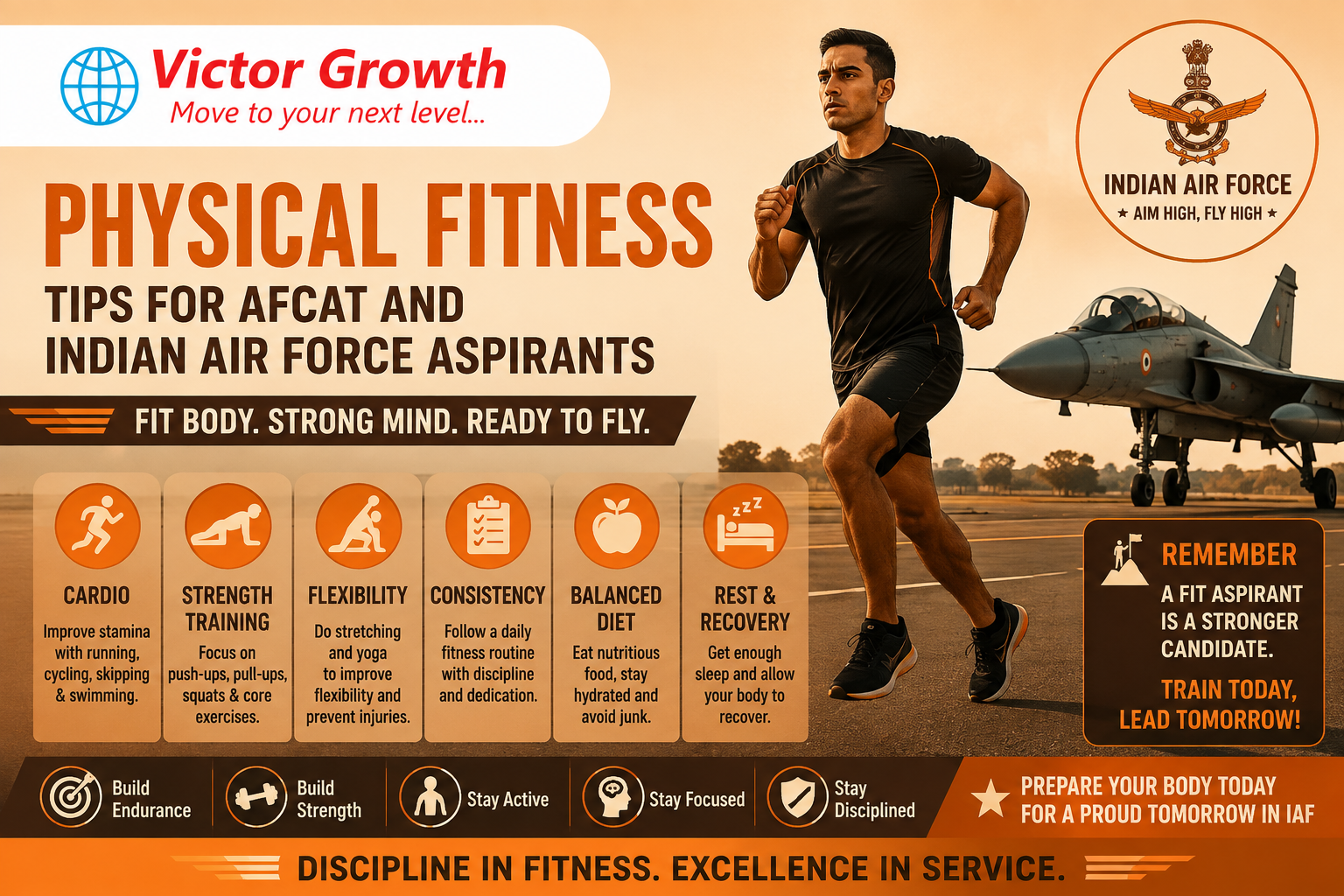
Physical fitness is an important part of preparing for a career in the Indian Air Force. AFCAT aspirants should not focus only on written examination subjects such as English, General Awareness, Numerical Ability and Reasoning. A well-rounded preparation strategy should also include physical conditioning, stamina development, mobility, healthy routines and overall fitness.
For candidates searching for the best AFCAT coaching in Kerala, it is worth considering whether the coaching programme provides guidance beyond academics, including physical fitness awareness, AFSB preparation and overall personality development.
However, physical preparation should be approached sensibly. The objective is not to follow an extreme workout routine. Instead, candidates should gradually develop cardiovascular endurance, muscular strength, flexibility, coordination and recovery habits while keeping their individual fitness level and medical requirements in mind.
Important: Fitness and medical eligibility requirements can vary by entry and may be updated. Candidates should always check the latest official Indian Air Force notification and medical standards applicable to their particular AFCAT entry.
Why Is Physical Fitness Important for AFCAT Aspirants?
Joining the Indian Air Force involves more than clearing a written examination.
Candidates progressing through the selection process should be prepared for:
- Physical activity
- Group activities
- Outdoor tasks
- Long assessment days
- Mental pressure
- Demanding professional responsibilities
Good fitness can support:
- Better stamina
- Improved concentration
- Greater confidence
- Better participation in group activities
- Improved energy levels
- More effective daily routines
Physical fitness should therefore be treated as a long-term preparation habit, not something to start a few days before selection.
Does AFCAT Require Physical Fitness?
AFCAT itself is primarily a written examination, but candidates selected through the relevant process must satisfy applicable physical and medical standards for their entry.
The selection process can include further stages where physical readiness, medical fitness and overall suitability matter.
Therefore, AFCAT aspirants should understand an important distinction:
Written Preparation
Focuses on:
- English
- General Awareness
- Numerical Ability
- Reasoning
- Military Aptitude
Selection Preparation
May additionally require attention to:
- Physical fitness
- Medical standards
- Psychological readiness
- Communication
- Teamwork
- Leadership
- Overall officer potential
This is why a comprehensive preparation plan should address both academic and physical development.
10 Essential Physical Fitness Tips for AFCAT Aspirants
1. Start Early
One of the biggest mistakes aspirants make is postponing physical preparation until they receive their selection call.
Instead, start gradually during your AFCAT preparation.
Even a simple routine involving:
- Walking
- Jogging
- Bodyweight exercises
- Stretching
- Mobility work
can help establish a foundation.
The goal is progressive improvement, not immediate peak performance.
2. Build Cardiovascular Endurance
Cardiovascular fitness is important for improving stamina.
Good options include:
- Brisk walking
- Jogging
- Running
- Cycling
- Swimming
- Skipping
If you are new to exercise, begin with brisk walking and short jogging intervals.
For example:
Walk → Jog → Run
Gradually increase duration as your fitness improves.
3. Develop Running Stamina Gradually
Running is a useful way to develop cardiovascular endurance.
However, beginners should avoid suddenly running long distances.
A gradual approach can look like:
Week 1
Brisk walking + short jogging intervals
Week 2
Longer jogging intervals
Week 3
Continuous easy-paced jogging
Week 4
Gradually increase duration or distance
The exact progression should depend on your current fitness level.
If you experience pain, dizziness, unusual breathlessness or other concerning symptoms, stop exercising and seek appropriate medical advice.
4. Strengthen Your Core
Core strength supports posture, stability and movement.
Useful bodyweight exercises include:
- Planks
- Side planks
- Bird dogs
- Glute bridges
- Controlled abdominal exercises
Start with manageable repetitions or durations and focus on proper technique.
Quality is more important than doing a large number of repetitions.
5. Build Upper-Body Strength
Upper-body strength can be developed progressively through exercises such as:
- Push-ups
- Incline push-ups
- Wall push-ups
- Assisted exercises
- Resistance-band exercises
If standard push-ups are difficult, begin with an easier variation.
For example:
Wall Push-Up → Incline Push-Up → Knee/Modified Push-Up → Standard Push-Up
The progression should match your current strength.
6. Strengthen Your Lower Body
Strong legs support running, walking, jumping and other physical activities.
Useful exercises include:
- Bodyweight squats
- Lunges
- Step-ups
- Calf raises
- Glute bridges
Maintain proper technique rather than chasing high repetition numbers.
7. Improve Flexibility and Mobility
Flexibility is often overlooked by aspirants.
Include basic mobility and stretching for:
- Shoulders
- Hips
- Hamstrings
- Calves
- Ankles
- Back
A short mobility routine before or after training can help you move more comfortably.
Avoid aggressive stretching or forcing a joint beyond a comfortable range.
8. Maintain a Healthy Body Composition
Fitness is not about achieving a particular appearance.
Aspirants should focus on:
- Healthy nutrition
- Regular exercise
- Adequate sleep
- Hydration
- Sustainable body weight
- Strength and endurance
Do not follow extreme diets simply to change your weight quickly.
Medical eligibility depends on official standards and individual assessment, so candidates should not rely on social-media fitness claims.
9. Focus on Recovery
Training every day without adequate recovery can lead to fatigue and injuries.
Recovery includes:
- Adequate sleep
- Rest days
- Proper hydration
- Balanced nutrition
- Appropriate training intensity
Your body becomes stronger through the combination of training and recovery.
10. Maintain Consistency
The most effective fitness routine is the one you can follow consistently.
A moderate workout performed regularly is usually more useful than an intense workout performed occasionally.
Think:
Consistency > Intensity
AFCAT Fitness Training Components
A balanced fitness programme should include five broad components:
1. Cardiovascular Endurance
Examples:
- Running
- Jogging
- Cycling
- Swimming
2. Muscular Strength
Examples:
- Push-ups
- Squats
- Lunges
- Core exercises
3. Mobility
Examples:
- Dynamic movements
- Hip mobility
- Shoulder mobility
4. Flexibility
Examples:
- Hamstring stretches
- Calf stretches
- Gentle full-body stretching
5. Recovery
Examples:
- Rest
- Sleep
- Hydration
- Balanced nutrition
Sample Weekly Fitness Plan for AFCAT Aspirants
A general beginner-friendly structure could be:
| Day | Training |
|---|---|
| Monday | Jogging + Core |
| Tuesday | Strength Training |
| Wednesday | Brisk Walk/Jog + Mobility |
| Thursday | Strength Training |
| Friday | Running + Core |
| Saturday | Light Cardio + Stretching |
| Sunday | Rest/Recovery |
This is a general framework, not a mandatory AFCAT fitness standard.
Adjust the intensity according to your fitness level.
AFCAT Morning Fitness Routine
If you prefer morning workouts, a simple routine could be:
5–10 Minutes
Warm-up
20–30 Minutes
Jogging or brisk walking
15–20 Minutes
Bodyweight strength exercises
5–10 Minutes
Cool-down and gentle stretching
The duration can be gradually increased as your fitness improves.
Warm-Up Before Exercise
Never jump directly into intense exercise.
A warm-up can include:
- Easy walking
- Arm circles
- Shoulder movements
- Hip rotations
- Leg swings
- Light jogging
- Dynamic mobility movements
A warm-up prepares the body for activity and allows you to gradually increase intensity.
Cool-Down After Exercise
After training, gradually reduce your intensity.
A cool-down can include:
- Slow walking
- Gentle stretching
- Controlled breathing
- Mobility exercises
Avoid immediately stopping after very intense exercise.
AFCAT Fitness Tips for Beginners
If you have never followed a structured exercise routine, start slowly.
Week 1
Focus on establishing the habit.
- Walking
- Light jogging
- Basic bodyweight exercises
- Stretching
Week 2
Increase exercise duration gradually.
Week 3
Introduce more structured running and strength sessions.
Week 4
Build consistency and improve endurance.
Do not compare your first week with someone who has trained for years.
AFCAT Fitness Tips for Candidates With Good Fitness
If you already exercise regularly, focus on:
- Improving endurance
- Developing functional strength
- Maintaining mobility
- Improving running efficiency
- Avoiding overtraining
- Maintaining recovery
You don’t need an extreme bodybuilding programme for AFCAT preparation.
Functional fitness is more useful than training purely for appearance.
Importance of Running for Indian Air Force Aspirants
Running can help develop:
- Cardiovascular endurance
- Leg strength
- Stamina
- Mental resilience
- Pacing ability
However, running should be introduced progressively.
Avoid suddenly increasing:
- Distance
- Speed
- Frequency
A common training principle is to increase workload gradually rather than making sudden jumps.
How to Improve Running Stamina
Use interval-based progression if continuous running is difficult.
For example:
Walk → Jog → Walk → Jog
As your endurance improves:
Jog → Short Run → Jog
Eventually:
Continuous Easy Run
Focus on maintaining a sustainable pace rather than sprinting throughout the session.
Strength Training for AFCAT Aspirants
You don’t necessarily need expensive gym equipment.
Bodyweight exercises can provide a useful foundation.
Upper Body
- Push-ups
- Incline push-ups
Lower Body
- Squats
- Lunges
- Step-ups
Core
- Planks
- Side planks
- Glute bridges
Full Body
- Controlled bodyweight circuits
Technique should always come before high repetitions.
AFCAT Fitness and Nutrition
Exercise alone is not enough.
Your body needs adequate nutrition to support training and recovery.
Focus on a balanced diet containing:
- Protein
- Complex carbohydrates
- Healthy fats
- Fruits
- Vegetables
- Whole grains
- Adequate fluids
Useful protein sources can include:
- Eggs
- Milk
- Curd
- Fish
- Chicken
- Pulses
- Beans
- Nuts
- Other suitable protein-rich foods
The exact diet should depend on your individual nutritional requirements.
Hydration for AFCAT Aspirants
Hydration is particularly important in a warm and humid climate.
Drink fluids regularly throughout the day, especially around exercise.
Your fluid needs can vary depending on:
- Weather
- Exercise duration
- Sweat levels
- Body size
- Diet
- Activity level
Don’t wait until you are extremely thirsty to drink water during a long training session.
Sleep and AFCAT Fitness
Sleep is part of physical preparation.
Adequate sleep supports:
- Recovery
- Concentration
- Learning
- Mood
- Physical performance
Aspirants should avoid sacrificing sleep every day to increase study hours.
A better approach is to create a balanced schedule:
Study + Exercise + Sleep + Recovery
Physical Fitness and AFSB Preparation
Physical fitness can also support AFSB preparation.
Group activities and outdoor tasks can require:
- Stamina
- Coordination
- Confidence
- Teamwork
- Physical readiness
However, physical fitness is only one component.
Candidates should simultaneously develop:
- Communication
- Leadership
- Decision-making
- Psychological readiness
- General awareness
- Teamwork
Fitness Preparation for AFSB Group Activities
Candidates should not approach group activities as pure physical competitions.
Focus on:
Teamwork
Work with the group.
Communication
Communicate clearly.
Initiative
Contribute ideas.
Cooperation
Support other members.
Leadership
Take responsibility when appropriate.
Good fitness can support participation, but attitude and teamwork matter too.
Physical Fitness and Medical Standards
AFCAT aspirants should understand that fitness and medical eligibility are not the same thing.
Being physically active does not automatically guarantee medical fitness.
Medical assessment may consider various factors depending on the entry and applicable standards.
Candidates should therefore:
- Read the latest official medical requirements
- Maintain healthy habits
- Avoid extreme weight changes
- Address persistent health issues appropriately
- Complete required medical examinations when applicable
Do not rely on unofficial social-media lists claiming that a particular exercise or diet guarantees medical clearance.
Common Physical Fitness Mistakes AFCAT Aspirants Make
1. Starting Too Late
Waiting until the selection stage can make fitness preparation stressful.
2. Exercising Too Intensely
Sudden intense workouts increase injury risk.
3. Ignoring Warm-Up
Cold muscles are less prepared for intense movement.
4. Neglecting Recovery
Your body needs time to adapt.
5. Following Extreme Diets
Rapid weight-loss or weight-gain plans can be counterproductive.
6. Focusing Only on Running
A balanced routine should include strength and mobility.
7. Ignoring Strength Training
Cardio alone does not develop overall physical strength.
8. Comparing Yourself With Others
Fitness levels differ significantly between individuals.
9. Ignoring Pain
Persistent or significant pain should not be treated as something to simply “push through.”
10. Neglecting Sleep
Poor sleep can affect both physical recovery and academic preparation.
AFCAT Fitness Plan for Busy Students
If you are studying full-time, you don’t need to spend several hours exercising.
A practical routine could be:
Morning
30–45 minutes of exercise
Evening
10–15 minutes of mobility or stretching
This leaves the majority of the day available for academic preparation.
AFCAT Fitness Plan for Working Aspirants
Working candidates can use shorter sessions.
Before Work
20–30 minutes of cardio
Evening
20–30 minutes of strength training
Weekend
Longer endurance session + mobility
Consistency is more important than workout duration.
How the Best AFCAT Coaching in Kerala Can Support Physical Preparation
For aspirants looking for the best AFCAT coaching in Kerala, physical-development support can be an additional factor when comparing institutes.
A comprehensive programme may provide:
1. Fitness Awareness
Guidance about maintaining general physical readiness.
2. Structured Exercise Sessions
Where offered, supervised sessions can help candidates establish consistency.
3. AFSB Preparation
Group activities and interview preparation can complement physical training.
4. Personality Development
Confidence, teamwork and communication can be developed alongside fitness.
5. Progress Monitoring
Regular fitness tracking can help candidates understand improvement.
However, candidates should verify exactly what physical-training facilities and support an individual coaching centre provides.
How to Choose the Best AFCAT Coaching in Kerala
If you are searching for the best AFCAT coaching in Kerala, don’t evaluate an institute only by its written-exam results.
Consider whether it provides a comprehensive preparation environment that may include:
- AFCAT academic coaching
- Physical fitness guidance
- AFSB preparation
- Mock interviews
- Group discussions
- Psychological-test practice
- Current-affairs sessions
- Defence awareness
- Study materials
- Mock tests
- Personalised mentoring
A comprehensive approach can help candidates prepare for the broader selection journey.
AFCAT Physical Fitness 30-Day Starter Plan
Days 1–7
Focus on building the habit:
- Brisk walking
- Light jogging
- Basic squats
- Modified push-ups
- Planks
- Mobility
Days 8–14
Gradually increase:
- Jogging duration
- Strength repetitions
- Core training
- Mobility work
Days 15–21
Introduce:
- Longer cardio sessions
- Structured strength circuits
- Short running intervals
Days 22–30
Focus on:
- Consistency
- Endurance
- Strength
- Recovery
- Mobility
Avoid suddenly increasing intensity during the final few days.
A Balanced AFCAT Daily Routine
A well-rounded AFCAT aspirant could structure the day around:
Morning
Physical exercise
Morning/Afternoon
Numerical Ability + Reasoning
Afternoon/Evening
English + General Awareness
Evening
Revision + Current Affairs
Night
Light revision + adequate sleep
The exact timetable should depend on your personal schedule.
Physical Fitness and Mental Discipline
Fitness preparation can also develop qualities useful for competitive examinations:
- Discipline
- Consistency
- Patience
- Goal-setting
- Resilience
- Time management
For example, maintaining a running routine teaches you to work towards gradual improvement rather than expecting immediate results.
The same principle applies to AFCAT academics.
Track Your Fitness Progress
Maintain a simple fitness log.
Record:
| Date | Activity | Duration | Notes |
|---|---|---|---|
| Day 1 | Walk/Jog | 30 min | Comfortable |
| Day 7 | Jog | 35 min | Improved stamina |
| Day 14 | Jog | 40 min | Better endurance |
| Day 21 | Run/Walk | 45 min | Improved consistency |
| Day 30 | Cardio | 45 min | Stable routine |
You can also track:
- Exercise consistency
- Recovery
- Strength progression
- Running comfort
- Mobility
Avoid becoming obsessed with daily numbers. Look for gradual progress over several weeks.
Final AFCAT Fitness Checklist
Before progressing through the selection process, make sure you are consistently working on:
- Cardiovascular endurance
- Running/jogging ability
- Lower-body strength
- Upper-body strength
- Core strength
- Flexibility
- Mobility
- Hydration
- Balanced nutrition
- Sleep
- Recovery
- Healthy body composition
- General medical awareness
- AFSB group-task readiness
- Overall discipline
Final Thoughts
Physical fitness should be an integral part of your preparation for a career in the Indian Air Force. However, successful preparation is not about extreme workouts, rapid weight changes or trying to achieve unrealistic fitness goals.
The better approach is:
Start Early → Train Gradually → Build Endurance → Develop Strength → Recover Properly → Stay Consistent
For aspirants searching for the best AFCAT coaching in Kerala, consider institutes that provide a comprehensive preparation environment covering academics, AFSB preparation, personality development, current affairs and, where offered, physical fitness guidance.
Remember that physical fitness is only one part of the overall selection journey. Your academic performance, psychological readiness, communication, teamwork, leadership potential and medical eligibility also matter.
Most importantly, follow the latest official requirements for your AFCAT entry rather than relying on unofficial fitness standards.
Remember:
You don’t need extreme fitness. You need consistent, healthy and purposeful preparation.
Start today, build gradually and make physical fitness a sustainable part of your AFCAT preparation routine.
Frequently Asked Questions (FAQs)
1. Is physical fitness important for AFCAT aspirants?
Yes. While AFCAT includes a written examination, candidates progressing through the selection process should also be prepared for applicable physical, medical and selection requirements.
2. Should I start physical preparation before clearing AFCAT?
Yes. Starting early allows you to develop fitness gradually instead of attempting intense training at the last minute.
3. Is running important for Indian Air Force aspirants?
Running is a useful way to develop cardiovascular endurance and stamina. However, training should be gradual and should be combined with strength, mobility and recovery.
4. How many days a week should I exercise?
A consistent weekly routine can be useful, with a balance between cardio, strength, mobility and recovery. Beginners should start according to their current fitness level rather than following an intense programme immediately.
5. What exercises should AFCAT beginners start with?
Beginners can consider brisk walking, light jogging, squats, modified push-ups, planks, glute bridges and basic mobility exercises, progressing gradually as fitness improves.
6. Is gym training necessary for AFCAT?
No. A gym is not essential for developing basic fitness. Bodyweight exercises and cardiovascular activities can provide a useful foundation.
7. How can I improve running stamina for AFCAT?
Begin with walking and short jogging intervals, gradually increase continuous jogging time and introduce running intervals as your fitness improves.
8. What should I eat while preparing for AFCAT?
Focus on a balanced diet containing adequate protein, carbohydrates, healthy fats, fruits, vegetables and fluids. Avoid extreme diets or rapid weight-change programmes.
9. How important is sleep during AFCAT preparation?
Sleep is important for physical recovery, concentration, learning and overall performance. Do not regularly sacrifice sleep to increase study hours.
10. Does physical fitness guarantee medical clearance?
No. General fitness and medical eligibility are different. Medical standards depend on the applicable entry and official requirements.
11. Can the best AFCAT coaching in Kerala help with physical preparation?
Some institutes may provide physical fitness guidance or training as part of their broader AFCAT and AFSB preparation. Candidates should check exactly what facilities and services are offered.
12. How do I choose the best AFCAT coaching in Kerala?
Look for experienced faculty, comprehensive AFCAT preparation, AFSB support, mock tests, study materials, current-affairs guidance, personality development and, where relevant, physical fitness support.
13. What is the biggest physical fitness mistake AFCAT aspirants make?
One of the biggest mistakes is starting intense training suddenly. Build fitness gradually, prioritise proper technique and recovery, and avoid pushing through significant or persistent pain.
14. How can I balance AFCAT studies and physical training?
Schedule exercise as a regular part of your daily routine, preferably during the morning or another consistent time. Even 30–60 minutes of focused physical activity can complement a structured academic schedule.