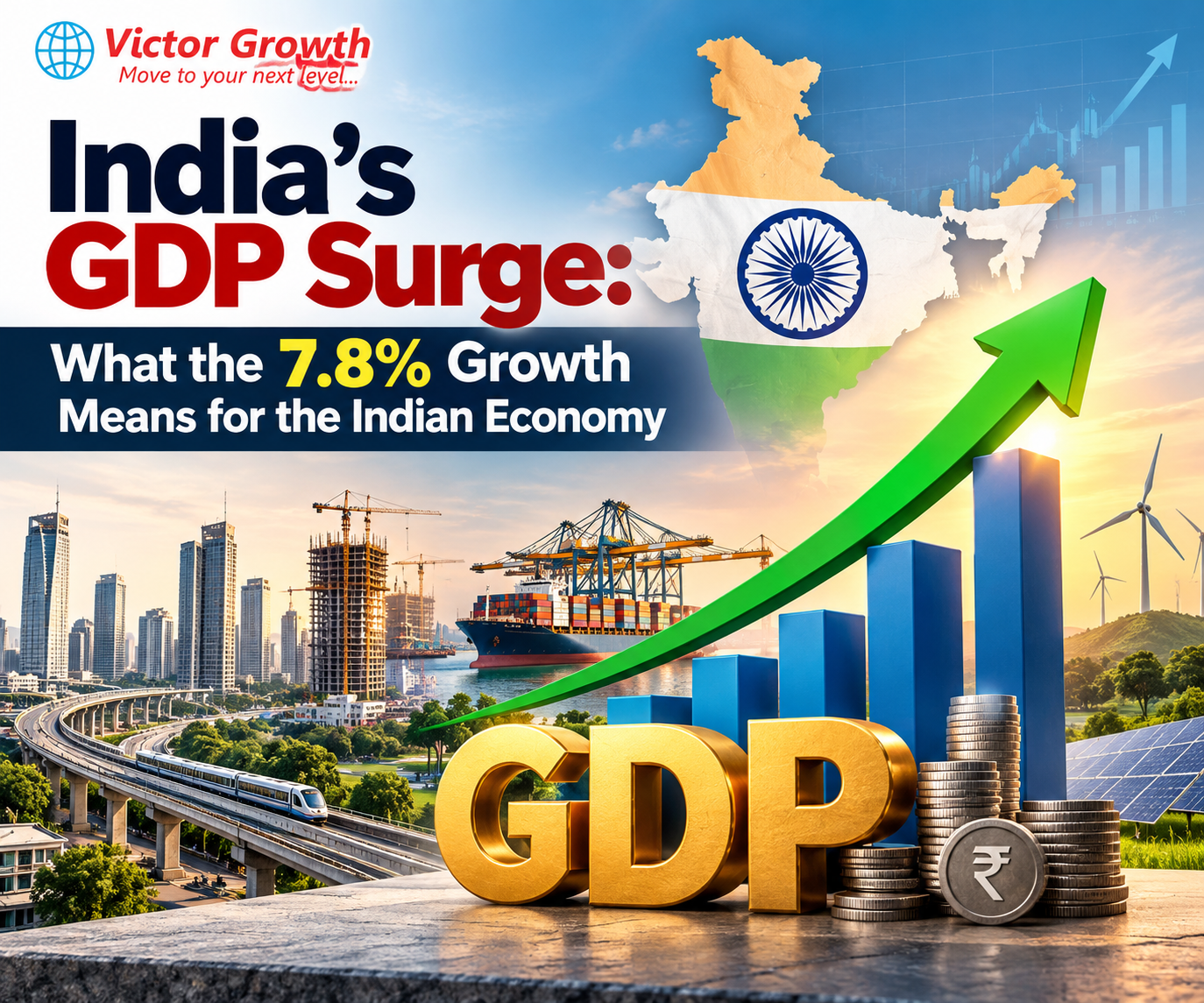
India’s economy recorded real GDP growth of 7.8% in the first quarter (April–June) of FY 2026–27, according to the latest estimates released by the Ministry of Statistics and Programme Implementation (MoSPI). Real GDP increased from ₹75.46 lakh crore in Q1 FY2025–26 to ₹81.36 lakh crore in Q1 FY2026–27.
The figure is significant for the Indian economy and UPSC preparation, as GDP growth is closely linked to employment, investment, consumption, government revenue and India’s position in the global economy.
What Does 7.8% GDP Growth Mean?
GDP or Gross Domestic Product represents the monetary value of final goods and services produced within a country’s domestic territory during a specified period.
The latest 7.8% figure refers to real GDP growth, which adjusts for changes in prices and therefore provides a better indication of the increase in actual economic output.
For comparison:
- Real GDP growth: 7.8%
- Nominal GDP growth: 10.3%
- Real GVA growth: 8.2%
The Q1 FY2026–27 growth rate was higher than the 6.9% recorded in Q1 FY2025–26, although it was below the revised 8.6% growth recorded in Q4 FY2025–26.
What is Driving India’s Growth?
The latest data indicates that India’s growth continues to receive support from manufacturing and services, while overall economic activity remains relatively strong.
1. Manufacturing
A strong manufacturing sector can contribute to:
- Higher investment
- Employment generation
- Export growth
- Greater industrial capacity
- Integration into global value chains
For India, sustained manufacturing growth is particularly important for achieving the objectives of Make in India and reducing excessive dependence on imports.
2. Services Sector
Services remain a major component of India’s economy. Information technology, financial services, transport, communication, trade and other services contribute substantially to economic activity.
India’s services-sector strength is also important for its position in the global economy.
3. Consumption and Investment
Economic growth is influenced by both private consumption and investment.
Higher consumption can stimulate demand, while investment in infrastructure, factories, technology and productive capacity can increase the economy’s potential growth over the longer term.
GDP vs GVA: An Important UPSC Concept
One of the most important concepts for UPSC aspirants is the distinction between GDP and GVA.
GVA (Gross Value Added) measures the value added by producers across different sectors of the economy.
The relationship can broadly be represented as:
GDP = GVA + Taxes on Products − Subsidies on Products
Therefore:
- GVA → Sectoral production/value addition
- GDP → Overall economic output at market prices
Real GVA grew by 8.2% in Q1 FY2026–27, compared with real GDP growth of 7.8%.
Real GDP vs Nominal GDP
This distinction is frequently relevant in UPSC Prelims and Mains.
Real GDP
Measures economic output after adjusting for price changes. It is more useful for understanding actual growth in production.
Nominal GDP
Measures output at current prices. It can increase because of both higher production and higher prices.
In Q1 FY2026–27:
Real GDP growth = 7.8%
Nominal GDP growth = 10.3%
Why is the GDP Surge Important for India?
A sustained period of high economic growth can have several implications:
Higher investment: Strong growth can improve business confidence and encourage investment.
Employment: Expanding production and services can create additional employment opportunities, although GDP growth does not automatically guarantee sufficient or evenly distributed job creation.
Government revenue: Higher economic activity can expand the tax base and government revenues.
Infrastructure development: Higher economic activity can support greater public and private investment in infrastructure.
Global position: Strong growth strengthens India’s economic weight and can contribute to its increasing importance in global economic affairs.
However, GDP growth alone does not capture income distribution, employment quality, poverty, inequality or human development. These indicators must also be examined to assess whether growth is broad-based and inclusive.
New GDP Series: An Important Development
MoSPI has introduced a new GDP series with 2022–23 as the base year, replacing the earlier 2011–12 base year.
The updated methodology makes greater use of administrative and high-frequency datasets and incorporates improvements in areas such as manufacturing, banking, construction and household-sector estimation.
For UPSC aspirants, this is important because questions can connect GDP methodology, national income accounting, base years, real vs nominal GDP and statistical revisions.
Challenges Ahead
Despite strong headline growth, India needs to address several structural challenges:
- Employment generation
- Low labour-force participation in some segments
- Agricultural productivity
- Regional disparities
- Income inequality
- Human capital development
- Manufacturing competitiveness
- External economic risks
Thus, high GDP growth is necessary but not sufficient for inclusive and sustainable development.
UPSC Perspective
The latest GDP data can be linked with several areas of the UPSC syllabus.
Prelims
Revise:
- GDP and GVA
- Real vs nominal GDP
- Base year
- National income accounting
- GDP deflator
- Fiscal deficit and taxation
- Consumption and capital formation
Mains – GS Paper III
A possible question could be:
“India’s high GDP growth is encouraging, but the quality and inclusiveness of growth remain equally important. Discuss.”
A good answer should connect GDP growth with:
Growth → Investment → Employment → Productivity → Income → Human Development
Conclusion
India’s 7.8% real GDP growth in Q1 FY2026–27 provides evidence of continued economic momentum. However, the long-term objective should be to convert high economic growth into productive employment, higher incomes, greater productivity and inclusive development.
For UPSC aspirants, the GDP release is more than a current-affairs statistic. It provides an opportunity to revise fundamental concepts of Indian Economy and National Income Accounting while connecting them with India’s broader development challenges.