Artificial Intelligence (AI) is moving beyond traditional applications such as chatbots, recommendation systems and image generation. Recent advances in AI-assisted mathematical research have raised a new question: Can AI help solve problems that have challenged scientists and mathematicians for decades?
In September 2026, OpenAI reported that its AI systems had produced a Lean-verified result related to the Navier–Stokes problem, one of the seven Millennium Prize Problems in mathematics. The claim has attracted significant scientific discussion about the role of AI in mathematical discovery and the need for independent verification.
For UPSC aspirants, this development is important because it connects Artificial Intelligence, scientific research, innovation, ethics, governance and India’s technological ambitions.
What is the Navier–Stokes Problem?
The Navier–Stokes equations describe the motion of fluids such as air and water.
They are fundamental to areas including:
- Aerodynamics
- Weather and climate modelling
- Oceanography
- Engineering
- Fluid dynamics
The mathematical challenge concerns whether solutions to these equations remain sufficiently smooth under relevant conditions. The problem is one of the seven Millennium Prize Problems identified by the Clay Mathematics Institute.
What Makes the AI Development Significant?
The importance of recent AI research is not simply that computers can perform calculations faster.
Modern AI systems are increasingly capable of:
- Generating mathematical hypotheses
- Exploring large numbers of possible approaches
- Writing and testing computer code
- Assisting with formal mathematical proofs
- Searching through complex solution spaces
- Working collaboratively through multiple AI agents
OpenAI reported that thousands of AI agents worked on the Navier–Stokes problem, producing a formally verified result. However, the scientific interpretation of the achievement remains subject to scrutiny and independent assessment.
This distinction is important: an AI-generated result is not automatically equivalent to an independently established scientific breakthrough.
From Generative AI to AI Agents
A major trend in artificial intelligence is the movement from generative AI to agentic AI.
Generative AI
Produces content such as:
- Text
- Images
- Code
- Audio
- Video
AI Agents
Can potentially:
Understand a task → plan → use tools → execute multiple steps → evaluate results → continue working toward a goal.
This could transform scientific research by allowing AI systems to conduct portions of literature review, experimentation, simulation and mathematical exploration.
Why is this Important for India?
India has identified AI as an important component of its technological and economic development strategy.
The IndiaAI Mission focuses on areas including AI compute infrastructure, datasets, indigenous AI capabilities, skill development, innovation and responsible AI.
India’s challenge is to ensure that AI development contributes not only to the technology sector but also to:
- Healthcare
- Agriculture
- Education
- Governance
- Manufacturing
- Disaster management
- Scientific research
India’s growing emphasis on sovereign AI also highlights the importance of domestic control over computing infrastructure, data, models and AI governance.
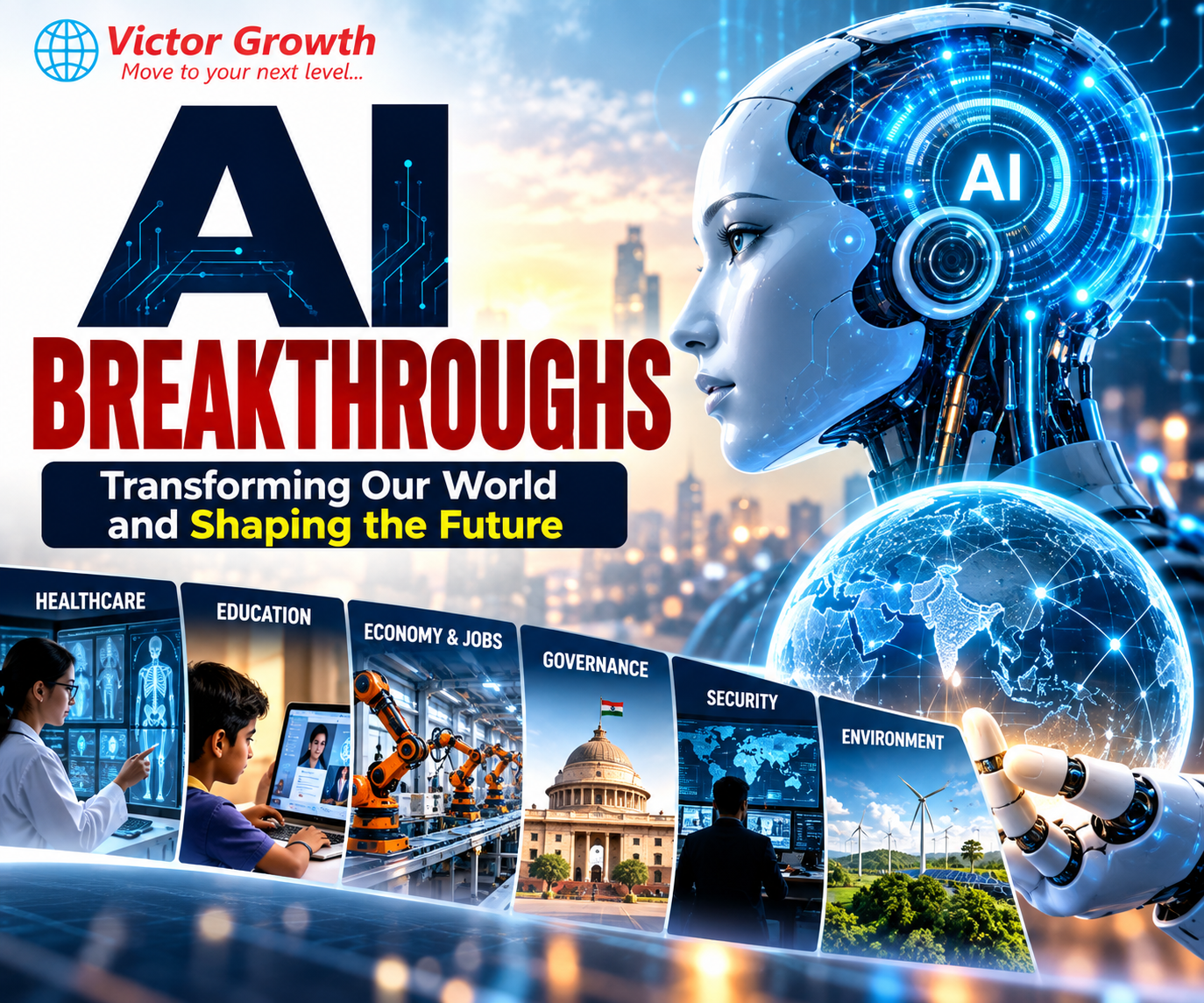
Opportunities Created by AI Breakthroughs
1. Scientific Research
AI can accelerate hypothesis generation, simulations and mathematical research.
2. Healthcare
AI can support medical imaging, drug discovery and personalised healthcare.
3. Agriculture
AI can assist with crop monitoring, weather forecasting and precision agriculture.
4. Governance
AI can improve public-service delivery, data analysis and decision-support systems.
5. Education
AI-enabled personalised learning can adapt educational content to individual learners.
Challenges and Ethical Concerns
The rapid development of AI also raises serious questions.
Reliability
AI systems can produce incorrect information or flawed reasoning.
Accountability
If an autonomous AI system makes an important decision, determining responsibility can be difficult.
Employment
Automation could change the nature of several occupations and increase demand for new skills.
Bias
AI systems can reproduce biases present in their training data.
Privacy
Large-scale AI systems require enormous amounts of data, raising concerns about data protection.
Security
AI can also be misused for cyberattacks, fraud, surveillance and disinformation. Recent reporting has highlighted growing concerns about the use of advanced AI in cyber operations.
UPSC Relevance
Prelims
Important concepts:
- Artificial Intelligence
- Generative AI
- Machine Learning
- Large Language Models
- AI Agents
- Navier–Stokes equations
- Millennium Prize Problems
- IndiaAI Mission
- AI ethics
GS Paper III – Science & Technology
Possible question:
“Recent advances in Artificial Intelligence indicate a shift from AI as a tool for information processing towards AI-assisted scientific discovery. Discuss the opportunities and challenges.”
GS Paper IV – Ethics
AI can be connected with:
- Accountability
- Transparency
- Bias
- Privacy
- Human oversight
- Responsible innovation
Essay
AI can be used to discuss the broader theme:
“Technology should augment human intelligence, not replace human responsibility.”
Way Forward
India needs an approach based on innovation + regulation + human oversight.
Key priorities should include:
- Investment in AI research and computing infrastructure
- Development of indigenous AI capabilities
- Strong data-protection mechanisms
- AI literacy and reskilling
- Independent testing and evaluation of advanced AI systems
- International cooperation on AI safety and governance
- Maintaining meaningful human oversight in critical decisions
Conclusion
The latest AI developments demonstrate that artificial intelligence is increasingly becoming a research partner rather than merely a digital tool.
Whether AI can independently produce genuinely groundbreaking scientific discoveries remains an evolving question. What is already clear is that AI is changing the way humans search, reason, experiment and solve complex problems.
For India, the objective should be to harness AI for scientific progress, inclusive development and better governance while ensuring transparency, accountability and human oversight.