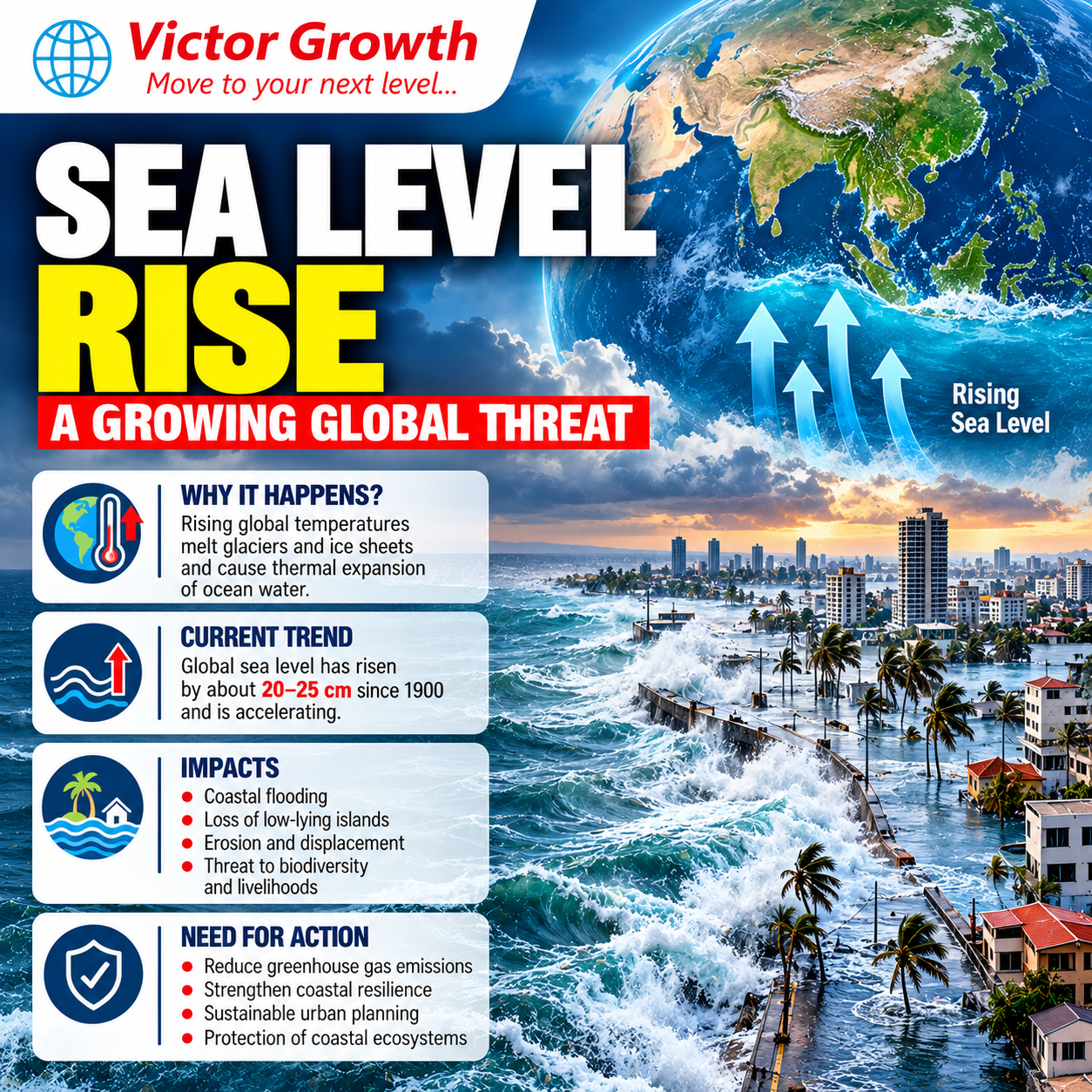
Sea level rise is one of the most significant consequences of climate change, threatening coastal ecosystems, cities, agriculture and millions of people living in low-lying regions. For India, with its long coastline and densely populated coastal areas, sea level rise has important implications for environmental security, disaster management, livelihoods and sustainable development.
For UPSC aspirants, the topic is important for GS Paper I – Geography, GS Paper III – Environment & Disaster Management, and current affairs.
What is Sea Level Rise?
Sea level rise (SLR) refers to the long-term increase in the average level of the world’s oceans relative to land.
It occurs due to both:
Thermal expansion of seawater as oceans warm.
Addition of water to oceans from melting glaciers and ice sheets.
Sea level is not rising uniformly everywhere. Local and regional sea levels are also influenced by land subsidence, ocean currents, changes in winds and variations in gravitational effects.
Major Causes of Sea Level Rise
1. Thermal Expansion
As ocean water absorbs heat from a warming atmosphere, it expands. This process, known as thermal expansion, contributes significantly to global sea level rise.
2. Melting Glaciers
Mountain glaciers are losing ice because of rising temperatures. Meltwater eventually reaches the oceans, contributing to sea level rise.
3. Melting Ice Sheets
The Greenland and Antarctic ice sheets contain enormous quantities of frozen water. Their loss through surface melting and increased ice discharge can significantly increase global sea levels.
4. Land Subsidence
In some coastal regions, the land itself is sinking because of groundwater extraction, sediment compaction, natural geological processes or urban development.
Therefore:
Relative sea level rise = Global sea level rise + Local land-level changes
Why is Sea Level Rise a Major Concern?
Coastal Flooding
Higher sea levels increase the risk of permanent inundation and flooding, particularly during high tides and storm surges.
Coastal Erosion
Rising sea levels can accelerate coastal erosion and threaten beaches, wetlands and settlements.
Saltwater Intrusion
Seawater can enter coastal aquifers and agricultural areas, affecting freshwater availability and soil fertility.
Extreme Events
A higher baseline sea level can make cyclones and storm surges more destructive, even when the intensity of the storm itself does not change.
Loss of Ecosystems
Mangroves, coral reefs, tidal flats and coastal wetlands are particularly vulnerable.
Sea Level Rise and India
India has a coastline of more than 7,500 km including its island territories, making coastal climate risks highly significant.
Vulnerable areas include:
Mumbai and other parts of the Maharashtra coast
Gujarat coast
Odisha and West Bengal
Andhra Pradesh
Tamil Nadu
Kerala
Lakshadweep
Andaman and Nicobar Islands
The Sundarbans, for example, face a combination of sea-level rise, coastal erosion, cyclones and salinity intrusion.
Low-lying coastal cities are also vulnerable because climate risks can interact with urban flooding, land subsidence and rapid urbanisation.
Sea Level Rise and Indian Islands
India’s island territories face particular challenges.
Lakshadweep consists largely of low-lying coral islands and is therefore vulnerable to coastal flooding, erosion and changes in freshwater availability.
The Andaman and Nicobar Islands face risks from coastal hazards, cyclones, ecosystem degradation and sea-level changes.
Sea Level Rise and Climate Change
Sea level rise is a slow-onset climate hazard, unlike sudden disasters such as earthquakes or flash floods.
However, its effects can accumulate over decades.
Climate change therefore requires two complementary approaches:
Mitigation → Reduce greenhouse-gas emissions
Adaptation → Prepare communities and infrastructure for unavoidable impacts
Measures to Address Sea Level Rise
Coastal Ecosystem Protection
Mangroves, wetlands, dunes and coral reefs act as natural barriers against waves and storm surges.
Climate-Resilient Infrastructure
Ports, roads, drainage systems and coastal settlements need to incorporate projected future sea levels into planning.
Coastal Zone Management
India’s Coastal Regulation Zone (CRZ) framework seeks to regulate activities in environmentally sensitive coastal areas.
Early Warning Systems
Better forecasting and evacuation systems can reduce loss of life during cyclones and storm surges.
Managed Retreat
In highly vulnerable areas, relocation of settlements and infrastructure may become necessary where protection is technically or economically impractical.
UPSC Relevance
Prelims
Important concepts:
Thermal expansion
Glacial melt
Ice-sheet loss
Sea-level rise vs land subsidence
Storm surge
Coastal erosion
Saltwater intrusion
Mangroves and coastal wetlands
GS Paper I – Geography
Connect the topic with:
Oceanography
Coastal processes
Climate systems
Islands
Coastal geomorphology
GS Paper III – Environment
Connect it with:
Climate change
Disaster management
Coastal regulation
Climate adaptation
Ecosystem-based adaptation
Climate-resilient infrastructure
Possible UPSC Mains Question
“Sea-level rise is a slow-onset climate hazard with potentially severe consequences for India’s coastal regions. Discuss its causes, impacts and adaptation strategies.”
A strong answer can follow:
Causes → Impacts → Indian vulnerability → Adaptation → Way forward
Conclusion
Sea level rise is not merely an environmental problem; it is a development, economic and security challenge. Its consequences can affect coastal populations, infrastructure, agriculture, freshwater resources and ecosystems.
For India, the way forward requires a combination of climate mitigation, coastal ecosystem restoration, resilient infrastructure, scientific monitoring, disaster preparedness and sustainable coastal planning.
For UPSC aspirants, sea level rise is best understood through the interconnected themes of Climate Change + Oceanography + Coastal Geography + Disaster Management + Sustainable Development.