
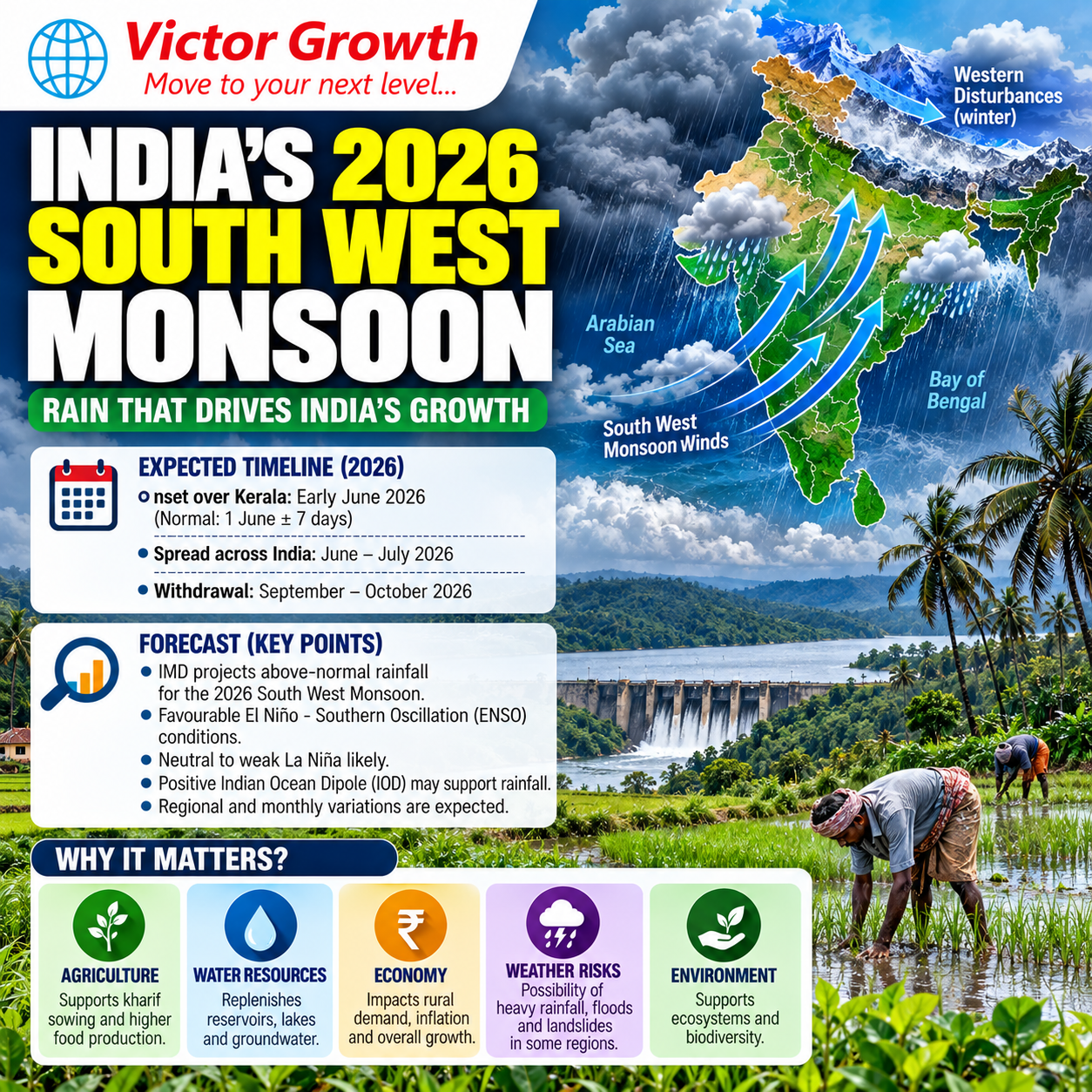
The 2026 Southwest Monsoon was a significant climate event for India, particularly because the country experienced a substantial rainfall deficit during the June–September season. The India Meteorological Department (IMD) reported that the 2026 monsoon ended with around 87% of the Long Period Average (LPA), making it one of the weaker monsoon seasons in recent decades.
For UPSC aspirants, the 2026 Southwest Monsoon is an important current-affairs topic linking Indian geography, climatology, El Niño, agriculture, water security, disaster management and climate variability.
What is the Southwest Monsoon?
The Southwest Monsoon is India’s principal rainy season, generally occurring from June to September.
Moisture-laden winds from the Indian Ocean move towards the Indian subcontinent, producing rainfall across large parts of the country.
The monsoon is crucial for:
Agriculture and Kharif crops
Reservoir and groundwater recharge
Drinking-water availability
Hydropower generation
Ecosystems
Rural employment and incomes
Therefore, variations in monsoon rainfall can have significant economic and social consequences.
How Did the 2026 Monsoon Perform?
The 2026 Southwest Monsoon recorded about 87% of LPA, compared with the long-period average of approximately 868.6 mm for the June–September season. The rainfall deficit was about 13%, making 2026 the lowest monsoon rainfall year since 2015 according to reports citing IMD’s final assessment.
The season also showed considerable spatial and temporal variation. For example, June experienced a substantial rainfall deficit, while July saw periods of stronger rainfall in some regions.
This highlights an important UPSC concept:
All-India seasonal rainfall does not necessarily reflect uniform rainfall across states or months.
El Niño and the 2026 Monsoon
One of the most important factors associated with the 2026 monsoon was the development of El Niño conditions in the equatorial Pacific.
The IMD had initially forecast below-normal monsoon rainfall and subsequently anticipated the development of El Niño during the season. El Niño can weaken the Indian summer monsoon by altering large-scale atmospheric circulation and Walker circulation patterns.
However, El Niño is not the only factor controlling the Indian monsoon. Other influences include:
Indian Ocean Dipole (IOD)
Eurasian and Himalayan snow cover
Land–sea thermal contrast
Madden–Julian Oscillation (MJO)
Atmospheric circulation
Sea-surface temperatures
Thus, monsoon variability results from the interaction of multiple climate drivers.
Impact on Agriculture
The Southwest Monsoon is particularly important because a large part of India’s agricultural land remains dependent on rainfall.
A weak or poorly distributed monsoon can affect:
Kharif sowing
Crop yields
Soil moisture
Irrigation demand
Rural incomes
Food prices
The government identified vulnerable agricultural districts and monitored rainfall, crop sowing, reservoir levels and vegetation conditions during the 2026 season.
Impact on Water and Hydropower
Reduced rainfall can affect:
Reservoir storage → Irrigation → Drinking water → Hydropower generation
This makes monsoon management an important part of India’s water-security strategy.
Efficient irrigation, watershed development, rainwater harvesting and groundwater management can reduce vulnerability to rainfall variability.
Monsoon Variability and Climate Change
Climate change is increasingly associated with changes in the intensity, distribution and variability of extreme rainfall events.
A warmer atmosphere can hold more moisture, potentially contributing to episodes of very heavy rainfall, even when seasonal rainfall totals are low.
This creates a critical challenge:
Lower seasonal rainfall + more intense short-duration rainfall = greater water-management and disaster-management challenges.
Therefore, India needs to prepare not only for drought but also for floods, cloudbursts and extreme rainfall events.
Importance for India’s Economy
The monsoon influences several sectors:
Agriculture
Food processing
Rural consumption
Electricity generation
Inflation
Water resources
Infrastructure
Employment
A normal and well-distributed monsoon can support agricultural activity, while deficient or erratic rainfall can increase economic pressures.
UPSC Relevance
Prelims
Important concepts to revise:
Southwest Monsoon
Long Period Average (LPA)
El Niño
La Niña
Indian Ocean Dipole
Monsoon trough
Jet streams
Breaks in monsoon
Onset and withdrawal
Rain-shadow regions
GS Paper I – Geography
Link the topic with:
Indian monsoon mechanism
ITCZ
Differential heating
Jet streams
Orography
ENSO
Indian Ocean circulation
GS Paper III – Agriculture & Environment
Connect it with:
Kharif agriculture
Irrigation
Food security
Water management
Drought
Floods
Climate change
Disaster preparedness
Possible UPSC Mains Question
“The 2026 Southwest Monsoon highlights the increasing importance of understanding both the quantity and spatial distribution of rainfall in India. Discuss the factors influencing monsoon variability and its implications for agriculture and water security.”
Way Forward
India needs to reduce its dependence on unpredictable rainfall through:
Expansion of micro-irrigation
Rainwater harvesting
Watershed development
Climate-resilient agriculture
Drought-resistant crop varieties
Better weather forecasting
District-level contingency planning
Improved reservoir and groundwater management
Conclusion
The 2026 Southwest Monsoon provides an important case study of India’s vulnerability to climate variability. Its below-normal seasonal rainfall, combined with significant regional differences, demonstrates why monsoon management cannot depend solely on seasonal rainfall totals.
For UPSC aspirants, the 2026 monsoon should be studied through the integrated framework of:
Monsoon Mechanism → ENSO → Rainfall Variability → Agriculture → Water Security → Climate Change → Disaster Management.