
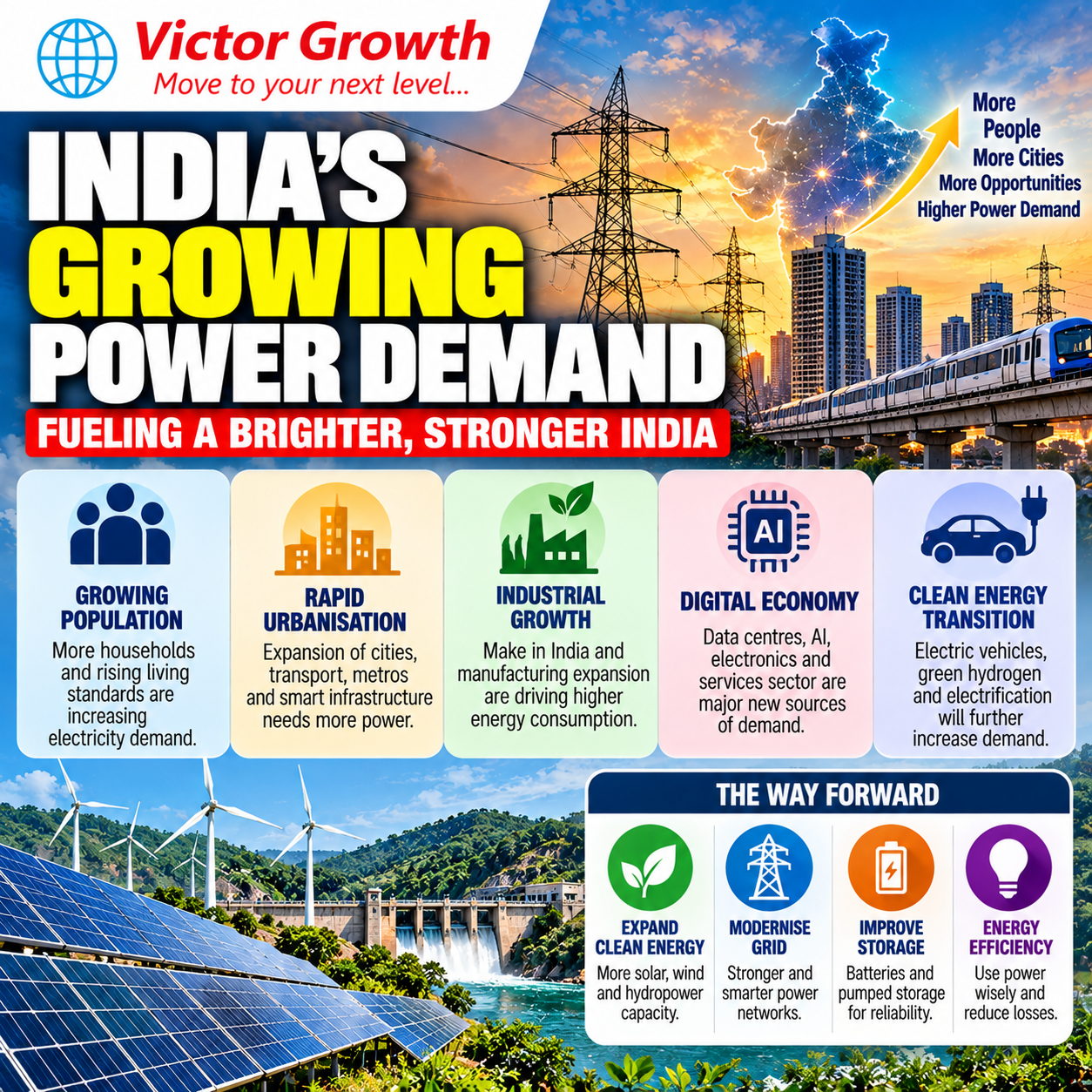
India is witnessing a significant increase in electricity demand, driven by economic growth, urbanisation, rising household incomes, industrialisation, digitalisation and increasing use of air conditioners and other electrical appliances.
The trend has become particularly important in 2026, when India’s electricity demand is forecast to grow by around 7%, according to the International Energy Agency (IEA). In May 2026, India’s peak electricity demand reached a record 270 GW, highlighting the growing importance of reliable power supply and grid management.
For UPSC aspirants, the issue connects Indian Economy, Energy Security, Infrastructure, Climate Change, Renewable Energy and Sustainable Development.
Why is India’s Power Demand Increasing?
1. Economic Growth and Industrialisation
Economic expansion increases electricity consumption in manufacturing, construction, mining, services and infrastructure.
The IEA estimates that industry will contribute about one-third of India’s electricity-demand growth through 2030.
2. Rising Cooling Demand
Higher temperatures, urbanisation and increasing ownership of air conditioners are major drivers of electricity consumption.
Cooling is expected to account for more than 20% of India’s electricity-demand growth between 2026 and 2030 according to IEA projections.
This creates a particularly difficult challenge because India’s peak demand increasingly occurs during hot summer evenings, when solar generation is declining.
3. Electrification
The increasing electrification of:
Transport
Agriculture
Households
Industry
Public infrastructure
is creating additional demand for electricity.
The expansion of electric vehicles (EVs) and charging infrastructure is expected to contribute further to electricity consumption.
4. Digitalisation and Data Centres
The expansion of digital services, telecommunications and data centres is creating another source of electricity demand.
As India develops its digital economy and AI infrastructure, reliable electricity and grid connectivity will become increasingly important.
Record Peak Demand
India’s power system is facing not only higher annual electricity consumption but also rapidly increasing peak demand.
The IEA reports that India’s peak load increased from around 162 GW in 2017 to 250 GW in 2024, a rise of approximately 54%. In May 2026, peak demand reached 270 GW during a period of extreme heat.
Why is Peak Demand Important?
Electricity must be available at the exact time it is required.
Therefore, even if India’s total annual electricity generation is adequate, the country can face challenges if generation capacity is insufficient during periods of exceptionally high demand.
This is known as the peak-load problem.
The Renewable Energy Challenge
India is rapidly expanding renewable energy, particularly solar and wind power.
However, renewable generation is variable:
Solar → unavailable at night
Wind → depends on weather conditions
This creates a challenge during evening and nighttime peaks.
In 2026, the IEA highlighted India’s growing nighttime cooling demand, when solar power cannot contribute to electricity generation.
Therefore, India’s energy transition requires not just more renewable capacity but also:
Battery storage
Pumped-storage hydropower
Flexible generation
Strong transmission networks
Demand-response mechanisms
Better electricity forecasting
India’s Power Grid
India has developed an integrated national electricity grid connecting its major regional grids.
The IEA notes that India’s inter-regional transmission capacity has exceeded 120 GW, supporting electricity transfers between regions with different demand and generation patterns.
A stronger grid is essential for integrating renewable energy and maintaining electricity reliability.
Power Demand and Climate Change
The relationship between electricity demand and climate change is becoming increasingly important.
Higher temperatures → More air-conditioning → Higher electricity demand
At the same time:
More electricity demand → Greater generation requirement → Potentially higher emissions if fossil fuels dominate
This creates a policy challenge: India must meet rising energy needs while pursuing decarbonisation.
Therefore, energy efficiency, renewable energy, nuclear power, storage and grid modernisation are all important components of the transition.
Energy Security
India’s growing power demand makes energy security increasingly important.
India needs:
Reliable electricity
Diversified energy sources
Domestic energy capacity
Resilient transmission infrastructure
Strategic fuel reserves
Greater renewable integration
A diversified electricity mix can reduce vulnerability to international fuel-price and supply shocks.
Way Forward
India can manage rising electricity demand through a combination of supply-side expansion and demand-side management.
Key measures include:
Renewable Energy
Accelerate solar, wind, hydro and other low-carbon sources.
Energy Storage
Expand batteries and pumped-storage projects to manage variable renewable generation.
Energy Efficiency
Promote efficient appliances, buildings, industries and cooling systems.
Smart Grids
Use digital technologies for forecasting, monitoring and demand management.
Transmission Expansion
Strengthen inter-state and inter-regional transmission infrastructure.
Nuclear Energy
Increase reliable low-carbon baseload generation where technically and economically appropriate.
UPSC Relevance
Prelims
Important concepts:
Peak electricity demand
Base-load and peak-load
Renewable energy
Grid integration
Battery storage
Pumped-storage hydropower
Energy efficiency
Demand-side management
Green Energy Corridor
GS Paper III – Energy
The topic can be linked with:
Energy security
Renewable energy
Electricity infrastructure
Climate change
Industrialisation
Sustainable development
Energy transition
Possible UPSC Mains Question
“India’s rapidly rising electricity demand presents both an economic opportunity and an energy-security challenge. Examine the measures required to ensure reliable, affordable and sustainable power supply.”
Conclusion
India’s growing power demand is a natural consequence of economic development, industrialisation, urbanisation, electrification and rising cooling needs. However, meeting this demand sustainably requires more than simply adding generation capacity.
India must simultaneously strengthen renewable energy, storage, transmission, energy efficiency and grid flexibility.
The central challenge is therefore:
More electricity + reliable supply + affordable power + lower emissions
For UPSC aspirants, India’s power-demand growth should be studied through the integrated framework of Energy Security + Economic Growth + Renewable Energy + Grid Management + Climate Change + Sustainable Development.