
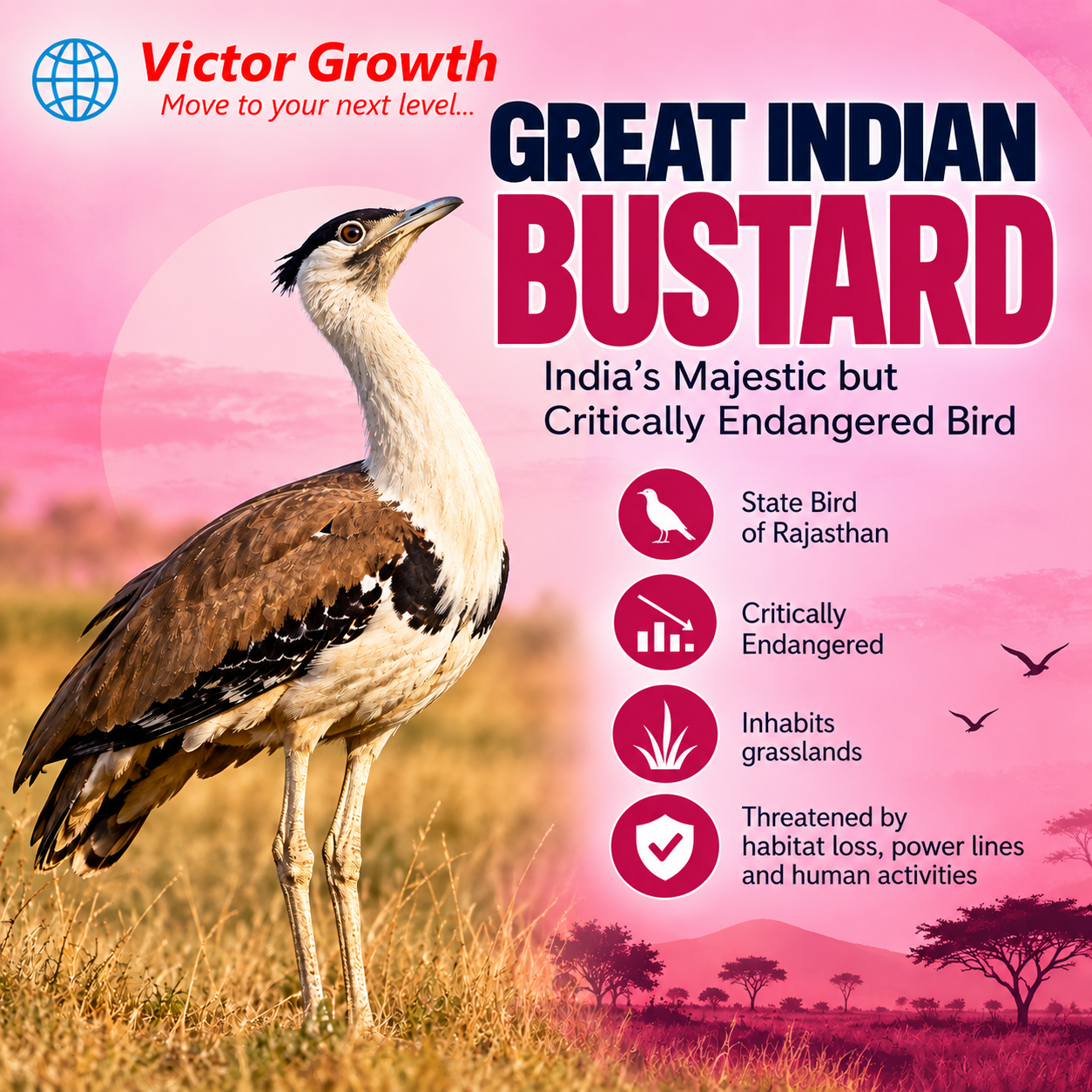
The Great Indian Bustard (GIB) has received renewed attention following a major milestone in India’s conservation efforts. In October 2026, two captive-bred male Great Indian Bustards were released into the wild at the Desert National Park in Jaisalmer, Rajasthan.
The release marks a transition from conservation breeding towards rewilding and rebuilding the species in its natural habitat. The programme is being implemented through collaboration between the Ministry of Environment, Forest and Climate Change, Rajasthan Forest Department and Wildlife Institute of India (WII).
What is the Great Indian Bustard?
The Great Indian Bustard (Ardeotis nigriceps) is one of India’s most threatened birds and is popularly known as Godawan in Rajasthan.
Key Facts
Scientific name: Ardeotis nigriceps
Conservation status: Critically Endangered – IUCN
Habitat: Grasslands, scrublands and open dry landscapes
State Bird: Rajasthan
Major population: Rajasthan, particularly the Thar Desert
Other important habitat: Kutch region of Gujarat
The species is particularly important as an indicator and umbrella species of India’s open natural ecosystems and grasslands.
Why is the Great Indian Bustard Endangered?
1. Power-Line Collisions
One of the most serious threats is collision with overhead power transmission lines. Because GIBs are large birds with limited manoeuvrability, they can collide with poorly visible power lines.
2. Habitat Loss
Conversion of grasslands for infrastructure, agriculture, industry and other land uses has significantly reduced suitable habitat.
3. Infrastructure Development
Roads, renewable-energy infrastructure and other development activities can fragment habitats and disturb breeding areas.
4. Low Reproductive Rate
The GIB has a slow reproductive cycle, making population recovery difficult when adult mortality is high.
5. Human Disturbance
Disturbance in breeding habitats and other anthropogenic pressures further affect the species.
A 2026 assessment reported that the GIB population in its Rajasthan range remained broadly stable at around 110–150 birds, but the species survives in only a small fraction of its historical/potential habitat.
Conservation Efforts in India
Project Great Indian Bustard
The Project Great Indian Bustard was formally launched in 2016 as a focused conservation initiative.
Major approaches include:
Conservation breeding
Habitat restoration
Protection of breeding grounds
Power-line mitigation
Scientific monitoring and telemetry
Community participation
Rewilding and release of captive-bred birds
The conservation-breeding programme at Sam and Ramdevra in Rajasthan has made significant progress. As of October 2026, the facilities housed 97 birds, including 57 captive-bred birds.
The “Jumpstart” Approach
An innovative conservation technique called the Jumpstart Approach has also been used.
In Gujarat, a fertile captive-bred egg from Rajasthan was transported to Kutch and placed in the nest of a wild female GIB. The female successfully incubated the egg and raised the chick.
This demonstrated the potential of combining captive breeding with natural parental care to strengthen small wild populations.
Great Indian Bustard and Renewable Energy
The conservation of GIB highlights an important environmental policy challenge: balancing renewable-energy expansion with biodiversity protection.
The Thar and Kutch regions have considerable potential for solar and wind energy. However, power infrastructure can create risks for large birds such as the GIB.
Therefore, conservation strategies include:
Mapping critical power-line corridors
Undergrounding power lines in priority areas where feasible
Installing bird diverters on selected lines
Careful siting of new infrastructure
Maintaining contiguous grassland habitats
The Bustard Recovery Programme specifically identifies power lines and renewable-energy infrastructure as important threats requiring mitigation.
Supreme Court and GIB Conservation
The conservation of the Great Indian Bustard has also become an important example of the interaction between environmental protection and infrastructure development.
The Supreme Court has considered the issue of protecting GIB habitats from power-line collisions, with an expert committee examining scientifically appropriate approaches to balancing conservation and energy-infrastructure requirements.
This makes the GIB relevant to debates on sustainable development and environmental governance.
UPSC Relevance
Prelims
Remember:
Great Indian Bustard: Ardeotis nigriceps
IUCN status: Critically Endangered
Rajasthan State Bird: Great Indian Bustard
Major habitat: Thar Desert
Important population in Kutch, Gujarat
Conservation breeding centres: Sam and Ramdevra, Rajasthan
Major threats: habitat loss and power-line collisions
Mains – GS Paper III
The topic can be linked to:
Biodiversity conservation
Grassland ecosystem protection
Human-wildlife conflict
Renewable energy vs biodiversity
Environmental Impact Assessment
Protected areas and habitat restoration
Sustainable development
Possible UPSC Mains Question
“The conservation of the Great Indian Bustard illustrates the challenge of balancing renewable-energy expansion with biodiversity protection. Discuss.”
Conclusion
The Great Indian Bustard represents both India’s biodiversity crisis and the possibilities of science-based conservation. The transition from captive breeding to rewilding, combined with habitat restoration and power-line mitigation, offers a promising pathway for species recovery.
For UPSC aspirants, GIB should be studied not merely as an endangered bird but as a case study connecting biodiversity, grassland ecology, renewable energy, infrastructure development, environmental governance and sustainable development.