
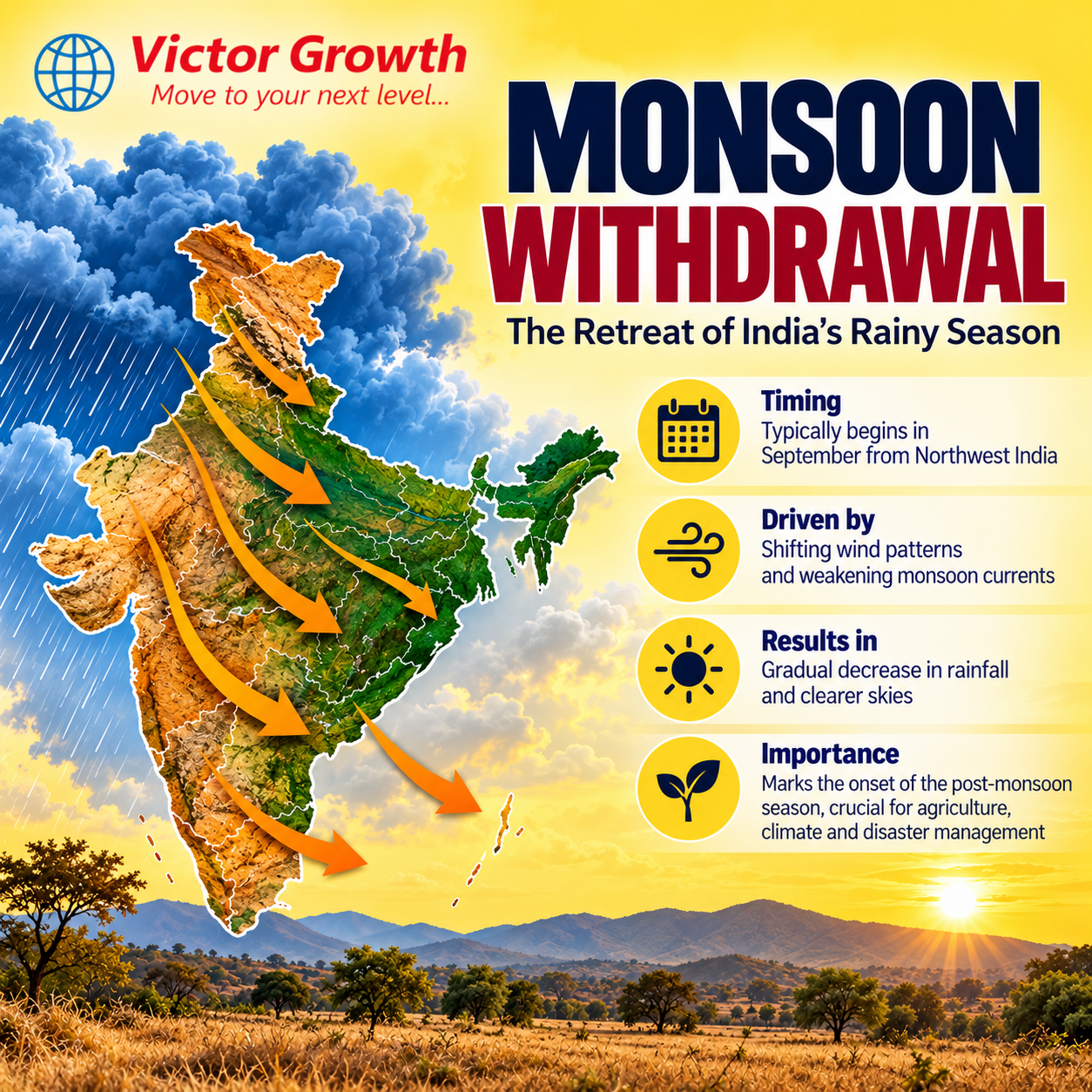
The Southwest Monsoon is currently withdrawing from several parts of India. The India Meteorological Department (IMD) began declaring withdrawal from parts of West Rajasthan on 19 September 2026, and the withdrawal line has subsequently moved south and east across parts of north and central India.
The withdrawal process is an important indicator of the transition from the Southwest Monsoon season to the post-monsoon season.
What is Monsoon Withdrawal?
Monsoon withdrawal refers to the gradual retreat of the Southwest Monsoon from the Indian subcontinent after the June–September rainy season.
Unlike monsoon onset, which generally progresses from southwest to northeast, withdrawal begins from northwestern India and gradually progresses towards the south and southeast.
The withdrawal is not simply the absence of rainfall. The IMD uses specific atmospheric indicators to declare it.
Criteria for Withdrawal
According to the IMD, withdrawal from northwestern India requires:
Cessation of rainfall for about five consecutive days.
Establishment of an anticyclone in the lower troposphere.
A significant reduction in atmospheric moisture, observed through satellite water-vapour imagery and atmospheric observations.
For subsequent withdrawal, the IMD considers spatial continuity, reduced moisture and persistent dry weather.
Therefore, an occasional rain shower does not necessarily mean that the monsoon has not withdrawn from an area.
Why Does the Southwest Monsoon Withdraw?
The withdrawal occurs because of seasonal changes in atmospheric circulation.
1. Decline in Land Temperature
After the peak summer season, land temperatures gradually decline, reducing the thermal contrast that supports the Southwest Monsoon circulation.
2. Change in Pressure Pattern
The pressure distribution over the Indian subcontinent changes, weakening the southwest monsoon flow.
3. Development of Anticyclonic Conditions
An anticyclone develops over northwestern India, promoting descending and relatively dry air.
4. Reduction in Moisture
Atmospheric moisture decreases, resulting in a gradual weakening of widespread monsoon rainfall.
Retreating Monsoon and Northeast Monsoon
The withdrawal of the Southwest Monsoon is closely associated with the development of the Northeast Monsoon.
During the Southwest Monsoon, winds generally blow from ocean to land as southwesterlies.
During the post-monsoon season, the circulation reverses, producing northeasterly winds.
This Northeast Monsoon is particularly important for Tamil Nadu and parts of southeastern India, where October–December provides a major share of annual rainfall.
Important Distinction
Retreating Southwest Monsoon refers to the withdrawal phase of the Southwest Monsoon, whereas the Northeast Monsoon refers to the subsequent seasonal wind and rainfall regime.
2026 Monsoon Withdrawal: Current Situation
In 2026, withdrawal began from parts of West Rajasthan in September and has progressively advanced into northern and central India. By early October, the withdrawal line had reached parts of Maharashtra and other central regions, while rainfall remained active in parts of southern India and the Northeast.
The IMD has also indicated that withdrawal from the Northeast requires the prescribed atmospheric conditions and cannot be declared merely because rainfall has decreased temporarily.
Importance for India
Agriculture
The timing of monsoon withdrawal influences:
Harvesting of Kharif crops
Soil moisture
Rabi sowing
Water availability
Water Resources
Reservoir levels, groundwater recharge and river flows are strongly influenced by the cumulative monsoon rainfall and its withdrawal pattern.
Disaster Management
The transition period can still produce heavy rainfall, thunderstorms and cyclones, particularly over southern and eastern parts of India.
Northeast Monsoon
The withdrawal of the Southwest Monsoon creates conditions for the Northeast Monsoon, which is crucial for agriculture and water resources in Tamil Nadu and adjoining regions.
UPSC Relevance
Prelims
Remember:
Southwest Monsoon normally begins withdrawing from northwestern India.
IMD considers rainfall cessation, anticyclone and reduction in moisture.
Post-monsoon season: October–December.
Northeast Monsoon is particularly important for Tamil Nadu.
Withdrawal is different from simply having a few rain-free days.
Mains – GS Paper I
The topic can be linked with:
Indian monsoon mechanism
Seasonal reversal of winds
Pressure and temperature patterns
Northeast Monsoon
Agriculture and water security
Climate variability
Possible UPSC Mains Question
“Explain the mechanism of withdrawal of the Southwest Monsoon in India. How does it contribute to the onset of the Northeast Monsoon?”
Conclusion
Monsoon withdrawal is a complex atmospheric transition rather than merely the end of rainfall. Changes in pressure, temperature, moisture and wind circulation collectively determine the retreat of the Southwest Monsoon.
For UPSC aspirants, understanding monsoon withdrawal is essential for connecting Indian climatology with agriculture, water resources, disaster management and the Northeast Monsoon.