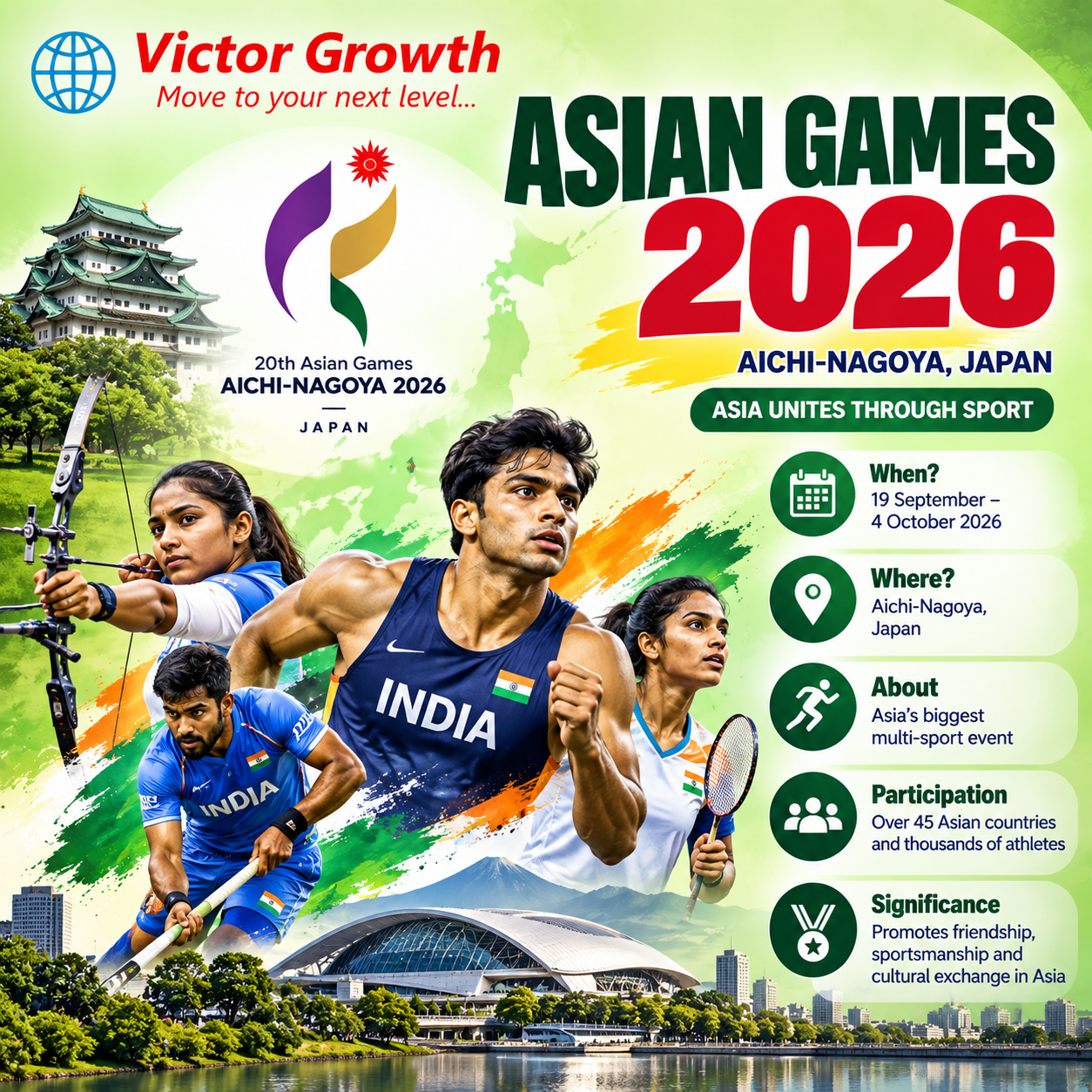
The 20th Asian Games 2026, officially known as the Aichi-Nagoya 2026 Asian Games, concluded in Japan on 4 October 2026.
The Games were held from 19 September to 4 October 2026, with competitions hosted across Aichi Prefecture and other locations in Japan. The official Games website lists 54 competition venues.
India finished fourth in the overall medal standings, winning 85 medals — 21 gold, 27 silver and 37 bronze.
Asian Games 2026: Key Facts
| Feature | Details |
|---|---|
| Edition | 20th Asian Games |
| Host | Aichi-Nagoya, Japan |
| Dates | 19 September – 4 October 2026 |
| Opening & Closing | Nagoya, Japan |
| India’s Rank | 4th |
| India’s Medals | 85 |
| India’s Gold Medals | 21 |
| Next Asian Games | Doha, Qatar – 2030 |
The Asian Games are the continent’s major multi-sport event and are organised under the Olympic Council of Asia (OCA).
India’s Performance at Asian Games 2026
India’s campaign produced several important achievements across sports.
1. Archery
Archery was among India’s most successful disciplines, producing nine medals — five gold, two silver and two bronze.
The women’s recurve team also ended South Korea’s long-standing dominance in the event, while Kumkum Anil Mohod became the first Indian woman to win an individual Asian Games recurve gold.
2. Cricket
India retained both cricket titles.
Women’s cricket: Gold
Men’s cricket: Gold
The men’s team defeated Pakistan in the final, while the women’s team defeated Sri Lanka.
3. Hockey
India achieved a historic men’s and women’s hockey gold-medal double.
Women’s team defeated China 1–0
Men’s team defeated Malaysia 5–1
Both teams also secured qualification for the Los Angeles 2028 Olympic Games.
4. Kabaddi
India won gold in both men’s and women’s kabaddi, completing another team-sport gold sweep.
5. Boxing
India topped the Asian Games boxing medal table with three gold and three bronze medals.
Why Are the Asian Games Important?
The Asian Games are significant for India because they:
Provide high-level international competition for Indian athletes.
Help identify and develop future Olympic medal prospects.
Provide qualification opportunities for certain Olympic events.
Promote sports diplomacy and India’s international sporting presence.
Encourage investment in sports infrastructure and high-performance training.
The Games also provide a useful indicator of India’s competitive position in Asian sport.
Asian Games and Sports Governance in India
India’s performance can be linked with initiatives aimed at developing sporting talent, including:
Khelo India Programme
Target Olympic Podium Scheme (TOPS)
Sports Authority of India (SAI)
National Centres of Excellence
Support for athletes through scientific training and sports medicine
The long-term challenge is to convert success at continental competitions into sustained performance at the Olympic level.
UPSC Relevance
Prelims
Important facts to remember:
2026 Asian Games: Aichi-Nagoya, Japan
20th edition
Dates: 19 September – 4 October 2026
Organised under the Olympic Council of Asia
India: 85 medals, including 21 gold
Next Asian Games: Doha, Qatar, 2030
Mains – GS Paper II
The topic can be linked with:
Government initiatives for sports development
Human resource development
Sports diplomacy
Youth development
India’s international image
Essay
Possible themes include:
Sports as an instrument of national development
From sporting potential to sporting excellence
Role of youth in nation-building
Possible UPSC Mains Question
“India’s performance at major international sporting events reflects both its growing sporting capabilities and the challenges of developing a sustainable high-performance sports ecosystem. Discuss.”
Conclusion
The Asian Games 2026 provided important milestones for Indian sport, particularly in archery, boxing, hockey, cricket and kabaddi. India’s 85-medal haul and fourth-place finish demonstrate significant competitive strength, while also highlighting the need for continued investment in grassroots development, sports science, infrastructure and athlete support.
For UPSC aspirants, the Asian Games should be studied not merely as a sports event but through the broader themes of sports governance, youth development, soft power, public policy and India’s global image.