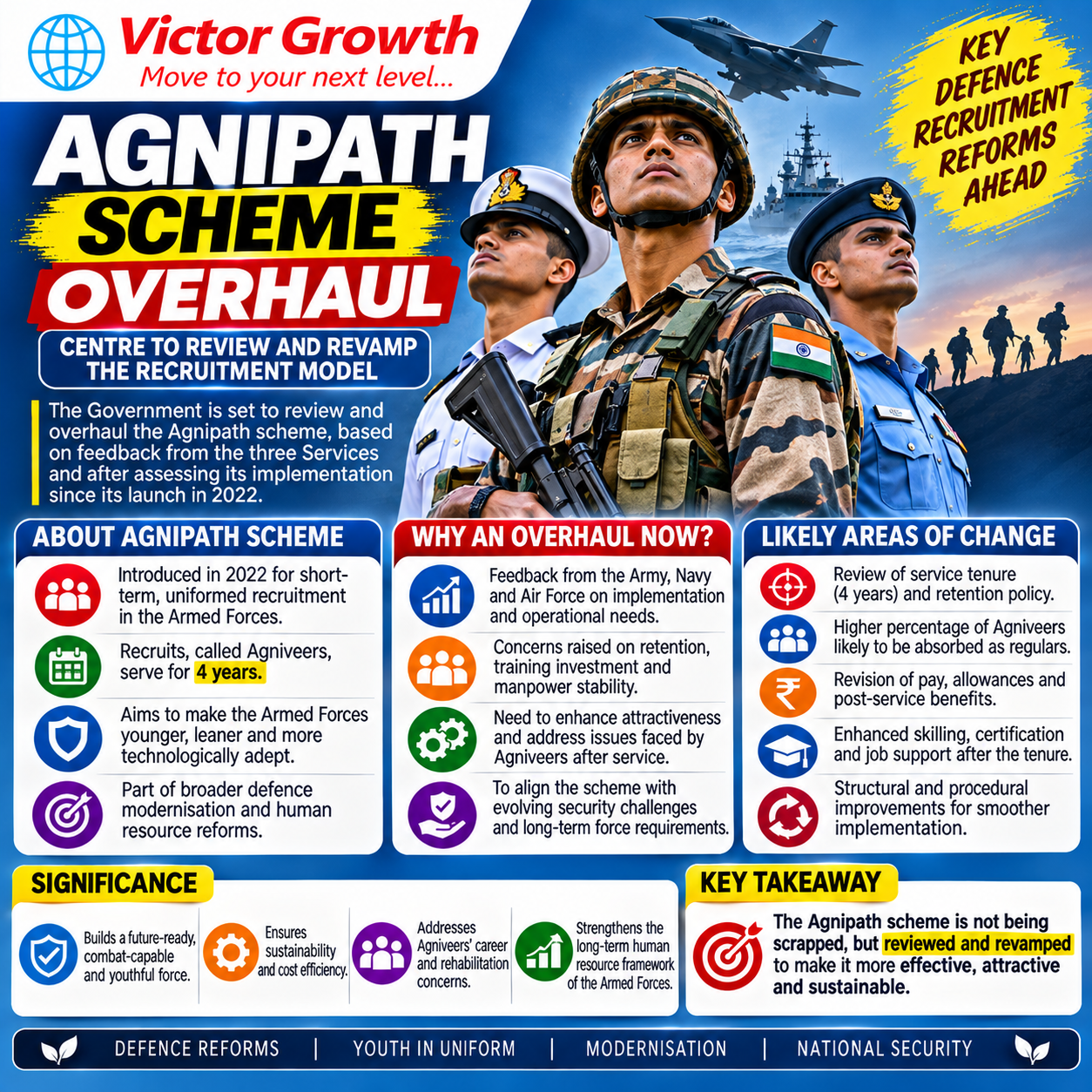
On 4 November 2026, the Union Cabinet approved a major overhaul of the Agnipath Scheme, introducing an additional two-year engagement period for Agniveers who are not selected for regular service after their initial four-year tenure.
The decision aims to address concerns over career continuity while retaining the scheme’s objective of building a younger, fitter and technologically equipped military.
What is the Agnipath Scheme?
Launched on 14 June 2022, the Agnipath Scheme is a short-term recruitment model for the Indian Army, Navy and Air Force. Recruits selected under the scheme are called Agniveers.
Under the original arrangement:
Eligible youth between 17.5 and 21 years were recruited for four years.
Up to 25% of each batch could be selected for permanent enrolment in the regular cadre, based on merit and organisational requirements.
The remaining 75% were to leave military service after four years.
Exiting Agniveers received a Seva Nidhi package, but were not entitled to pension or gratuity under the scheme.
The scheme was introduced to reduce the average age profile of the armed forces, manage long-term personnel costs and create a more dynamic military workforce.
Major Changes Under the Agnipath Overhaul – 2026
The revised framework introduces a new pathway for Agniveers to continue serving beyond the original four-year period.
Key changes include:
Existing 25% retention provision continues: Up to 25% of Agniveers will continue to be selected for regular service after four years on the basis of merit and service requirements.
Additional two-year engagement: The remaining 75% will be offered an opportunity for another two years of engagement, subject to their willingness.
Pathway to regular enrolment: After completing the additional two-year period, Agniveers will be offered enrolment as regular soldiers, subject to their willingness and fulfilment of prescribed selection criteria.
Improved financial benefits: The extended engagement will provide higher remuneration, an enhanced Seva Nidhi package and seniority-related benefits.
Continuation of the scheme: The government has clarified that the Agnipath Scheme will continue, with the revised provisions intended to improve its effectiveness.
Important clarification: The revised arrangement does not mean automatic permanent employment for every Agniveer. Regular enrolment remains subject to willingness and the prescribed selection criteria.
Why Was the Agnipath Scheme Overhauled?
The changes follow a review of the scheme after four years of implementation. The armed forces reported positive feedback regarding Agniveers’ physical fitness, motivation, discipline, technological adaptability and performance.
The overhaul seeks to address several concerns:
Career uncertainty: The original four-year tenure created uncertainty about long-term employment for the majority of recruits.
Retention of trained personnel: The additional engagement period allows the armed forces to retain personnel who have already received military training and operational experience.
Recruitment and training efficiency: Retaining experienced personnel can reduce the need for repeated recruitment and training.
Balancing aspirations and military needs: The revised model attempts to provide greater career continuity while maintaining performance-based selection.
Significance of the Overhaul
1. Strengthening military preparedness
Retaining trained personnel for longer can improve continuity, experience and operational effectiveness.
2. Addressing youth concerns
The additional service opportunity offers greater career certainty to young recruits and their families.
3. Improving skill utilisation
The armed forces can make better use of the technical, operational and leadership skills developed during the initial service period.
4. Balancing reform and welfare
The overhaul reflects an attempt to balance defence modernisation with the career aspirations and welfare of military personnel.
Challenges and Concerns
Despite the changes, some important questions remain:
Pension expenditure: Longer-term regular enrolment may increase future pension and gratuity liabilities, requiring careful financial planning.
Selection transparency: Clear and objective criteria will be essential to maintain confidence in the recruitment process.
Military structure: The armed forces must balance the need for a youthful workforce with the importance of experience and continuity.
Implementation: The revised model needs clear rules on pay, seniority, service conditions and regular enrolment.
Long-term evaluation: Its impact on operational readiness, recruitment quality and defence expenditure must be assessed periodically.
Way Forward
The government should ensure transparent selection procedures, clear communication of service conditions and effective grievance-redressal mechanisms. Regular assessments should examine the scheme’s impact on military preparedness, personnel welfare and public expenditure.
A balanced recruitment policy must combine youth, experience, professionalism and long-term institutional stability.
UPSC Examination Relevance
Prelims
Agnipath Scheme and its launch year
Agniveers and the three branches of the armed forces
Seva Nidhi package
Recent changes approved in November 2026
Mains – GS Paper III
Security challenges and management of defence forces
Defence reforms and modernisation
Human resources in national security
Balancing military efficiency with personnel welfare
Possible UPSC Mains Question:
“The Agnipath Scheme overhaul of 2026 seeks to balance the need for a youthful military with the career aspirations of defence personnel. Examine its significance and the challenges involved.”
Conclusion
The 2026 overhaul marks an important shift in India’s military recruitment policy. By introducing an additional two-year engagement period and a pathway to regular enrolment, the government seeks to address concerns about career continuity while preserving the objectives of defence reform. Its long-term success will depend on transparent implementation, financial sustainability and its contribution to India’s operational preparedness.