The Air Force Common Admission Test (AFCAT) is an important examination for graduates who aspire to become officers in the Indian Air Force. To clear AFCAT 2027, candidates must have a clear understanding of the syllabus, examination pattern and subject-wise preparation strategy.
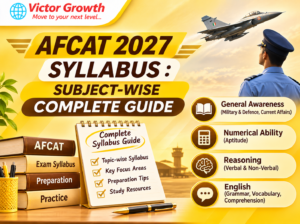
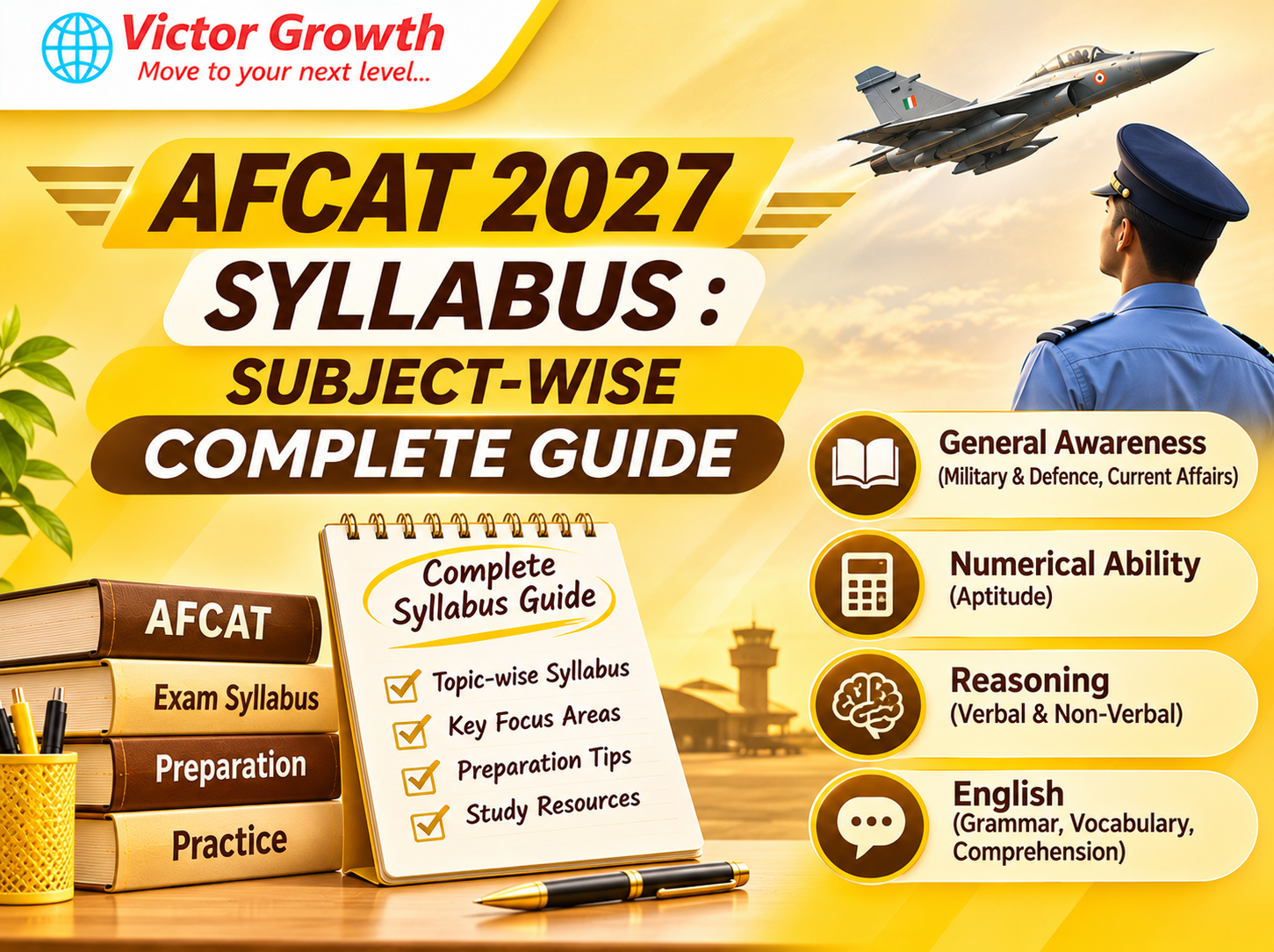
The AFCAT examination tests candidates in four major areas: English, General Awareness, Numerical Ability, and Reasoning and Military Aptitude. Understanding each subject helps aspirants prepare systematically, identify important topics and manage their study time effectively.
This guide covers the AFCAT 2027 syllabus, important topics and preparation tips for beginners.
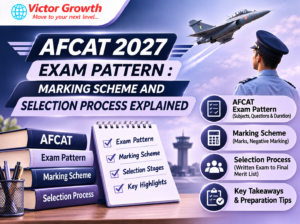
1. AFCAT 2027 Exam Pattern
Before starting preparation, candidates should understand the examination pattern.
Particulars | Details |
|---|---|
Examination mode | Online |
Type of questions | Objective (Multiple Choice Questions) |
Total questions | 100 |
Maximum marks | 300 |
Duration | 2 hours |
Correct answer | +3 marks |
Incorrect answer | -1 mark |
Unattempted question | 0 marks |
The examination includes four subject areas. Candidates should prepare all sections because performance across the complete paper matters.
2. AFCAT 2027 Subject-Wise Syllabus
A. English
The English section tests vocabulary, grammar, comprehension and language skills.
Important topics:
Comprehension
Synonyms and Antonyms
Error Detection
Sentence Completion
Idioms and Phrases
One-Word Substitution
Cloze Test
Sentence Rearrangement
Fill in the Blanks
Vocabulary
Preparation strategy:
Read English newspapers and articles regularly.
Learn new words and revise their meanings.
Practise grammar exercises every day.
Solve comprehension passages.
Attempt previous year English questions.
Regular reading and practice can improve vocabulary, accuracy and reading speed.
B. General Awareness
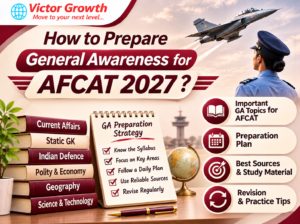
General Awareness covers static knowledge as well as current affairs. Candidates should develop a basic understanding of national and international developments.
Important topics:
Indian History
Indian Geography
Indian Polity
Indian Economy
General Science
Environment and Ecology
Art and Culture
Sports
Important Awards and Honours
Famous Personalities
National and International Organisations
Defence-related Current Affairs
Important Days and Events
Current National and International Affairs
Preparation strategy:
Read newspapers regularly.
Prepare short notes on important current affairs.
Focus on Indian defence developments and military exercises.
Revise static GK topics.
Practise daily General Awareness questions.
Give special attention to important developments related to the Indian Air Force, defence technology and national security.
C. Numerical Ability
Numerical Ability tests mathematical understanding and problem-solving skills. The questions are generally based on the matriculation-level standard.
Important topics:
Number System
HCF and LCM
Percentage
Average
Ratio and Proportion
Profit and Loss
Simple and Compound Interest
Time and Work
Time, Speed and Distance
Mixture and Alligation
Area and Perimeter
Probability
Decimal Fractions
Basic Algebra
Preparation strategy:
Start with basic mathematical concepts.
Memorise important formulas.
Practise calculation techniques.
Solve topic-wise questions regularly.
Attempt timed practice sets.
Candidates who find mathematics difficult should focus on strengthening their fundamentals before moving to advanced questions.
D. Reasoning and Military Aptitude
This section evaluates logical thinking, analytical ability and visual reasoning skills.
Important topics:
Verbal Reasoning
Non-Verbal Reasoning
Analogy
Classification
Coding and Decoding
Number Series
Alphabet Series
Blood Relations
Direction Sense
Venn Diagrams
Pattern Recognition
Figure Completion
Spatial Ability
Embedded Figures
Preparation strategy:
Practise reasoning questions daily.
Understand the logic behind each question.
Solve verbal and non-verbal reasoning exercises.
Practise figure-based questions.
Improve speed through regular timed tests.
3. AFCAT 2027 Subject-Wise Preparation Priority
A balanced timetable helps candidates cover all subjects without neglecting weaker areas.
Subject | Recommended Daily Study Time |
|---|---|
English | 45 minutes |
General Awareness | 1 hour |
Numerical Ability | 1 hour |
Reasoning and Military Aptitude | 1 hour |
Revision and Practice | 30 minutes |
Adjust the timetable according to your strengths, weaknesses and available study time.
4. Best Preparation Tips for AFCAT 2027
Follow these tips to improve your preparation:
Understand the syllabus: Know every subject and its important topics before starting.
Prepare a realistic timetable: Allocate sufficient time to all four sections.
Solve previous year questions: Understand the question pattern and difficulty level.
Take mock tests: Practise answering questions within the two-hour time limit.
Revise regularly: Prepare short notes for formulas, vocabulary and current affairs.
Improve accuracy: Avoid random guessing because AFCAT has negative marking.
Prepare for AFSB: Develop communication skills, confidence, leadership qualities and general awareness alongside written preparation.
5. What Happens After the AFCAT Written Examination?
Clearing the written examination is not the final stage of selection. Candidates who qualify are called for the Air Force Selection Board (AFSB) process, subject to eligibility and the official selection procedure.
The selection process generally includes:
Stage I: Officer Intelligence Rating Tests and Picture Perception and Discussion Test.
Stage II: Psychological tests, Group Tests and Personal Interview.
Medical Examination: Recommended candidates undergo the prescribed medical examination.
Therefore, aspirants should prepare for personality development and AFSB testing along with their written examination.
6. Choose the Right Defence Coaching in Kerala
Proper guidance can help beginners understand the syllabus, strengthen weak subjects and follow a systematic preparation plan.
When searching for the best NDA coaching in Kerala, candidates should remember that NDA and AFCAT are different defence entrance examinations. NDA is an entry route for candidates after Class 12, while AFCAT is designed for eligible graduates and other candidates who meet the prescribed requirements.
Before joining a coaching institute, check:
Faculty experience and teaching quality.
Complete syllabus coverage.
Updated study materials.
Regular mock tests.
Doubt-clearing sessions.
AFSB preparation support.
Victor Growth Coaching Centre in Kochi provides coaching support for defence examination aspirants. Choose a programme that matches your target examination and offers structured academic guidance.
Frequently Asked Questions (FAQs)
1. What are the subjects in the AFCAT 2027 syllabus?
The AFCAT syllabus includes English, General Awareness, Numerical Ability, and Reasoning and Military Aptitude.
2. Is mathematics compulsory for AFCAT?
Yes. Numerical Ability is one of the four sections in the AFCAT written examination.
3. What is the difficulty level of AFCAT mathematics?
The Numerical Ability section is generally based on matriculation-level mathematics.
4. How many questions are there in AFCAT 2027?
The AFCAT written examination consists of 100 objective-type questions carrying a total of 300 marks.
5. Is there negative marking in AFCAT?
Yes. Three marks are awarded for each correct answer, and one mark is deducted for each incorrect answer.
6. How should beginners prepare for AFCAT 2027?
Beginners should understand the syllabus, strengthen basic concepts, practise previous year questions, read current affairs and attempt regular mock tests.
7. Is coaching necessary to clear AFCAT?
Coaching is not compulsory. However, structured classes, regular assessments and expert guidance can help aspirants prepare more effectively.
Conclusion
Understanding the AFCAT 2027 syllabus is the first step towards effective preparation. Focus on all four subjects, practise previous year questions, improve time management and revise important topics regularly. Along with written examination preparation, develop the confidence and communication skills required for AFSB testing.
With a clear study plan, consistent practice and proper guidance, beginners can build a strong foundation and work towards their goal of joining the Indian Air Force.