
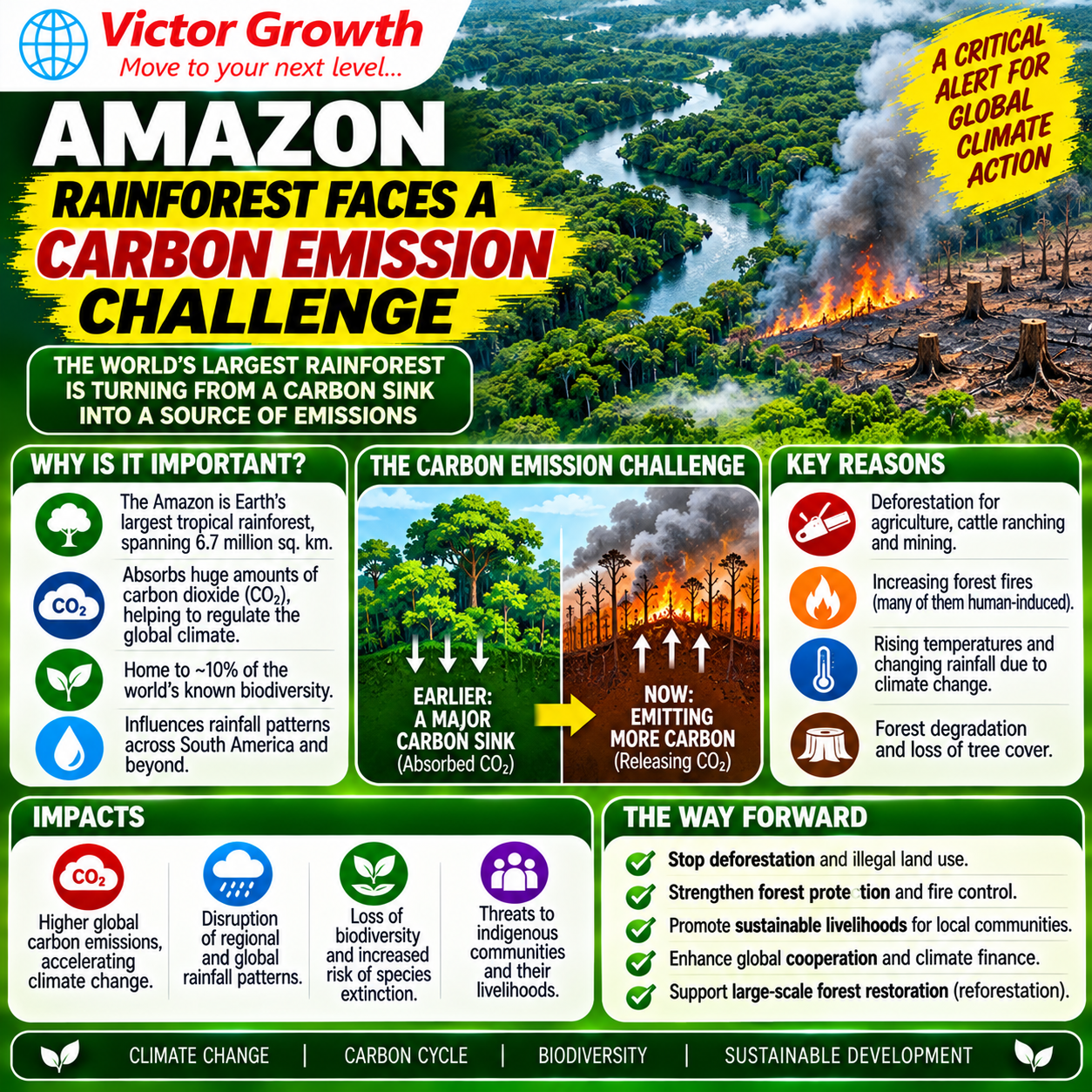
A research study published in the journal Nature on 21 October 2026 has highlighted the growing carbon emission challenge in the Amazon rainforest. Based on 15 years of atmospheric carbon dioxide measurements, the study found that human activities, particularly deforestation, forest degradation and fires, are weakening the Amazon’s ability to absorb carbon.
The findings raise concerns about the possibility of the Amazon rainforest increasingly functioning as a net source of carbon emissions rather than a carbon sink.
What is the Amazon Rainforest?
The Amazon rainforest, located in South America, is the world’s largest tropical rainforest. It extends across nine countries, with the largest share located in Brazil.
Its importance includes:
Carbon storage: Stores enormous quantities of carbon in trees, vegetation and soils.
Biodiversity: Supports an exceptionally rich variety of plant and animal species.
Climate regulation: Influences regional and global temperature and rainfall patterns.
Water cycle: Releases moisture through evapotranspiration, contributing to rainfall across South America.
Livelihoods: Supports Indigenous communities and millions of other people.
The Amazon is often called the lungs of the Earth, although its scientific importance is more accurately understood through its role in carbon storage, biodiversity conservation and climate regulation.
What Is the Carbon Emission Challenge?
Forests act as carbon sinks when they absorb more carbon dioxide from the atmosphere than they release. They become carbon sources when their emissions exceed their absorption.
The 2026 Nature study analysed Amazonian carbon fluxes using atmospheric CO₂ measurements over 15 years. It estimated a positive carbon balance of approximately 0.32 billion tonnes of carbon per year, indicating net emissions during the study period.
Fires were identified as the dominant source of emissions, while the forest’s capacity to absorb carbon was increasingly unable to offset these losses.
The research highlights an important concern: the Amazon’s ability to regulate the global carbon cycle is being weakened by the combined effects of human activity and climate stress.
Major Causes Behind Rising Carbon Emissions
1. Deforestation
Large areas of forest are cleared for cattle ranching, soybean cultivation, infrastructure development and other land-use activities. This releases stored carbon and reduces future carbon absorption.
2. Forest Fires
Fires release carbon stored in trees and vegetation. Many fires are associated with human activities, including land clearing, and become more destructive during drought conditions.
3. Climate Change and Drought
Rising temperatures and changing rainfall patterns increase water stress, tree mortality and forest flammability.
4. El Niño Events
El Niño can contribute to reduced rainfall and higher temperatures in the Amazon region, intensifying drought and increasing the risk of forest fires.
5. Forest Degradation
Logging, fragmentation and repeated fires damage forests even when the land is not completely cleared. Degraded forests store less carbon and become more vulnerable to future disturbances.
The Risk of an Amazon Tipping Point
A climate or ecological tipping point is a critical threshold beyond which a relatively small additional disturbance can trigger major and potentially difficult-to-reverse changes in an ecosystem.
Scientists warn that the interaction of deforestation, warming, drought and fires could weaken the Amazon’s resilience.
This may create a dangerous feedback loop:
Deforestation reduces moisture released by trees.
Reduced moisture can contribute to declining rainfall.
Drier conditions increase the risk of forest fires.
Fires and tree mortality release more carbon.
Rising carbon emissions contribute to global warming, further increasing stress on the forest.
Such feedback mechanisms could lead to the degradation of large areas of rainforest. However, the precise location and timing of any large-scale tipping point remain uncertain.
Global Implications
Climate change: Reduced carbon absorption and increased emissions could make it harder to achieve global climate targets.
Biodiversity loss: Habitat destruction threatens thousands of species and fragile ecosystems.
Water security: Changes in the Amazon’s rainfall cycle can affect agriculture, river systems and water availability.
Indigenous communities: Forest degradation threatens the livelihoods, cultures and traditional knowledge of Indigenous populations.
Global climate governance: The findings reinforce the need for stronger international cooperation on forest conservation and emission reduction.
Way Forward
Strengthen forest protection: Improve monitoring and enforcement against illegal deforestation and land clearing.
Prevent forest fires: Develop early-warning systems, fire management capacity and community-based prevention programmes.
Promote restoration: Restore degraded forests with native species and protect ecological corridors.
Recognise Indigenous rights: Strengthen the role of Indigenous communities in forest conservation.
Climate action: Reduce global greenhouse gas emissions and strengthen international cooperation.
Sustainable agriculture: Encourage production systems that reduce pressure to convert forests into agricultural land.
Initiatives such as REDD+ (Reducing Emissions from Deforestation and Forest Degradation) can provide financial incentives for developing countries to conserve forests and improve carbon stocks.
India’s Relevance
The Amazon crisis offers important lessons for India, particularly in protecting tropical forests and strengthening climate resilience.
India’s initiatives such as the Green India Mission, National Action Plan on Climate Change and Mission LiFE aim to promote forest conservation, sustainable lifestyles and climate action.
The issue is also relevant to India’s commitments under the Paris Agreement and its efforts to enhance forest and tree cover as part of its climate strategy.
UPSC Examination Relevance
Prelims
Location and geographical extent of the Amazon rainforest
Carbon sinks and carbon sources
El Niño and its climatic impacts
REDD+ and international climate initiatives
Forest degradation and ecological tipping points
Mains – GS Paper III
Environmental conservation and biodiversity
Climate change and global warming
Forest ecosystems and sustainable development
International environmental cooperation
Possible UPSC Mains Question:
“The declining capacity of the Amazon rainforest to absorb carbon highlights the growing interaction between deforestation and climate change. Examine the causes and global implications of this phenomenon.”
Conclusion
The Amazon rainforest is not merely a regional ecological resource; it is a critical component of the global climate system. The latest scientific findings underline how deforestation, forest fires and climate change can weaken its ability to absorb carbon. Protecting the Amazon requires coordinated action at local, national and international levels. Forest conservation must therefore be treated as an essential part of the global climate strategy.